

5 disconcerting cultural side effects of Borders' liquidation
Borders plans to liquidate — and the economic impact is obvious. Some 10,700 jobs gone, 399 empty stores, millions of dollars lost for creditors.
But the cultural implications are significant, too.
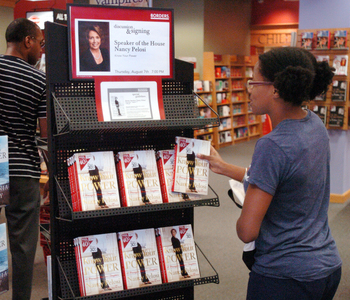
Borders' liquidation means fewer places to discover books.
File photo | AnnArbor.com
1. Less reading.
Consumers who bought books at Borders won't necessarily buy the same number of books through other sources, such as Barnes & Noble or Amazon.com, said Michael Norris, a publishing industry analyst with Simba Information.
"It doesn't work that way," Norris said. "Fewer people will buy books because there’s not going to be an immediate transition for people. The money that consumers spend on books is money that could be spent on other consumer goods. It’s not like the rent or an electrical bill. It’s an optional form of entertainment."
2. Fewer social hangouts.
The loss of Borders means fewer places to chat with your friends, casually browse the Web or sip coffee with a colleague while considering a purchase.
When Borders invented the superstore concept for bookstores, in fact, the company encouraged people to hang out as long as they wanted to.
"It’s like the last safe social escape for retail," Borders President Mike Edwards said in a rare interview in May. "I don’t think people want to hang out or relax in a Target.”
3. A faster transition to digital.
Fewer bookstores will lead to more electronic book sales and more Internet-based sales of physical books.
"The technology and the industry is all in transition," said Jim McTevia, a turnaround consultant with Bingham Farms-based McTevia & Associates.
4. Fewer places to discover books.
Regular readers like to tell stories about browsing shelves at the bookstore, discovering an author, reading a book and going back for more. It's harder to replicate the browsing experience on an e-reader or online.
As of March, Borders still had 10.7 percent market share in the book store industry, according to a report by research firm IBISWorld.
5. Fewer venues for authors.
On the flip side, writers will have fewer places to get their books discovered.
"The real story is all these amazing writers out there — where are they really going to be able to show their books in a way that continues to inspire society?" Edwards said in May. "That’s what the bookstore is about.”
Contact AnnArbor.com's Nathan Bomey at (734) 623-2587 or nathanbomey@annarbor.com. You can also follow him on Twitter or subscribe to AnnArbor.com's newsletters.
Comments
Robert Stone
Sun, Jul 24, 2011 : 4:08 a.m.
Less reading? You have to be kidding me. Sounds like more of the ann arbor overblown sense of global significance simply applied to Borders instead of ann arbor. Since the world couldn't possibly survive without ann arbor, obviously it can't survive without borders either.
David Paris
Sun, Jul 24, 2011 : 3:26 a.m.
Thankfully, the Borders plan to take over Barnes & Nobles fell through!
Cathie
Sat, Jul 23, 2011 : 11:02 p.m.
There are less book shelves at Ann Arbor libraries with all the computer rooms and CDs.
AfterDark
Sun, Jul 24, 2011 : 11:57 a.m.
If you look at total books in the collection I suspect you'll find more because there are now five library branches instead of four: Main Mallets Creek Pittsfield Traverwood West and requests can be made to have specific items transited from one branch to another for you to check out.
Stephen Landes
Sat, Jul 23, 2011 : 8:27 p.m.
A long time ago in a universe far, far away (Washington DC) my great uncle and great aunt owned a restaurant. They were very successful and had a thriving business with Congressional staffers. However, my great uncle had a dream -- he wanted to run a very high class seafood restaurant. He used the successful business to finance the new one. Do you have any idea how many seafood places there are in Virginia and Maryland? Suffice it to say that both establishments were gone before I could even see them. His speciality was serving good food to busy people 24/7/365 and he put it all on the line against people who had been in a different business for, in some cases, more than a hundred years. In my opinion Borders had three great strengths: their book collection, order/retrieval system, and knowledgeable employees on the floor. The book store was a place one could go and actually talk to a human being face to face who had in-depth knowledge of their section of the store, could have a conversation with you about books, and help you find another author when you had exhausted all the work of your favorite author. They mortgaged those assets to get into a business that others were already doing AND doing better than they could. Now we have neither the Borders of old nor the dream Borders of the new owners. Is there a moral? I suppose it is understand what it is that you do that makes you successful, focus on that core competency, and stay out of the seafood restaurant business.
Knobby Kabushka
Sat, Jul 23, 2011 : 6:27 p.m.
Number one reason they're going is greed - they wanted it all, they rolled through towns knocking 99% of small and/or independent bookstores out of business, and they wanted it that way... Number two reason they're going is they sold to Kmart which lead to more greed and bad management on top of it... Number three reason they're going is they didn't stay simple. The consuming greed, the Kmart partnership, made them way to complex and the bad managing could not figure out a way to undo it all and it was downhill after that...
goingfast3579
Sat, Jul 23, 2011 : 5:44 p.m.
There's no job's. If i still had a good paying job i would buy some books. just remember you have elected people that have sold us out to the communists.
David Paris
Sun, Jul 24, 2011 : 3:25 a.m.
Certainly, you're referring to the Emergency Financial Managers that are being instituted by Governor Snyder!?!
Chicagobob
Sat, Jul 23, 2011 : 5:20 p.m.
Kudos to Annarbor.com for recent articles on Borders. The most instructive article was one from several days ago providing a time line of events from Borders' earliest days to the present. In that time line it was noted that the executive compensation package was changed in the recent past when questions about Borders' survival were escalating. It was a perfect example of "thems that have, get more" despite the fact that their business judgments have proven to be deeply flawed. Most disturbing is the fact that getting more for the elite few means that the the average workers get less.
Lynn Liston
Sat, Jul 23, 2011 : 3:43 p.m.
I don't believe there will be less reading going on in Ann Arbor- we recently rated as one of the highest 'reader' communities in the country. We have an excellent library system, and quite a few locally-owned, independent bookstores, as well as the big national chain, B&N. If you can't find books to read in Ann Arbor, you aren't trying very hard. Just support your local brick and mortar bookstores and there will always be places to find books, fellow readers, and good browsing. I do think, from conversations I've had with others around the US, that there will be communities who are now losing their only bookstore and who don't have our rich library resources. They will be scrambling to find alternatives for books for their own reading, for gifts, for presents for kids... As for gathering places, we've only lost one bookstore with a cafe upstairs. Anyone who frequents the Westgate mall knows that Nicola's is a terrific bookstore, and several doors away is one of the best-kept reader's secrets in town, Star's Cafe. Between Stars and Barry Bagels, you can find small groups at almost any time talking over their books. People gather in welcoming spaces, not corporate-defined cafes. Honest- there is book and reading life outside Borders. I am mostly sorry about the loss of jobs for Border's employees. How sad to work hard, do a good job and see your job eliminated by over-paid executives who make bad decisions, run your company into the ground and then leave with their big salaries and bonuses. Bet you won't find them worrying about how to make their rent next month.
Tom Joad
Sat, Jul 23, 2011 : 3:09 p.m.
Decidedly wrong. Not only can you check out books at the library you can preview them on Google Books or Amazon, which often gives a generous preview from which you can then decide to purchase online at a discount...I'm sorry but I'm not paying for Borders infrastructure...he he
rusty shackelford
Sat, Jul 23, 2011 : 3:02 p.m.
Fortunately and unfortunately, the 3 recent bookstore closures in A2 were all a result of bad business practices, not inherently less demand for books. Someone with some business sense could do quite well opening a new bookstore with a well-curated selection downtown. An interesting study about the commercial state of books was commissioned by a major independent publisher: <a href="http://www.mcsweeneys.net/articles/some-good-news-from-the-world-of-books" rel='nofollow'>http://www.mcsweeneys.net/articles/some-good-news-from-the-world-of-books</a>
Jerry Foster
Sat, Jul 23, 2011 : 1:58 p.m.
Let's not forget, no one shed a tear for the thousands of mom-n-pop bookstores that were forced under when the Borders and B&N onslaught rolled through. What goes around comes around. Also, I believe #5, "Fewer venues for authors", is totally bogus. The advent of electronic publishing has made it possible for more authors to get their works in front of more people than ever before.
tdw
Sat, Jul 23, 2011 : 1:52 p.m.
Are you serious ? really ? only from someone from Ann Arbor
David Paris
Sun, Jul 24, 2011 : 3:31 a.m.
That's a hella pointa view ya got there, mate. Care to elaborate?
Nicola Rooney
Sat, Jul 23, 2011 : 1:52 p.m.
Ann Arbor is fortunate in having many bookstores, new, used antiquarian, specialized and wide ranging. While the cultural blight mentioned by the pessimistic pundits quoted here may apply to some parts of the country, we should be relieved that once again Ann Arbor is different. We have many other locations for meeting friends, drinking coffee, web surfing, hearing concerts, and yes, even browsing books before buying them. We understand that for some, Westgate is a long way off their habitual route, but if you have a car, it's got parking, which is a plus - and there is a fine selection of other merchants to make your trip worthwhile. If you do make the long trek to Westgate, and brave the unknown, hitherto unvisited regions of Nicola's Books, I hope you will introduce yourself to us as new to these parts, and we will welcome you to our neighborhood and do our best to make you feel at home.
David Paris
Sun, Jul 24, 2011 : 3:29 a.m.
"While the cultural blight mentioned by the pessimistic pundits quoted here may apply to some parts of the country, we should be relieved that once again Ann Arbor is different." Agreed!
Elizabeth Sikkenga
Sat, Jul 23, 2011 : 5:21 p.m.
Thank heavens for you, Nicola!
Eric
Sat, Jul 23, 2011 : 3:49 p.m.
And there is a library branch next door to Nicola's if you want to browse magazines. Which you are not allowed to do at Nicola's per posted signs. I read that sign several years ago and have never set foot in your shop again. You must be breathing a sigh of relief that you have finally outlasted your competition because it seems doubtful you are gaining customers based on service. Though it does appear you are using this forum to give the hard sell on your store, I am not convinced. Nothing like free advertising I guess.
Lynn Liston
Sat, Jul 23, 2011 : 3:26 p.m.
Nicola, I completely agree with you! Your shop is a jewel for book lovers in Ann Arbor and I hope that many new readers discover you soon. My friend, Amy the Librarian, and I really enjoyed that quick conversation in Star's Thursday morning and that's what I think a local businessperson should be- a genuine person, someone you can talk to, see around and who is a presence in the community. And- Westgate is on the bus line, so you are very accessible and worth the short trip.
Macabre Sunset
Sat, Jul 23, 2011 : 1:49 p.m.
If all this is true, then Borders will be replaced by another book store. Maybe even one with a local connection.
KJMClark
Sat, Jul 23, 2011 : 1:40 p.m.
1. Less reading - I don't buy it. Part of the problem for Borders, the old Ann Arbor News, etc. is that there is so much reading available on-line. If you have the money for an internet connection, the reading options are endless. If you don't have the money for an internet connection, libraries have always had thousands or hundreds of thousands of reading opportunities. 2. Fewer social hangouts - There are still neighborhoods, parks, libraries, malls. And is it really that valuable, culturally, to have retailers as hangouts? 3. Faster transition to digital - So? And if you still like physical books (I do), what about libraries? 4. Fewer places to discover books - Libraries are better for that anyway. ...and Amazon is now excellent for discovering books. 5. Fewer venues for authors - What about the Internet? Set up a website for next to nothing, publish the book by pdf, make the first chapter free online, sell copies via Paypal. That's the easiest publishing has ever been.
xmo
Sat, Jul 23, 2011 : 1:33 p.m.
6) Less tax revenue for the city of Ann Arbor and the State of Michigan!
lumdum15
Sat, Jul 23, 2011 : 1:29 p.m.
I will miss Borders also for the incredible concerts I heard, Brandi Carlysle and James Taylor immediately come to mind...
Dan Romanchik
Sat, Jul 23, 2011 : 1:01 p.m.
Fewer venues for authors? There's no need to weep for the authors here. With the advent of the Kindle and Nook, and Kindle and Nook apps for PCs and tablets, anyone can publish their work, easily and quickly. Most of these books would never have had a chance of making it into a Border's, because either the author was unknown or the book was a special-interest book that didn't appeal to a mass audience. If Borders really had wanted to be a venue for up-and-coming authors, it would have been more on top of the e-reader/e-book phenomenon. I have published a couple of amateur radio license study guides this way. They are only available electronically, and I'm selling both Kindle and Nook versions. I would have gladly published a Border's version if they'd been a player in this market. It looks to me that this is just another area in which they blew it.
Gordon
Sat, Jul 23, 2011 : 12:54 p.m.
too much change. Past change was too much. And there are too many children in Washington.
slug
Sat, Jul 23, 2011 : 12:38 p.m.
Did people really read more books during the bookstore boon? I didn't believe it then and I still don't. People browsed more, and those who read anyway were able to choose from better selections, but I just don't think it made people want to read any more than they already were doing. Did anyone study what percentage of sales was generated by books as opposed to videos, coffee, mags, trinkets, toys, etc.? I'll bet the other stuff was at least half.
Vivienne Armentrout
Sat, Jul 23, 2011 : 12:33 p.m.
This story does not recognize the existence of a locally-owned bookstore, Nicola's Books (at Westgate) Nicola's has a regular customer rewards program and a busy schedule featuring local authors and others. There is an email newsletter to keep customers advised. Nicola's generally carries books recently reviewed in major media, such as the New York Times book review. When the library had many holds ahead of me for a nonfiction book I wanted to read (it had been extensively discussed on NPR), Nicola's had it on the shelf and I was able to pick it up that afternoon.
DBH
Sat, Jul 23, 2011 : 4:28 p.m.
Nicola's is not downtown, but the parking is free. Every day. No validation needed.
PattyinYpsi
Sat, Jul 23, 2011 : 2:26 p.m.
I love Nicola's too. But I wish they were downtown--just for ease of access. Now that Borders is gone from downtown, what are the chances that Nicola's will move to fill the void?
Vivienne Armentrout
Sat, Jul 23, 2011 : 2:06 p.m.
I agree that having bookstores downtown is a different quality of experience and I mourn the loss of Shaman Drum, Books In General, and Afterwords. The story didn't mention Dawn Treader either - still downtown. The West Stadium area has been undergoing a transformation (slowly) and serves a fairly large population. Westgate's parking lot was rather full on Thursday with the Westside Farmers' Market. I could list a number of anchors, both chain and local. There is good bus service. If it were not strung out along a busy street in 1950s strip development style, it would be a downtown in its own right. Come visit. You could get in line at Barry Bagels for lunch.
Mark
Sat, Jul 23, 2011 : 12:48 p.m.
True, but they are at Westgate, not downtown. For some people Westgate might as well be Pinckney.
Diego Amor
Sat, Jul 23, 2011 : 12:32 p.m.
While I am sorry to see Borders go, the idea that there will be less reading is just plain ridiculous. First of all, there are still book stores and there will be continue to be bookstores. Second, Borders went bankrupt because despite the fact that there were giant Borders stores all over the country, people were spending ever more money on books via other channels (Web, Kindle, Nook, etc). The newspaper that this digital site represents should be sufficient evidence that people aren't reading less, they are just changing their reading locales.
SLG
Sun, Jul 24, 2011 : 12:29 a.m.
Assuming, of course, that there are just as many people reading this web site as used to read the Ann Arbor News.
Mark
Sat, Jul 23, 2011 : 12:06 p.m.
I forgot to add - I still miss Afterwords! <a href="http://randomphoto.blogspot.com/2011/07/goodbye-borders.html" rel='nofollow'>http://randomphoto.blogspot.com/2011/07/goodbye-borders.html</a>
Patti Smith
Sat, Jul 23, 2011 : 2:48 p.m.
Me too, Mark! I loved that place!
Edward R Murrow's Ghost
Sat, Jul 23, 2011 : 12:52 p.m.
I doubt it. I find Nicola's to have oppressive atmosphere and to be downright unfriendly to anyone who might sit down to look at a book or magazine. My book business will (unfortunately) go to B&N. Good Night and Good Luck
AfterDark
Sat, Jul 23, 2011 : 12:31 p.m.
I think Nicola's should pick up a lot of business now.
Mark
Sat, Jul 23, 2011 : 12:03 p.m.
For those of us that enjoy books, a book store is a necessity. There is more to a book than mere words. I enjoy the physicality of the book, the ability to scan a table or shelf of titles and then be pleasantly surprised by a title and the subsequent browsing of the pages -- is something that on-line stores and e-books just don't have. For mass-market paperbacks and best-selling novels, yeah, I know that the nook, kobo, kindle, etc. is fine. However, I like books on photography, and those don't make the electronic transition so well. Ann Arbor is a university town, with a lot of readers. Hopefully, another large bookstore will relocate downtown. We have plenty of used bookstores (though not as many as we used to), but they don't carry new titles and have the stock of B&N, for example. The Border's on S. State was the best, and I'd like a Wayback machine, please. Yes, Libraries are fine, but a) old titles are often discarded b) a new title may not be in for some time, and c) I'd rather have my own copy, and d) you can also rent cars, chainsaws, and camera lenses -- but I'd rather have my own.
DBH
Sat, Jul 23, 2011 : 4:26 p.m.
KJMClark, I have not heard of MEL loans. What are they?
KJMClark
Sat, Jul 23, 2011 : 1:52 p.m.
Um... a) Have you heard of MEL loans? Dawn Treader? ABEBooks? b) There are plenty of places to buy new books. c) There are lots of places to buy new or used books. d) There are lots of places to buy new or used books. Yes, I would very much like to have Shaman Drum back, and I consider some of the people working at the downtown Borders local merchants, even though they worked for a big box retailer. Pardon me if I won't shed a tear for the loss of another big box chain, however. Except for the flagship store, which was half chain and half local bookstore, I'm only going to miss the chain as a local employer. Maybe Nicolas will open another store downtown, and hire some of the experienced staff? Then we can both be happy to support a local business.
Elaine F. Owsley
Sat, Jul 23, 2011 : 11:47 a.m.
Where was a board of directors or something like that to halt the headlong expansion when it became evident that it was a wrong minded business move. Looking at the downward spiral of profits as the number of stores increased should have given anyone a wake up call ten or more years ago.
AfterDark
Sat, Jul 23, 2011 : 10:17 a.m.
Never heard of libraries, huh?