

Ann Arbor SPARK's early bookkeeping errors resurface as gubernatorial campaign subject
(Editor's note: Laurel Champion, AnnArbor.com's executive vice president, is a member of Ann Arbor SPARK's Board of Directors and Executive Committee. She was elected treasurer earlier this year.)
Poor bookkeeping during Ann Arbor SPARK's early years - problems that were corrected two years ago after an audit - was thrust back into the spotlight today.
The Associated Press wrote a story highlighting accounting errors that occurred at SPARK while Michigan gubernatorial candidate Rick Snyder was serving as chairman of the economic development group.
From the AP story:

Snyder, who cofounded Ann Arbor SPARK, is pictured with former Washtenaw County Administrator Bob Guenzel and University of Michigan professor Fawwaz Ulaby at the economic development group's opening celebration in 2005.
File photo | AnnArbor.com
No money went missing, and none of the audit's findings pointed to illegal activity. Snyder, who remains on SPARK's executive committee, told The Associated Press the problems were merely growing pains.
Yet while Snyder boasts on his website of SPARK's success at attracting talent and investment to the Ann Arbor area, a 2008 audit of the organization's 2007-08 contract with the Ann Arbor-Ypsilanti SmartZone Local Development Finance Authority found that SPARK didn't have adequate internal controls, submitted invoices late, provided services for companies that weren't eligible because they weren't in Ann Arbor and billed for services even when they hadn't fulfilled the contract's terms.
I covered the complex situation in 2008 as a reporter for the Ann Arbor Business Review.
Here's what happened:
Snyder cofounded SPARK in 2005 in collaboration with the University of Michigan, Eastern Michigan University, Washtenaw Community College, local businesses and the Ann Arbor/Ypsilanti Local Development Finance Authority (LDFA), the board responsible for distributing tax dollars captured as part of the SmartZone initiative. The universities and LDFA board agreed to provide funding for SPARK.
Snyder personally recruited former Michigan Economic Development Corp. Vice President Michael Finney, then working in Rochester, NY, to return to Michigan to become CEO of SPARK.
SPARK provides various business development services and job-searching help to companies in Washtenaw County.
After three years in operation, LDFA discovered SPARK had not properly documented some of the hours its workers spent providing services to businesses within the cities of Ann Arbor and Ypsilanti. LDFA commissioned a law firm to conduct an audit of the contract between LDFA and SPARK, a contract in which LDFA provided $872,836.
After the $20,000 audit, the entities agreed SPARK had over billed LDFA by $45,643.75 and under billed it by $22,031.25 for various services. SPARK, which had an annual budget of $2.7 million at the time, agreed to refund $23,612.50 to LDFA, and the dispute was resolved.
But before that, one LDFA Board member, Mike Reid, resigned and wrote a letter to the Ann Arbor City Council saying SPARK deserved more punitive action.
"The audit report findings are indicative of system-wide internal control failures that obscure the LDFA board's ability to provide basic oversight and create conditions where misuse of public funds or outright fraud could easily go undetected," Reid said in a letter to the City Council.
Reid, discussing the situation with the Associated Press now, said "it would be patently wrong to call this a lack of oversight on the part of Rick Snyder."
After Reid's resignation in 2008, Snyder told the Ann Arbor News: "You have to take those things seriously. (Reid) is a respected public official. There has been a constructive dialogue so far, and there are some improvements I clearly think SPARK can make in this regard, and I believe the organization is very intent on doing that."
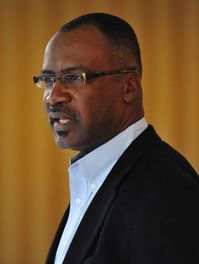
Ann Arbor SPARK CEO Michael Finney
Ryan J. Stanton | AnnArbor.com
Reid's fiery letter to the Ann Arbor City Council was not reflective of the attitude on the LDFA Board, which generally supported SPARK's activities and called them effective in creating jobs for the area.
"I think it's important to say that we should get this resolved so
that everyone can move forward and spend time on the real issues, which
are the entrepreneurs," Rob Risser, an LDFA board member during the dispute, said at the time.
During the process, Finney repeatedly acknowledged the bookkeeping problems and said SPARK had not established perfect accounting procedures until hiring a full-time finance director in January 2008. After the audit, SPARK made additional changes to its policies, agreeing to keep stricter reporting deadlines and additional conflict-of-interest stipulations.
"It was a fast-growing organization that had to grow and develop and
things, and as part of that process, its systems didn't totally keep up
with the growth," Snyder told The Associated Press in a recent interview.
While Snyder, who still serves on SPARK's board, was serving as chairman, Finney and Snyder met regularly to discuss various ideas for new services SPARK could provide.
However, the AP, paraphrasing Finney, said "Snyder and other board members didn't deal with day-to-day operations."
Contact AnnArbor.com's Nathan Bomey at (734) 623-2587 or nathanbomey@annarbor.com. You can also follow him on Twitter or subscribe to AnnArbor.com's newsletters.
Comments
Technojunkie
Wed, Jul 7, 2010 : 2:16 p.m.
I interpret this article as trying to add detail to and balance out AP's attempt at a hit piece against Snyder. I for one appreciate it. I'm told that Governmental Accounting is the hardest class taught to accounting majors at EMU. Nonprofit accounting is much different than corporate accounting. There's even more paperwork to grind through and it's even less logical. So, if your focus with your limited budget is on getting productive work done it's easy to see where an expensive auditor will find fault if only to justify their fees. I summarize the story as: SPARK could have done nefarious things without using the accounting controls that Mr. Expensive Auditor recommended but they didn't. The worst thing they did was help some people in the distant land of Ypsilanti. That will be $20,000. Thanks for playing, please come again. I'm voting for Snyder.
Trepang674
Wed, Jul 7, 2010 : 1:20 p.m.
Ann Arbor Spark is a wonderful organization. There is so much positive energy and creative ideas floating around that place. Thanks to the hard work by the folks like Amy Cell and Rick Snyder, SPARK is a terrific place to connect with seed money and resources. It got me through the dark days of unemployment.
Terminal
Thu, Mar 31, 2011 : 1:27 a.m.
SPARK is a money pit with no accountability.
johnls
Wed, Jul 7, 2010 : 9:52 a.m.
A $20,000 audit to find a $23,612.50 mistake...
Ed Kimball
Wed, Jul 7, 2010 : 8:26 a.m.
I have reasons I'm reluctant to vote for Snyder -- for example, his latest TV ad in which he claims we should tear down the state government and start over. It's not going to happen! If he can't accomplish what he wants working with the (career) politicians who will be elected to the legislatrue, then he shouldn't be running for governor. This article, however, does not provide reason to oppose Snyder. The problems were small, quickly corrected, and, although they may not happen to "every" company they do happen to many new companies, both for-profit and non-profit. As for mentioning that Laurel Champion is on the board of SPARK, I assume that's merely to avoid future claims of "Isn't she on the board? Doesn't that make reporting on SPARK a conflict of interest?" You have the information; you can decide if it affects your view of the article.
KeepingItReal
Wed, Jul 7, 2010 : 3:54 a.m.
As I read this article, I kept looking for the smoking gun and couldn't find one. What was this article trying to convey? Why was it necessary to mention that Laurel Champion as a board member and recently elected treasurer of the board? Don't get it?
Craig Lounsbury
Tue, Jul 6, 2010 : 8:55 p.m.
"Why is this newsworthly when it happens to every company's first few years?" because it doesn't happen to every company?
a2parentof4
Tue, Jul 6, 2010 : 6:47 p.m.
I agree - what's the purpose of this story? Any new company, let alone a nonprofit, will incur accounting errors in the beginning especially internal controls as they rarely have enough people to properly distribute functions. When they could they did an audit and fixed it properly. Why is this newsworthly when it happens to every company's first few years?
Craig Lounsbury
Tue, Jul 6, 2010 : 6:46 p.m.
anyone run a non-profit? its not easy.... we have some sloppy paperwork and book keeping from a new non-profit which came out in an audit and was fixed (we were told) so what is the story here several years later?" That he wants to run the biggest "nonprofit" of his life?
lumberg48108
Tue, Jul 6, 2010 : 3:01 p.m.
anyone run a non-profit? its not easy and the basic point of the story reads "No money went missing, and none of the audit's findings pointed to illegal activity." so we have some sloppy paperwork and book keeping from a new non-profit which came out in an audit and was fixed (we were told) so what is the story here several years later?
Sunny
Tue, Jul 6, 2010 : 2:46 p.m.
Finally a guy who has some job creating experience and who isn't taking PAC or special interest money and the media wants to tear him apart with insidious reporting. You want to know why we have corrupt politicians in power--its because we tear down the good guys.