

University of Michigan microcontroller startup leaving Michigan for Texas
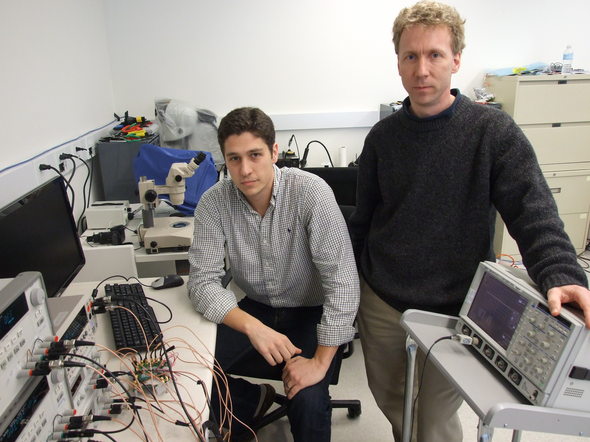
Ambiq Micro cofounders Scott Hanson (left) and David Blaauw have said the company's microcontroller technology is significantly more energy efficient than technology currently available on the market.
Nathan Bomey | AnnArbor.com
The firm, Ambiq Micro, determined that the Austin region offered the best chance of landing the talent to advance its integrated circuitry technology, which improves energy efficiency in wireless electronic applications.
“That’s essentially what it boils down to,” Ambiq Micro CEO Scott Hanson said. “We really wanted to grow real quickly with the strongest possible, most experienced talent, and that’s where the highest concentration of talent is for our business. It’s really too bad. I am from Michigan myself and wanted to build the business here, but it’s really in the best interests of the company to move down there.”
Hanson, who founded Ambiq Micro as a post-doctoral student at U-M, is moving to Texas within days to start building the company. His co-founders, U-M engineering professors David Blaauw and Dennis Sylvester, will remain at the university and continue to consult with the startup.
The company’s decision to move from Ann Arbor to Austin comes after the firm announced Tuesday that it had secured $2.4 million in early-stage venture capital from several investment firms. Investors included Houston-based DFJ Mercury, United Kingdom-based ARM Limited, California-based Draper Fisher Jurvetson, Cisco Systems, Ann Arbor-based Huron River Ventures and the U-M student-led Frankel Commercialization Fund.
Hanson said the investors didn’t force Ambiq Micro to leave Michigan as part of their investment - a strategy some venture capitalists have been known to employ.
“We have a great group of investors and I think they all wanted to do what was best for the company,” he said. “We took a close look at whether we could stay local or whether we should move.”
Ambiq Micro, which spun out of U-M earlier this year, won a global industrial business plan competition thus summer, giving the startup access to $250,000 in funding from Cisco and DFJ. The accomplishment was seen as a key validation of Ambiq Micro's technology.
Manufacturing of Ambiq Micro’s device was already set to be done in Taiwan. But the engineering jobs the firm plans to add will be based in Texas.
Hanson told AnnArbor.com earlier this year that his firm could have 30 employees in Ann Arbor within four to five years. He said the firm's microcontroller is 25 to 130 times more energy-efficient than currently available technology.
Today, Hanson said the company still has “great growth potential.”
“The goal is within the next 12 months or so to have seven to 10 engineers working hard on building a product,” he said.
Hanson emphasized that blame for Ambiq Micro’s departure should not fall on the shoulders of local leaders. He said his sales leader would be based in Michigan and that the company could still establish a presence in Michigan in the future.
“We still view this as a Michigan company. It’s a Michigan success,” Hanson said. “I think we’ve got a pretty tremendous local entrepreneurial community here. We’ve got all the right resources here.”
Contact AnnArbor.com's Nathan Bomey at (734) 623-2587 or nathanbomey@annarbor.com. You can also follow him on Twitter or subscribe to AnnArbor.com's newsletters.
Comments
peg dash fab
Tue, Nov 16, 2010 : 5:02 p.m.
i'll bet someone forgot to tell ambiq where the nearest integrated circuit manufacturing plant is located. oh, wait.
lotus_65
Tue, Nov 16, 2010 : 5:37 a.m.
southeast michigan has been trying to become the new silicon valley since the early 80's, and this is the result... how sad that despite vast wealth in the s. e. michigan area, the state can't cull enough perks to keep the talent around for future generations, and that's just a matter of marketing.
Stephen Lange Ranzini
Tue, Nov 16, 2010 : 12:24 a.m.
Fix the root of the problem and you fix the problem: Michigan was #19 nationwide of the states (25 deals with just $131 million invested) in venture capital investments in 2009. Texas was #4 (111 deals with $645 million invested). See www.michiganvca.org/documents/MVCA2009ResearchReport_final.pdf We need government policies to increase the amount of venture capital available to Michigan based businesses so we can keep them here as they grow! We need government policies that are friendly to growing industry here! Why is the chip fab business in Austin Texas? You needs lots of water for chip fab operations. Michigan has that but we also have many barriers to doing business not found in other states. Another sector that Michigan is the nationwide leader in is the health information exchange segment of the health information technology industry. For example, the South East Michigan Health Information Exchange (www.semhie.org) raised $45 million in 2010 to launch into operation backed by a who's who of health care industry firms. There are huge opportunities in Michigan for firms in this space despite the many issues that hold us back.
Sam
Mon, Nov 15, 2010 : 10:29 a.m.
Yup...no state income tax. Nuff said.
IfYouSeekAPleasantPenninsula
Mon, Nov 15, 2010 : 9:38 a.m.
Really? Texas because they have engineers there? Have you been on North Campus? Have you heard about all the engineers in their 50's given the boot from GM, Ford, Chrysler? Couldn't a little of the money be spent to "relocate" a couple Texas engineers up to Michigan? They could get the other Michigan engineers "up to speed"! It's outrageous and very very sad.
Hanz Landa
Sun, Nov 14, 2010 : 2:11 p.m.
Just hung up with a partner at a notable VC firm and he said the businesses that the VC community would fund and would be best located in Michigan are: foreclosure related services, bail bonds and other services related to the criminal justice system, and anything related to housing of the elderly. He concluded by saying any other industry meriting a large investment is most likely better off in another part of the country due to Michigan's many problems and the absence of any solution in the near to medium term.
mjc
Sun, Nov 14, 2010 : 9:56 a.m.
I wouldn't consider this a waste of tax dollars. Most certainly, the state money invested in this company converted to shares at the close of this round. If the company has a great exit, the state could receive 10X back on their investment, which will be reinvested in other local companies, some of which will surely be hiring in-state. If Ambiq truly can't achieve this level of success in MI, then they should move. It is better for the state to get the 10X return than to not succeed.
Jay Thomas
Sat, Nov 13, 2010 : 7:24 p.m.
@Macabre Sunset: Yes, this is also happening under Granholm's watch. Snyder doesn't take over til January. :|
Jay Thomas
Sat, Nov 13, 2010 : 7:19 p.m.
I still remember when Comerica moved their HQ to Dallas. They had been in Detroit for 158 years. :( The reality is that Michigan is not competitive with Texas. It's worse than other Midwest states also.
StartupGeek
Sat, Nov 13, 2010 : 6:54 p.m.
Who was the lead investor in this deal? My guess is DFJ Mercury. And they required the move. Plus, it made sense to be located where there is a semiconductor industry cluster. One question not addressed in the article is "why weren't one of Michigan's VC's the lead in the deal?" Did they try? Were they passed over for a better connected, semiconductor focused VC fund? It is unlikely an insider would disclose this to a reporter, but it would be interesting to know. Unfortunately for Michigan, the entrepreneurs made what was the best decision for the potential success of the company. I do not blame them. If you have not tried to build a company with pioneering technology, it is difficult to appreciate how hard it is without access to all the critical resources in your backyard. And that ain't Michigan yet. It is getting better, but much more work has to be done.
FredMax
Sat, Nov 13, 2010 : 5:13 p.m.
I would not assume that this particular news story confirms any kind of trend or failure on our part to retain industry. Probably there are alot more "UM seed" tech companies operating around Ann Arbor than people generally realize. But we cannot expect that it is possible for every type of tech industry to operate in Ann Arbor. Many engineering disciplines are very specialized, and a startup has a high risk for failure. A location with a critical mass of similar industries is a risk mitigator.
Cash
Sat, Nov 13, 2010 : 1:31 p.m.
I still say let's STOP wasting our precious tax dollars developing ANY business that will not commit to Michigan. We do not have resources to waste developing businesses for China or for Texas. If you want to be in Texas GO to Texas. But go there to develop your start up. Stay out of Michigan altogether. I don't care about why they are leaving for Texas. I care that we continue to waste resources in Michigan on start ups with no commitment to Michigan. Stop it NOW.
Hanz Landa
Sat, Nov 13, 2010 : 11:37 a.m.
This is a surprise? There are probably ten other companies or entrepreneurs that did the same thing. Ann Arbor is done. It's way past its prime. The old guard is clinging to the past glories resisting change. The business and legal climate in Ann Arbor is too provincial and too egotistical to see how it does not stack up as anything but insignificant now. I bet if Mary Sue could take the endowment she'd change the name and move out of state to. Congrats on the move to the Texas guys as real success in now possible. Buh-bye, Sad Arbor.
Craig Lounsbury
Sat, Nov 13, 2010 : 11:17 a.m.
RockCreek@ "so let's put everybody in a room with pizza... people eating free pizza...." Now a profitable pizza empire is something South East Michigan can do.
RockCreek
Sat, Nov 13, 2010 : 11:05 a.m.
Alpha Alpha, I don't know how Concerned would answer but I'll take a stab at it. You have a little company that's probably just 2 or 3 young people. You have to recruit over the next few years if things go right a lot more people than that. It's cheap to put those people on a plane but that's the easy part. Getting them to move, sell their homes, change their kids schools, leave friends behind and stuff like that is not easy. Plus they want to stay where the action in their field is. You notice when Pfizer closed how many people stayed here trying to come up with a job so they wouldn't have to go through that. Another thing. Don't expect UM engineering to know much about creating companies that stay and grow. They run their mouths on about it and spend a lot of money on it but their idea is that another 2 guys in a dorm will be the next 2 Google guys so let's put everybody in a room with pizza and see what happens. They don't know enough about real world business to keep the real winners here. It's more of a smoke and mirrors and count the number of people eating free pizza operation.
Craig Lounsbury
Sat, Nov 13, 2010 : 11:01 a.m.
A promising University of Michigan startup developing microcontroller technology is moving to Austin, Texas....The firm, Ambiq Micro, determined that the Austin region offered the best..." "Manufacturing of Ambiq Micros device was already set to be done in Taiwan" "We still view this as a Michigan company..... Hanson said." Don't insult our intelligence on your way out of town Mr. Hanson. Do you think the Los Angles Dodgers are a Brooklyn baseball team? I would wish you success in your move but the truth is I am as indifferent to your success as you are to the struggles of the State of Michigan.
AlphaAlpha
Sat, Nov 13, 2010 : 10:40 a.m.
Somewhat Concerned - "Scott Hanson has known for some time that he would move the company either to Texas or California" Can you elaborate as to why? Labor is so easy to transport from wherever it is to wherever it's needed; moving a company can be quite disruptive and potentially costly. Also, if you do know why, what do you suppose it would have taken to get a company like this to remain here? Thank you.
JimB
Sat, Nov 13, 2010 : 10:24 a.m.
Don't the founders of this comapany feel any obligation to stay in the state of Michigan...especially since they developed their product through the UofM..as professors, fellows, and using the facilities. Also, weren't they given money from UofM's Frankel Fund to seed their business at a critical time in their launch? Shouldn't they stay here to develop their business as part of some stipulation for accepting the grant? Where is the Governor/ UofM officials?
Somewhat Concerned
Sat, Nov 13, 2010 : 10:03 a.m.
Good questions. Generally, it is more efficient (important when you don't have giant amounts of cash on hand) and more likely to succeed if you build deep infrastructure in areas in which you already have a start and have some credibility. In Michigan, that probably means areas like medical devices and pharmaceutical development, advanced manufacturing, and some types of material sciences. We have substantial talent, employment, infrastructure and credibility in those areas. Areas like movie production, fashion, and semiconductors would require us to build from a very low base and compete against people who already have a lot going for them that would take a lot of money and many, many years to catch up to - and that assumes they don't keep making progress.
Cash
Sat, Nov 13, 2010 : 9:53 a.m.
Well, someone started the "deep infrastructure" that now exists (supposedly) in Austin. Why can't that be done here? We are throwing millions of tax dollars into business development etc...and the jobs go to other states. This is NOT what taxpayers intend to have happen with our hard earned tax dollars. Why support a start up that "has known for some time" it wasn't going to stay in Michigan? It's insanity.
glacialerratic
Sat, Nov 13, 2010 : 9:09 a.m.
Then what are the reasons SE Michigan does not have a comparable semiconductor development and fabrication infrastructure, especially since these are important components in both cars and biomedical devices? Supporting startups with flash capital (flash in, flash out) is no substitute for a strategic investment policy in rebuilding the state's capacity to combine r&d with local manufacturing. This is what Germany has done.
norainnorainbow
Sat, Nov 13, 2010 : 8:56 a.m.
Sorry, humdinger.... the BBQ at County Line (2222 & 360) is much better than Stubbs! :-)
Elaine F. Owsley
Sat, Nov 13, 2010 : 8:51 a.m.
Develop it in Michigan, move it to Texas, make it in Taiwan. Isn't there something familiar about this scenario?
Somewhat Concerned
Sat, Nov 13, 2010 : 8:48 a.m.
It is not a matter of investors forcing the company to move. Scott Hanson has known for some time that he would move the company either to Texas or California, and has not kept that a secret; he just had to decide which was best. UM produced the idea, but now it is time to produce the product, and Michigan is not a center of semiconductor development and production. Austin is. Michigan does not have the deep infrastructure to support a semiconductor startup. Austin does. Different regions offer different assets. For example, Michigan is a center of medical device and biopharma expertise. Austin is not. Michigan has the deep infrastructure to go from idea to company in those domains. Austin does not. We are not the best at everything, but we are very good at some important industries that have a big future. Even there, we will have our hits and our disappointments, as when HandyLab was moved. That's life in the real world (as opposed to the Big 3 - UAW world that is never coming back). We're still in a potentially good position - better than a lot of regions, and, if we support entrepreneurs and companies in the fields in which do have what it takes, we will have a slice of the future.
63Townie
Sat, Nov 13, 2010 : 8:26 a.m.
Yep, that SPARK has been a rip-roaring success. We still view this as a Michigan company. Its a Michigan success, Hanson said. I think weve got a pretty tremendous local entrepreneurial community here. Weve got all the right resources here. So then why are you moving to Austin? The sooner Ann Arbor government gets its collective head out of the sand, acknowledges the REAL issues and starts working on them, the better.
Silly Sally
Sat, Nov 13, 2010 : 8:07 a.m.
"U-M engineering professors David Blaauw and Dennis Sylvester, will remain at the university and continue to consult with the startup." Great, tax-supported UM still will offer resources and time, but the profits will all go elsewhere, certainly not in Michigan. Perhaps UM should admit more Michigan residents into its schools who will want to stay in Michigan instead of thouse who only want to get an education and then leave. Its too bad that the manufacturing is to be in Taiwan, and not Texas. More potiential jobs exported. What was Ann Arbor's Spark doing to keep this start-up in Michigan? Nothing, is its leader more concerned with helping the governor?
clownfish
Sat, Nov 13, 2010 : 8:01 a.m.
Again...WOW! These Very Smart Guys cannot find 7-10 engineers in the A2/Detroit metro area? I find that difficult to swallow. Macabre must be right..it must be the current governors fault! Except the owners said it wasn't. Snyder should have his SPARK protege' get on the phone, I recall Snyder ran as a high tech job "creator". Make it happen! Pretty sad that these guys would use MI govt (UM) to get them started, then flee when the state needs them. Is there a virtual tar and feather website we could send these people to? Have to agree with TRU, hope their Plan flops, and all the Taiwanese and Austonians end up busted.
Cash
Sat, Nov 13, 2010 : 4:49 a.m.
Right...the investors didn't force the move. Ha!! All rattlesnakes should be in Texas.
AlphaAlpha
Sat, Nov 13, 2010 : midnight
This move was almost certainly VC driven. Hanson as much as says so, only being able to allude to that which might embarrass the investors. Of course the company could have brought help here, just as companies have done for centuries. One or more VC's said 'move', and Hanson had little choice but to do what the lenders 'suggested'.
wes palm
Fri, Nov 12, 2010 : 11:15 p.m.
1.2 billion dollars in research flows through the University and they cannot find a few good engineers (like Larry Page)? Dig deeper - there must be more to this move.
81wolverine
Fri, Nov 12, 2010 : 7:35 p.m.
I don't doubt this is the right move for this company at this time. That being said, Governor-elect Rick Snyder needs to work with U-M to develop new companies where the talent to staff them already exists in the state. Maybe provide some incentives to HQ in Michigan. U-M is a tremendous asset to the state as a potential business incubator. But obviously, we'd like to see those companies stay here.
MjC
Fri, Nov 12, 2010 : 6:24 p.m.
Well as Texas cowboy Roy Rogers used to say... "Happy trails to you"
trespass
Fri, Nov 12, 2010 : 5:51 p.m.
Why don't we have the engineers locally to support this company? I thought the UM was supposed to be the engine for our recovery. Could it be that most of the engineers we graduate go back to China?
Macabre Sunset
Fri, Nov 12, 2010 : 5:29 p.m.
Blown away...
RudeJude
Fri, Nov 12, 2010 : 5:12 p.m.
@ Rusty As an Ann Arbor-born Austinite in his late-twenties, I hate to agree with you. I love my hometown, so it is painful to admit to the many counts on which Ann Arbor has lost its way (If you ask me, it began with the closing of Drake's Candy Shop on University Avenue when it was replaced with a bank). From article... We still view this as a Michigan company. Its a Michigan success, Hanson said. I think weve got a pretty tremendous local entrepreneurial community here. Weve got all the right resources here. And yet Ambiq Micro will soon be successful at putting food on the tables of the Texans it will hire, or stealing away Michigan grads from the Michigan economy.
nickcarraweigh
Fri, Nov 12, 2010 : 5 p.m.
Move the business to where the brains are? Why not? I hope it works out for them. On the face of it, this is no indictment of Michigan. It tells us nothing about the suitability of this state for future growth. If this technology is truly cutting edge, there are probably only a handful of people in the world who understand it (and you may have already met some of them in downtown Ann Arbor, panhandling while on their way to a medical marijuana dispensary after cashing their SSI checks). As a former Texas resident I can guarantee Austin is the nicest place in Texas, but that's like praising a particular straw mat as the best bed in Bedlam. Anything that keeps Texans in Texas is a good thing for the country, for the world, and for civilization as we know it. Except for the burritos; if we really want to help Ann Arbor, let's grant asylum to a good Tex-Mex chef.
treetowncartel
Fri, Nov 12, 2010 : 4:58 p.m.
I love it, use the resources available to you at the University while you work/go to school there, and then continue to work there while you take what was made there and make bookoo bucks off of it. I am not against people from the industry being involved in our fine educational systems, but maybe the school, and the state of Michigan taxpayers, should get some of these shares the company has.
DonBee
Fri, Nov 12, 2010 : 4:08 p.m.
This is why we all have to work together to fix Michigan.
rusty shackelford
Fri, Nov 12, 2010 : 4:04 p.m.
Obviously. Austin beats Ann Arbor culturally, economically, and intelligence-wise, in every way. But hey, all the local politicians can just continue to dismiss the concerns of anyone under 50 as silly. Ann Arbor will still be one of the best places to retire! Until there's no money and no youth to run all those things rich retired boomers ostensibly love to do.
trs80
Fri, Nov 12, 2010 : 3:37 p.m.
Texas the new Silicon Valley