

Bernero says he will push to get court reviews before foreclosures
Democratic gubernatorial candidate Virg Bernero said Friday he'll push to change Michigan law to require a court review before a bank can foreclose on a home.
Bernero made the campaign pledge at the home of an Iraq war veteran he says was unfairly treated by the system. Banks in the state can initiate foreclosures on their own, but Bernero says 23 other states require the same kind of judicial review he is seeking for Michigan.
He also called for a freeze on foreclosures until the completion of investigations into how some major lenders handled them. Republican Attorney General Mike Cox is among the attorneys general checking into the matter.
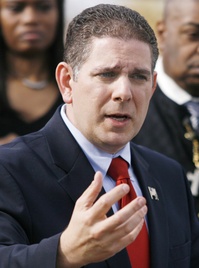
Democratic gubernatorial candidate Virg Bernero speaks during a news conference in Flint.
(AP Photo/The Flint Journal, John Ehlke)
"It's very difficult for a regular citizen to stand up to the power of the big banks," Bernero said.
Bernero's Republican opponent, Rick Snyder, has said a foreclosure freeze and further legal oversight isn't necessary, and his campaign reiterated that stance Friday.
"What we need to do is make sure we're going after the bad actors who aren't following the law," said Snyder campaign spokesman Bill Nowling. "Rick agrees with President (Barack) Obama that having a foreclosure freeze will have a chilling effect on Michigan families' ability to access capital."
Bernero said he has seen too many examples of why the laws need to be changed to stick with the status quo.
The Lansing mayor held a news conference Friday at the home of Bill Krieger, who told reporters he spent weeks trying to persuade JP Morgan Chase & Co. not to foreclose on his suburban Lansing home after the lender made an accounting mistake.
The error came about after Krieger made his September payment electronically, as he usually did, then set up automatic electronic payments on the bank's website. Chase immediately took out another payment of nearly $1,800, something Krieger couldn't afford. When Krieger asked Chase to cancel the second payment, bank officials said they couldn't do that but would mail him a check.
The bank sent the check but also canceled the second payment, Krieger said. Then it sent him a letter saying he was in foreclosure for missing the September payment, which he had paid, and had to send $5,300 immediately or risk losing his home. Calls to the lender didn't get the mistake reversed.
"Even by their own records I had made all my payments," he said. "I was assured this would be taken care of. ... (Then) I received a letter from them stating I now owed them $7,000. So their idea of fixing it was to make it worse."
Krieger eventually turned to Cooley Law School, which offers free legal advice to military personnel. Krieger is a member of the Michigan Army National Guard, as is his wife. He has served in Iraq, and his wife and son, an Army private, are deployed there now. Yellow ribbons flutter on the large tree in the family's front yard.
Krieger said he and his lawyer have been assured by Chase that they should be getting letters soon that the error has been fixed. But his credit score has dropped to under 600 because of the mix-up, a downgrading in his credit rating that kept him from being able to lease a new Chevrolet Silverado truck earlier this month.
Chase spokesman Michael Fusco said the bank is working with Krieger to resolve the payment issue and other matters.
"We are contacting the credit bureaus to amend his credit and will reimburse any fees he may have incurred," Fusco said.
Krieger said he should never had to spend so much time resolving a mistake that wasn't his fault.
"There's got to be some oversight on what these banks are doing," he said. "It's just incredible that someone can tell me that I'm behind and that I have to prove that I made my payments. ... I still have received nothing from them that says this is all over and done with."
Bernero said Krieger's troubles aren't an isolated example.
"We know that mistakes are being made in Michigan," he said. "We need to have legal protections in place so that instead of the burden being on the side of the homeowner to prove that he's legitimately in his home ... the bank should have to prove that they're legitimately taking the home."