

Billionaire benefactor of University of Michigan faces SEC securities fraud charges
A billionaire who gave $10 million to the University of Michigan's business school in the late 1990s donated cash he stockpiled by engaging in securities fraud and insider trading, the U.S. Securities and Exchange Commission is alleging.
Samuel Wyly and his brother Charles Wyly face SEC civil charges in what "could result in one of the biggest judgments ever in a securities fraud case," the New York Times reported. Wyly's gift financed half of the cost of the U-M building that bears his name on the corner of Hill Street and East University Avenue on U-M's Central Campus.
SEC investigators accused the brothers of receiving more than $550 million in "undisclosed gains" and more than $31.7 million from insider trading at various companies, including Sterling Software, which the brothers sold for $4 billion. (Read the entire SEC complaint here.)
"Sam Wyly and Charles Wyly engaged in a 13-year fraudulent scheme to hold and trade tens of millions of securities of public companies while they were members of the boards of directors of those companies, without disclosing their ownership and their trading of those securities," the SEC alleged.
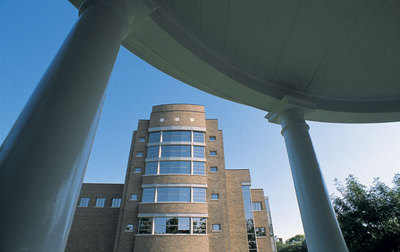
U-M named this building after 1957 MBA grad Sam Wyly, who gave $10 million to the university in the late 1990s. Wyly is now accused of donating money he gained through securities fraud.
Photo courtesy of University of Michigan
"The Wylys' scheme defrauded the investing public by materially misrepresenting the Wylys' ownership and trading of the securities at issue while enabling the Wylys to realize hundreds of millions of dollars of unlawful gain and other material benefits in violation of the federal securities laws governing the ownership and trading ofsecurities by corporate insiders."
The announcement details civil charges, but the brothers are also being investigated for possible criminal violations as well, the Times reported.
Their lawyer, William A. Brewer III, a partner at the Dallas law firm of Bickel & Brewer, denied the charges.
“They have never been given any reason to believe the financial transactions in question were anything other than legal and fully appropriate,” he told the Times.
The charges come 10 years after the university opened Sam Wyly Hall, which cost $20 million and was built to house Business School functions such as the executive education department and the William Davidson Institute. Wyly earned his master's in business administration in 1957.
“My mother always told me that when someone does something for you, you say ‘thank you.’ Thank you, Michigan,” Sam Wyly said at the time, according to U-M's University Record publication.
A spokesman for the U-M Business School referred questions to the university's chief spokeswoman, Kelly Cunningham.
"Mr. Wyly has been a long time friend and supporter of the university," Cunningham said in e-mailed response to a telephone interview request. "We're sorry to hear he is facing these difficult circumstances."
The gift, at the time one of the two largest donations in the history of the Business School, was first announced in January 1997.
"This is a tremendously generous gift and it comes to us at an important moment in the School's history," Business School Dean B. Joseph White said in a statement announcing the gift. "It's a gift that will truly make a difference and I'm deeply grateful to Sam for the commitment and for helping fuel even greater success for the School."
According to the SEC complaint:
The Wylys used offshore cash to cover charitable commitments each had made. In 1996, for example, Sam Wyly pledged to donate $10 million to his business school alma mater over five years in connection with the construction of a new building on campus, which was subsequently built and named for him. Although Sam Wyly made the initial $2 million portion of this donation from domestic sources, he caused the remaining $8 million to be paid from the Offshore System.
Lee Bollinger, U-M's president when the gift was made, said at the time: “This means an enormous amount to the University. To have this space available means that we will have the finest possible areas for our faculty to be able to do research and teach.”
Contact AnnArbor.com's Nathan Bomey at (734) 623-2587 or nathanbomey@annarbor.com. You can also follow him on Twitter or subscribe to AnnArbor.com's newsletters.
Comments
runbum03
Sat, Jul 31, 2010 : 1:42 p.m.
The Wyly Brothers have started, bought and sold many companies over the years. Is profiting from the sale of a closely held investment "insider trading?" I don't believe so, but it makes great Press and the Left has a long memory and never forgiven Mr. Wyly's support of the Swiftboaters. These charges are puffed up and Political in nature and Mr. Wyly's name was at the top of the Left's Enemies List. Good luck Mr. Wyly!
McGiver
Sat, Jul 31, 2010 : 6:56 a.m.
Is this the same SEC that failed to catch Bernie Madoff after being handed to them on a platter for more than 10 years? Doesn't exactly inspire confidence. I'll reserve judgement.
John Alan
Fri, Jul 30, 2010 : 10:53 p.m.
Regardless of all these..... Atleast he gave $10M to U of M, there are alumni that do not give a dime to their school or charity!!!
Alan Benard
Fri, Jul 30, 2010 : 10:52 p.m.
"Behind every great fortune there is a crime." -- Honore de Balzac
Speechless
Fri, Jul 30, 2010 : 10:01 p.m.
UM's Wyly building has just become a substantial multi-story monument. It is a larger-than-life symbol for the process of great financial accumulation in the upper stratosphere of business, as well as for its social implications. Sam Wyly, himself, represents this business life cycle on the personal level — from campus undergrad to grad, and from entry level to rising star to financial titan to generous campus benefactor. And, ultimately, to court. Upon entering the autumn of his years (cue Sinatra), he assumes the role of great campus donor to honor his roots in his own honor. Important people from campus and well beyond speechify to each other about this great donation and the wonders of the real world that it so aptly represents. Along the way to becoming huge winners, the Wyly brothers bent a big rule or two or three or four or five or six. But America, including UM, just loves a big winner, especially when the sport is financial accumulation. We always prefer to overlook any problematic details for as long as history will allow — whether it's athletes on steroids or speculators hooked on insider trading. Money might not be the only thing that counts, but in the business world it is all that matters. The UM Business School should rechristen the building as Wile E Coyote Hall to maintain a sound consistency in both name and ethical methods.
Marvin Face
Fri, Jul 30, 2010 : 9:38 p.m.
"business is business And business must grow regardless of crummies in tummies, you know"
Old Salt
Fri, Jul 30, 2010 : 8:53 p.m.
Send the money back it is dirty
trespass
Fri, Jul 30, 2010 : 6:47 p.m.
This is not the first UM building named for a felon (e.g. Alfred Taubman, the Taubman Medical Library, Taubman Health Care Center. In fact, a school within the university is named after him: the Taubman College of Architecture and Urban Planning.) Perhaps this reflects the University Administration's own ethics.
Gorc
Fri, Jul 30, 2010 : 6:45 p.m.
John Galt....When they take back ill gotten gains, it think they call it "clawbacks". If a sports team violate any rules they would have to lose scholarships, take down banners, forfeit prior wins, etc. I would be shocked if the university had to repay the funds. But equating this to the athletic department is comparing apples to oranges.
CynicA2
Fri, Jul 30, 2010 : 5:23 p.m.
Very funny... I love it when the Big U gets egg all over its' face! Too bad they didn't take all the money that thief-in-a-suit Ivan Boesky offered them a few years before this, I think... he wanted them to rename the B-School for him just before the wheels came off his cart, and he traded pin stripes for prison stripes. That would have been hilarious... the Boesky School of Business! What could be more appropo for a den of thieves?
Inside MI GOP
Fri, Jul 30, 2010 : 5:13 p.m.
.com bubble housing bubble oil bubble stock market bubble cost of higher education bubble Is the cost of higher education, possibly the most insidious bubble in that it is sold directly to the newest members of adulthood, preying mostly on their fear of being left behind economically and socially if they do not attend the best institutes of higher learning and then purposefully indoctrinating them against any common sense apprehension against long term indebtedness. How can the result be any different than the housing bubble i.e. they will have purchased the same model of education sold to millions of their generation at inflated prices, thus diminishing the competitiveness of the degree they obtained and making their debt even more difficult to pay. And unlike mortgagors, the new grads won't be allowed to give their shingle back to the university in lieu of collection, or declare bankruptcy on the deficiency. And, they may even have their drivers licenses suspended. Proposal: allow the discharge of student loans in bankruptcy. Lenders will stop lending so much money. The cost of a degree will fall as the universities deal with a simple supply and demand curve, rather than one adulterated with the "leveraging" of young peoples naivette and lifetime indebtedness potential.