

Bob Lutz: Clean energy must become viable without government subsidies
Auto industry veteran and Ann Arbor area resident Bob Lutz, a former vice chairman of General Motors, said today in Ann Arbor that clean energy technologies must become financially viable without government support.
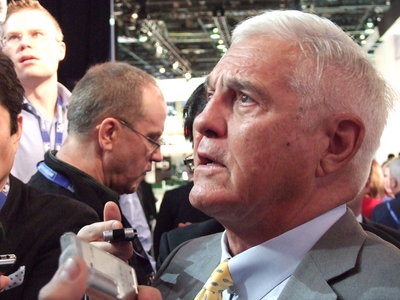
Former General Motors Vice Chairman Bob Lutz speaks to reporters at the North American International Auto Show in Detroit a few years ago.
Nathan Bomey | AnnArbor.com
“Clean energy must, at some point, for long-term success, be the most efficient solution,” he said. “It cannot exist forever on government subsidies and mandates. It just can’t.”
He added: “Folks, that is not going to last because for something to be viable over time, it has to produce economic value. Otherwise you’re doing it all for the wrong reasons.”
Lutz championed the development of the extended-range electric Chevrolet Volt while serving as a product development leader for the Detroit-based automaker. He’s also come under fire at times for controversial remarks about climate change and oil policies, but he said today that he’s an avid “proponent of clean energy.”
Lutz, speaking at an event organized by the University of Michigan College of Engineering’s Center for Entrepreneurship, said the electrification of the automobile will be “gradual” but is inevitable.
The Switzerland native, who turned 80 on Sunday, also slammed “the self-serving right-wing talk show windbags like Rush Limbaugh,” Bill O’Reilly and Lou Dubbs as ill-informed about the Volt.
The Volt came under scrutiny in late 2011 after the National Highway Traffic Safety Administration launched an investigation into the safety of the Volt when the vehicle caught on fire three weeks after a crash test in the lab. NHTSA, which did not follow standard safety procedures for a semi-electric vehicle after the crash test, later declared the Volt to be safe.
But some Republicans used the incident to criticize President Barack Obama, accusing the administration of spending government dollars to push the Volt.
Lutz expressed regret that the Volt had become a “political punching bag.”
“The amount of misinformation was really disturbing, to say the least,” Lutz said. “So that was an unfortunate incident. It hurt the car, but that too shall pass. The Volt will survive and justifiably become a landmark vehicle.”
Lutz, revealing details of the NHTSA crash test, said the Volt slammed into a pole severely during the test — and that the crash was so severe, “probably no occupant would have escaped alive.”
After the test, he said, the agency rolled the car on its right side for five minutes, onto its roof for five minutes and onto its left side for five minutes before returning it to the upright position. During that process, he said, fluid leaked, “got into the top of the battery” and three weeks later the fire ignited.
Speaking to a crowd of a few hundred students, including many who competed in the Michigan Clean Energy Venture Challenge, Lutz said oil and natural gas discoveries in the U.S. and Canada would make the nation “independent of foreign oil” within five years.
That means that renewable sources of electricity “cannot compete head on with fossil fuels over the next 20 years economically,” Lutz said. “That’s the tough truth and nobody wants to hear it.”
But he said the price of fossil fuels would continue to rise over time as demand increases in developing nations like China and India, making renewables necessary.
“The demand in the rest of the world is going to rise so fast,” Lutz said.
Lutz also:
--Revealed that Jon Lauckner, president of GM Ventures, would be named as a top GM executive for research and development.
--Said electric vehicles were “inherently more efficient” thermally than internal combustion engines.
--Said lithium-sulfur technology is about five years away from being integrated into vehicles while lithium-air technology is about 10 years away.
--Projected that U.S. sales of electric vehicles would reach 1 million to 2 million within 10 years. That compares to overall annual vehicle sales of 12 million to 15 million.
“The future is electric, but gasoline will be around for the foreseeable future. That’s a future that, any way you slice it, looks a lot of brighter to me for the folks like you,” he told students.
Contact AnnArbor.com's Nathan Bomey at (734) 623-2587 or nathanbomey@annarbor.com. You can also follow him on Twitter or subscribe to AnnArbor.com's newsletters.
Comments
snapshot
Tue, Feb 21, 2012 : 3:59 a.m.
Hell, we're subsidizing Lutz's consulting fees with our automotive bailouts. He continues to profit from the industry's economic failure of which he was a contributing entity and people still listen to him?
15crown00
Sat, Feb 18, 2012 : 5:01 p.m.
Either way u look at it Bobby the people pay for it.
EyeHeartA2
Sat, Feb 18, 2012 : 3:16 p.m.
Let me re-write the article: Bob Lutz states the obvios. Everyone ignores him, since it doesn't fit their agenda.
Mike D.
Sat, Feb 18, 2012 : 2:54 p.m.
Lutz is the man who championed and fought for the Volt, the only vehicle sold at any scale that can (and, in practice, does) run in fully electric mode most of the time and function as a real car for people who have to drive more than 50 miles in a 7-hour period (that's how far I can drive a Leaf before it dies). For all the commenters' talk of Lutz being a right-wing environment hater, he's literally done more to bring green personal transportation to Middle American than anyone else. He's explaining the Volt's low sales, not saying we shouldn't continue to invest in alternative technologies. I read Lutz's comments as saying that we have to invest in technology now to get alternative fuels to the point of economic viability, or near it (as oil is today). He acknowledges that oil, while plentiful and cheap today, will continue to rise in price eventually, so I don't think he's saying that electric cars will never be viable, just that it's going to take a long time (see his notes about when various next-gen batteries will be salable).
Mike D.
Sun, Feb 19, 2012 : 3:45 p.m.
Certain statements above epitomize what I call a head-in-the-clouds hippie mentality. Being "green" isn't a binary characteristic that means you support anything that calls itself green, no matter how silly, nonviable, or ultimately harmful to the environment. Being green means supporting lifestyle choices, investments, and technologies that actually have some hope of ultimately reducing energy use and waste. Solyndra wasn't that. And no, I don't blame Obama. Not every investment you make is a good one, but when you make a bad one, at least own up to it and call it what it was: a rat hole.
Arborcomment
Sat, Feb 18, 2012 : 11:12 p.m.
Solyndra panels were a unique design and more expensive than both foreign and domestic models while prices were rapidly dropping (China was a factor here, but also as other US makers of the cheaper models stepped up production). "Investing" taxpayer dollars in a product too expensive for the market, followed by company actions of building a taj mahal corporate headquarters rather than reducing production costs, did make it a very splashy rat hole however.
ffej440
Sat, Feb 18, 2012 : 4:50 p.m.
Lutz, citing the collapse of solar firm Solyndra as an example of "$500 million down the rat hole," said subsidies won't last Did you not read this part? Someone who calls investing in solar energy, money down a rat hole does not sound very green to me. The collapse of Solyndra was caused by China dumping solar equipment in this country. A trade problem NOT an alternative energy problem. Watch the movie "Who killed the electric car?" Then tell us again how GM is working so hard to provide electric transportation.
towny
Sat, Feb 18, 2012 : 1:33 p.m.
Bob, well said. Right On. I believe your future predictions for the country are very accurate. You still know your business. This country should of been off dependence of fossil fuels 30 years ago. But, big oil has a lot of money and lobbyists. Say it like it is they own the government. Happy 80th. Hope you where able to take a birthday flight.
Sallyxyz
Sat, Feb 18, 2012 : 5:28 a.m.
Big oil gets all kinds of multi-billion dollar tax breaks, but clean energy should stand on its own. Level playing field? I think not. Where would big auto be today without government subsidies, in bankruptcy. Agree with posters bhall and ffej440.
ffej440
Sat, Feb 18, 2012 : 1:58 p.m.
cfpmac- Henry Ford had Rockefeller oil money behind him. Some things never change.
Craig Lounsbury
Sat, Feb 18, 2012 : 12:09 p.m.
cfpmac what Henry Ford did or didn't receive is hardly relevant. We aren't driving model T's on dirt roads anymore. Much in the world is very different from when Henery Ford began the Ford Motor Company.
cfpmac
Sat, Feb 18, 2012 : 11:26 a.m.
You agree with them rather than real life experience eh? How much government subsidies did Henry Ford receive?
cfpmac
Sat, Feb 18, 2012 : 4:36 a.m.
It is a shame that we are pursuing policies that make energy scarce and expensive. It hasn't worked out so well in Germany or Great Britain either and the people are tired of it. High energy prices hurt our most vulnerable citizens the most and don't help manufacturing, tourism or agriculture either. <a href="http://www.spiegel.de/international/germany/0,1518,809439,00.html" rel='nofollow'>http://www.spiegel.de/international/germany/0,1518,809439,00.html</a> <a href="http://www.telegraph.co.uk/news/politics/9061997/101-Tories-revolt-over-wind-farms.html" rel='nofollow'>http://www.telegraph.co.uk/news/politics/9061997/101-Tories-revolt-over-wind-farms.html</a>
ffej440
Sat, Feb 18, 2012 : 1:47 p.m.
The lesson we can learn from both is to instal a grid that is able to handle charge and draw loads at variable times.It can be done. I dispute your claim that it hasn't worked out so well. Germany has a problem with China dumping solar products at below cost which is killing the German solar start ups- That is a trade problem, not energy. Great Britain thinks wind turbines are an eyesore, they should try a big stinky oil well.
NoSUVforMe
Sat, Feb 18, 2012 : 2:18 a.m.
I find it incredible that Bob Lutz is considered an expert about anything. He is a right-wing talker who has never cared about the environment or clean energy. His viewpoint is not surprising for someone who is responsible for some of the most obscene "muscle cars" that testosterone-starved men seem to crave so much. Lutz thinks he is smarter than 98% of the world's climatologists when it comes to global warming. Oh, he's just like the Republican Party!!! Clueless... hating science... intent on destroying Mother Earth.
15crown00
Sat, Feb 18, 2012 : 5:02 p.m.
Blah,Blah,Blah
walker101
Sat, Feb 18, 2012 : 12:17 a.m.
Sure why not, what happened to the auto industry, I guess he already forgot about the bail out his industry had and has failed to pay back.
motorcycleminer
Fri, Feb 17, 2012 : 11:43 p.m.
Always fun to read the prattle of the OZ brain trust..One must assume these people don't pay tax's for the beltway blunderers to uranite away on boondoggles like soylndra...otherwise they might be less than excited by the political perpetual motion schemes that just love to tap into my wallet, basically to re elect people that don't know how to turn or a light or could care less as long as their pockets are well lined....
Arborcomment
Sat, Feb 18, 2012 : 10:51 p.m.
@ffej440, solyndra loan was remanded, not approved, by career DOE officials at end of Bush Admin pending additional information. Same career officials estimated additional information would be complete by March 2009 and made preliminary approval at that time. Decision then went to OMB where a budget analyst said the deal was not ready for prime time due to a credit worthiness analysis needing to be done and Solyndra needing to come up with an additional $200 million in private capital. By March 20th, VP Biden and DOE Secretary Chu announced loan anyways. Timeline courtesy of media matters. Even they couldn't slant it: <a href="http://mediamatters.org/research/201109190020" rel='nofollow'>http://mediamatters.org/research/201109190020</a>
ffej440
Sat, Feb 18, 2012 : 4:58 p.m.
Since Bush started the 1703 loan guarantee program, and Solyndra applied and had a conditional commitment from the Bush admin. before Obama was even elected, just who are you talking about?
ffej440
Sat, Feb 18, 2012 : 1:55 p.m.
Have you ever heard of the "National City Lines Conspiracy" ? Maybe if you understand history and how we got here you could make more informed judgements.
Townie
Fri, Feb 17, 2012 : 11 p.m.
More trash talk (fact free as usual) from Bob. No mention of all the subsidies the oil energy companies nor the fact that they evade paying even their low taxes. I don't see Bob letting a fracking operation to set up in his back yard - OK in the yards of other people but he'll get some high priced lawyers to fight it if they try it close to his house (or pollute his water). The Chinese are eating our lunch and destroying our domestic solar industries, but Bob won't say a word on that one given GM's presence and profits in China (where they will copy the Volt...).
Bablat
Sat, Feb 18, 2012 : 9:09 p.m.
That's amazing! Have you thought about publishing this? Preferably in some Psych Journal.
Soothslayer
Fri, Feb 17, 2012 : 10:14 p.m.
Yeah? Well then that should go for car companies too Bob.
ffej440
Fri, Feb 17, 2012 : 10:03 p.m.
bhall - You hit the nail on the head. US oil industry gets about 5 Billion in subsidies and profits still exceed 30 Billion per year. Bob Lutz knows this also, don't let him fool you....its all about protecting the oil industry. They seem to have gotten by quite well for a long time with government money, why would it not work for alternative energy? We would be driving "Jetson Mobiles" by now if we had the thirty years of research Jimmy Carter wanted to start. With attitudes like Lutz and Reagan "Gasoline will be around for the foreseeable future"
pseudo
Fri, Feb 17, 2012 : 9:52 p.m.
Bob talks alot...and drops various expensive toys on airports periodically - neither qualifies him for much credibility. What I LOVE about him is the trash he talks about having to go without government subsidies and yet each of the car companies he never made it to the top in, took billions in corporate welfare.
bhall
Fri, Feb 17, 2012 : 9:20 p.m.
The reason we have subsidies for clean energy is because... we subsidize dirty energy, and we do not account for its external costs in the prices paid for dirty energy by consumers. Until we remove subsidies for dirty energy and accurately include its external costs in its price, it'll be a hard slog to make headway in developing clean energy.
Alan Benard
Sat, Feb 18, 2012 : 2:34 p.m.
@DonBee... this took exactly .0005 seconds with Google: <a href="http://www.gao.gov/new.items/d08102.pdf" rel='nofollow'>http://www.gao.gov/new.items/d08102.pdf</a> See page 11
Peter
Sat, Feb 18, 2012 : 1:31 a.m.
bhall hit the nail on the head.
ArthGuinness
Fri, Feb 17, 2012 : 10:44 p.m.
I came here to say basically this. I agree with Lutz, but I would also agree that "dirty" energy must become viable without government subsidies. Oh, and here's some info on coal energy subsidies, albeit from a biased source (take it for what its worth): <a href="http://sierraclub.typepad.com/mrgreen/2010/03/does-the-coal-industry-get-subsidies.html" rel='nofollow'>http://sierraclub.typepad.com/mrgreen/2010/03/does-the-coal-industry-get-subsidies.html</a>
DonBee
Fri, Feb 17, 2012 : 10:12 p.m.
Which parts of the "dirty" energy are subsidized? If you are talking oil and gas for transportation, I would agree. But I want to see your sources for electricity generation.