

Borders' destiny to be decided this week in New York with liquidation looming as serious possibility
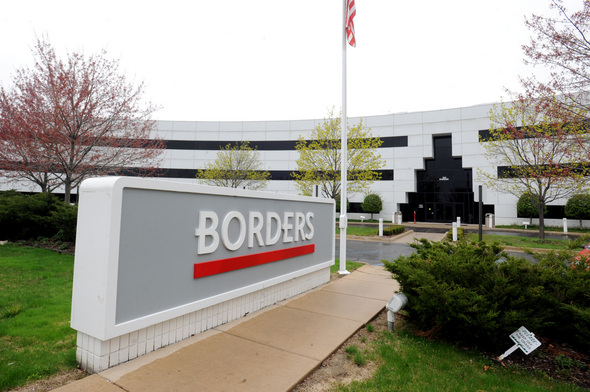
Borders employs more than 11,000 workers, including nearly 400 at its Ann Arbor headquarters.
Melanie Maxwell | AnnArbor.com
Borders, five months removed from its Chapter 11 bankruptcy filing, is running out of cash, and its hopes of surviving rest on an auction for the company's assets that is scheduled to take place Tuesday in New York.
A team of liquidators, led by Hilco Merchant Resources LLC and Gordon Brothers Retail Partners LLC, received preliminary approval on Thursday to become the leading bidder in the auction.
They are stepping in to serve as the so-called “stalking-horse” bidder after Najafi Companies, a Phoenix-based private equity firm, pulled out of its tentative deal to acquire Borders. Najafi — which owns Direct Brands, operator of the Book of the Month Club and Doubleday Book Club — had offered to buy Borders, but that deal effectively collapsed after landlords and publishers objected.
The developments don’t necessarily mean Borders will be forced to liquidate, experts said. Other bidders — including possibly Najafi — could step in and outbid the liquidators.
“We are hopeful that Najafi Companies and other potential bidders who are interested in operating Borders as a going concern will choose to participate in the auction,” Borders said in a statement, using a business term that refers to a operating company. “In the meantime, as the process moves forward, we continue to conduct business as usual.”
But if no one else emerges as a competing bidder, the liquidators are likely to win the auction.
In that scenario, the 11,000 people who still work for the company, including nearly including nearly 400 at the corporate headquarters on Ann Arbor’s south side, would lose their jobs. If the liquidation is approved, going-out-of-business sales could start as soon as Friday, according to court filings.
Even if Najafi or some other entity steps in to acquire Borders and decides to continue operating the company, it’s likely that more stores will close, industry observers say.
“The ideal outcome is for the fewest number of bookstores to close as possible,” said Michael Norris, a publishing industry analyst with Maryland-based Simba Information.
Borders declined to make its CEO available for an interview, and attorneys for the company did not respond to a request for comment.
The bankruptcy auction process can be a dramatic affair in which prospective bidders jockey to acquire assets for a good price, trying to out-maneuver each other and convince lawyers that their bid represents the best route.
It’s a highly unpredictable process, but possible suitors may “come out of the woodwork” by the July 17 deadline for submitting bids, said John Pottow, a University of Michigan law professor and a national expert on bankruptcy proceedings.
“A lot of these auctions are really auctions,” said “This could be a really interesting, really tense July 19.”
Bankruptcy auctions look a lot like the NFL Draft — with “guys wearing suits,” “little deal teams” and each group setting up “their own war room” to strategize and develop counter bids, Pottow said. Bankruptcy auctions can even drag on deep into the night.
“Judges can pull all-nighters, too,” Pottow said. “This could be a late thing. But it could be over in 45 minutes, you never know.”
According to bankruptcy filings, Borders received interest from 86 possible investors or acquirers. That list turned into 20 parties that signed confidentiality agreements to examine Borders’ financial data — after which five parties filed “non-binding indications of interest.” Two of those, including Najafi’s offer, were “for the majority” of Borders’ assets, attorneys said in the filings.
The other offer was believed to be from Los Angeles-based private equity firm Gores Group, which was competing with Najafi to be named as the leading bidder for Borders, according to the Wall Street Journal.
If the liquidators’ bid turns out to be most lucrative, Borders attorneys would be obligated to recommend that the court approve a sale to the liquidators, who would shut down the rest of the company’s stores.
Borders, in a court filing, estimated that a liquidation of all of the chain’s assets would yield between $252 million and $284 million.
Najafi, which declined an interview request, had tentatively agreed to pay $215.1 million in cash and assume about $220 million of liabilities. The firm emphasized in a statement that it was still interested in buying Borders, but its plans were disrupted when publishers objected Wednesday to the proposed sale.
The publishers, speaking as a committee of unsecured creditors, told the court that Najafi’s bid did not prevent Najafi from waiting a few months to liquidate Borders, pocketing the cash and keeping valuable intellectual property. They also objected to a proposed $6.45 million fee that would have been paid to Najafi if Borders picked a different suitor to buy the company. But that fee was scrapped when Najafi removed itself from consideration as the stalking-horse bidder.
If Borders is to be liquidated, the publishers said they want the process to be handled by the liquidators Borders has already selected — not Najafi.
"From day one, our intention had been to keep Borders intact and to provide the best long-term outcome for Borders’ loyal customers, publishers, employees and the entire book industry," Najafi said in a statement.
In any bankruptcy auction, the leading bidder is always the “the presumptive, odds-on favorite party to win the auction,” Pottow said.
Even if Najafi bids and wins the auction, it’s unclear how many stores will remain open. Najafi has not commented on what strategy it would pursue if it wins the auction, but most industry observers expect more stores to close.
Borders — which currently operates about 400 stores, including more than 100 small-format locations — has closed more than 230 superstores since its bankruptcy filing.
The company had hoped to reorganize under Chapter 11 bankruptcy and reemerge in September as a profitable company, ready to capitalize on the lucrative holiday shopping season. But that plan fell apart as losses continued despite the closure of unprofitable stores.
For Ann Arbor — the home of Borders since it was started 40 years ago as an 800-square-foot shop on South State Street by brothers Tom and Louis Borders — the outcome of the auction is of supreme importance.
It’s not clear how a sale of Borders as an operating company would affect the 400 workers employed at Borders’ headquarters or the two remaining stores in Washtenaw County: the flagship location on Liberty Street in downtown Ann Arbor and the superstore on Lohr Road in Pittsfield Township.
Private equity firms often decide to consolidate operations in a bid to restructure struggling companies and return them to profitability. But they often choose to invest in technology development or infrastructure needed to make the company successful.
One of Borders’ many challenges is that the company has had no spare cash to invest to develop its own electronic books reader or upgrade its stores in recent years.
“Borders has had a lot of problems over the past eight years and some of it has been of their own making and some of it has been poor retailing circumstances,” Norris said. “What Borders needs more than anything is a clear vision in terms of what it’s going to do for the next several years as a retailing entity, and it also needs to create one cohesive system to satisfy the customer.”
He added: “There needs to be leadership at Borders that ties everything together and really explains to people why a bookstore matters.”
Contact AnnArbor.com's Nathan Bomey at (734) 623-2587 or nathanbomey@annarbor.com. You can also follow him on Twitter or subscribe to AnnArbor.com's newsletters.
Comments
rm
Sun, Jul 17, 2011 : 8:54 p.m.
This may in part be a game of chicken -- uh, excuse me, hard-nosed negotiations -- among these players. The article notes that Najafi " had offered to buy Borders, but that deal effectively collapsed after landlords and publishers objected." With any luck, the landlords and publishers, faced with liquidation and a likely less favorable resolution for them, may rethink their demands and permit a deal that keeps a (further-shrunken) chain of bookstores in business. It seems that the currently proposed liquidation plan would close all the bookstores. Why can't the liquidation include selling some of the stores as stores to other chains? Maybe the answer is: Amazon, and there are no other bricks and mortar bookstores. At least it's true that the flagship location next to campus would be a fine location for an independent bookstore, assuming the landlord doesn't prefer the rent available form a tee-shirt shop, restaurant, or whatever.
Huron74
Sun, Jul 17, 2011 : 5:35 p.m.
Changes in demographics and technology are going to render selling dead-tree editions less and less viable as a business. You can't have premium wine shop on every corner (unless you have a very wealthy and wine-loving population). On the other hand you can and often do have lots and lots of party stores that sell common brand wines, liquors, and beers. That's the way it's going for books too. More & more bookstores are going look like the ones at airports and shopping malls. Lots of common stuff. For the "good stuff" (whatever that means for you) will have to seek out yard sales, private sales (eBay and Craigslist) or funky used bookshops. In time only the real bibliophiles will read from paper at all. All the rest of the hoi poloi will read digitally if they bother with reading at all because it's cheaper and faster (not to mention way more profitable) and which is what our culture does best. How I see it.
debling
Sun, Jul 17, 2011 : 5:02 p.m.
Even if they liquidate and sell off their inventory, I bet I still can buy the same book cheaper at Amazon.
arborlib
Sun, Jul 17, 2011 : 3:53 p.m.
What will happen to the employees at the corporate office once this auction is over?
Jack Gladney
Sun, Jul 17, 2011 : 4:32 p.m.
I don't think Borders can auction off the employees so they can continue to show up for their jobs as usual. And their retail employees can roam various malls across America. Seriously?
Ken
Sun, Jul 17, 2011 : 3:11 p.m.
Their first big mistake was in not jumping into internet sales sooner; seems like it should've been a no-brainer, with their supply and distribution network already in place, and a decade ago they could have scooped up Amazon just as it was emerging as a strong business model- and hopefully leave them the heck alone to develop it using using existing resources where possible. Then, as they started losing market share, the "solution" was to replace book-lovers with bean counters. Hiring accountants is a great way to boost short-term profits by shrinking a company, but they make horrible long-term business decisions because they often fail to see the big picture, and have no vision of what the future will and could hold- it's all about slashing anything that isn't making money right now. Once a company starts going down that path, its days are numbered; you can't cut your way into growth and prosperity; few new ventures make money right out of the gate, and no one is going to invest in a company that is in slash-and-burn mode and has no vision except the same failing business model. Works the same way with government; once you start slashing services and "value-engineering" those that remain, the quality of life starts declining, and all the tax breaks in the world won't lure people to invest in the community. The whole thing is really sad; the lack of vision, lack of guts, and unwillingness to adjust to a changing marketplace seems to be a virus that has infected most of Michigan's once-dominant major companies.
Goober
Sun, Jul 17, 2011 : 4:38 p.m.
Agree - well said. As I have stated before, this same holds true for both our school board and city council - a lack of true, visionary leadership. This will take us down paths that we do not wish to travel.
John B.
Sun, Jul 17, 2011 : 4:22 p.m.
Well-said! Thank you for the thoughtful post. Not sure that they could have ever acquired Amazon, but the rest of your comments are spot-on.
Sallyxyz
Sun, Jul 17, 2011 : 2:08 p.m.
If the flagship store in downtown A2 closes, which is a ghost of its former self, that will leave a big retail hole in a prime location. Please do not fill that space with tee shirts, UM-wear, a restaurant, bar or a coffee shop. Independent bookstores are thriving in other locations around the country (Portland, OR, --Powells's, and Cambridge, MA, --Harvard Square Books, Porter Square Books, etc), but unfortunately, A2 real estate developers are so greedy that the only businesses that can survive in A2 commercial areas have to be very high profit (restaurants, bars, clubs, overpriced "gift" shops, etc). The city needs to put a cap on rents to allow other businesses to survive.
D8ton
Sun, Jul 17, 2011 : 4:55 p.m.
Hmmm....I'm thinking that large, soon-be-empty flagship location on Liberty would be an ideal location for a department store!
John B.
Sun, Jul 17, 2011 : 4:19 p.m.
I tend to agree with you, except for your last sentence. Good luck with trying to institute commercial rent control....
Huron74
Sun, Jul 17, 2011 : 12:35 p.m.
Not to dismiss Border's bad management decisions but the nature of the book itself has changed. We're moving backward in time to the days when books were only for well-off literate people. As a book lover myself I have been dismayed over the years at purchasing a well reviewed book only to get home read it through and find that it wasn't all that and then just put it on the shelf where they sit forever. Many of those books still sit there to this day taking up space and collecting dust and I am rueful at the $20-$60 that is gone forever every time I look at them. As much as I like the form of dead tree editions I find that Kindle editions (which cost $10-$20 typically) are much more convenient and if the book sucks it is no great loss of money or space.
MikeB
Sun, Jul 17, 2011 : 1:14 p.m.
I agree with you. It is easy to blame Borders management but the handwriting has been on the wall for a long time and Borders never made the changes necessary to be successful. Case in point - they for a long time let Amazon fulfill their online orders making a good (not great) tactical decision that left them completely unprepared for the shift to the internet for ordering and sales them to ebooks. OK tactics (saved money) but a very flawed strategy. I am not sure they could have stemmed the tide but they were unprepared for the future even when it was no longer speculative
D8ton
Sun, Jul 17, 2011 : 12:03 p.m.
As someone who remembers the original Borders (and believes it has been downhill ever since), I recommend you return to the location on State as a "used and unique" shop. Start over as if none of this expansion stuff ever happened. Who needs three t-shirt shops in a row...geez. All will be forgiven and forgotten.
John B.
Sun, Jul 17, 2011 : 4:16 p.m.
I'm afraid it's way too late to do that. Not even remotely likely to happen.
Caferacer
Sun, Jul 17, 2011 : 12:10 p.m.
D8ton- You nailed it. They lost their focus on the core business... BOOKS. All the other junk is just clutter... Sell books and create an atmosphere around them and they can survive this mess.
Caferacer
Sun, Jul 17, 2011 : 11:46 a.m.
I blame the CEO and management of Borders! This never should have happened and I hope they understand their failure and the impact it has had on so many. Sad!