

Ann Arbor's last hookah bar reports strong sales, but national advocates say it's deceivingly unhealthy
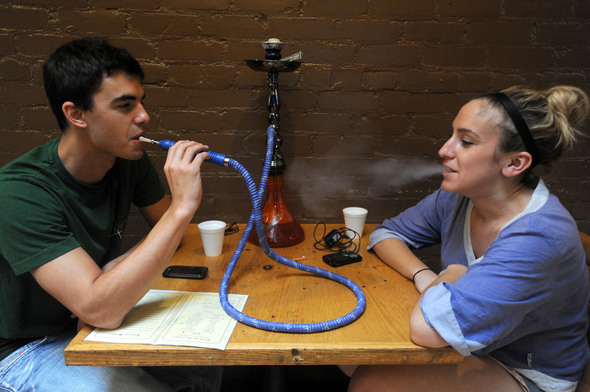
Ann Arbor residents John Deirala, 21, and Laura Peretick, 20, share a hookah at Smoka Hookah Lounge on South University in Ann Arbor.
Angela Cesere | AnnArbor.com
Opposition to hookah — a water pipe that is commonly used to smoke flavored tobacco — is building among national healthy living advocates and some political leaders.
One study showed that an hour-long waterpipe smoking session involves inhaling 100 to 200 times the volume of smoke inhaled with a single cigarette.
Some experts say that the emerging movement against hookah bars could threaten the future of the business, but the last remaining hookah bar in Ann Arbor is doing just fine.
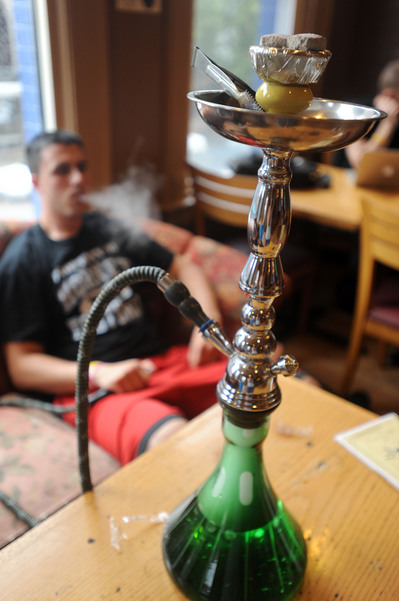
Kyle Saukas, 18, smokes hookah at Smoka Hookah Lounge in downtown Ann Arbor.
Angela Cesere | AnnArbor.com
“We have a ton of business from hookah,” said Ahmad Almusawi, assistant manager of the Smoka Hookah Lounge, located at 1108 South University Avenue. “We’re really busy, especially on the weekends.”
Just a year after Michigan’s statewide indoor smoking ban took effect, multiple hookah bars across the state have closed down due to the stricter requirements placed on hookah businesses, said Regina Calcagno, a representative with the Michigan Department of Community Health.
Smoka Hookah Lounge, which is located on the second floor of the building above Rendezvous Cafe, had to make changes to comply with the smoking ban, too.
Under the law, Rendezvous Cafe was forced to separate its hookah lounge into an entirely new legal entity. To abide by the new state regulations, Rendezvous owner Naizar Alwar last year started the Smoka Hookah Lounge.
“All we did is basically open another business,” Almusawi said. “We had to make two doors instead of one and change the name. We cannot sell food or alcohol, and if you order food from Rendezvous to take upstairs, it has to be to-go.”
For Smoka Hookah, the process was fairly simple. But other bar owners weren’t as fortunate, Almusawi said.
“We were set up for this,” he said. “But a lot of places closed because you can’t really separate a basement from the upstairs without it costing a lot of money.”
Michigan’s Smoke Free Air Law banned smoke in all restaurants, bars and businesses beginning in May 2010. However, the law provided an exemption allowing hookah bars to qualify as a tobacco specialty retail store if the business doesn’t serve food or liquor. The law also prohibits new hookah bars from allowing smoking.
But complicating matters for hookah bar owners is an emerging movement among health activists to raise awareness of the damage hookah smoke can do to your body.
“We’re very concerned about hookah bars because hookah is dangerous, but a lot of people perceive it as being a safe thing to do,” said Shelly Kiser, director of advocacy with the American Lung Association. “Sometimes hookah smoking has more dangers than cigarettes.”
According to a health study conducted by the World Health Organization in 2005, Kiser’s claim has some support.
Among the findings in the study:
--After spending an hour smoking hookah in a bar, users have inhaled about 100 to 200 times as much smoke as they would with a single cigarette.
--Smoke from a waterpipe contains toxins known to cause lung cancer, heart disease and other diseases.
--Hookah smoking sessions often last longer than cigarette smoking, with smokers inhaling 50 to 200 puffs of tobacco.
--Sharing a waterpipe mouthpiece poses a serious risk of transmission of communicable diseases, including tuberculosis and hepatitis.
[Download a PDF of the study here]
Health activists are also concerned that since waterpipe tobacco is flavored, it’s more appealing to young people.
These findings have prompted anti-hookah legislation in other states, according to a recent New York Times report that drew more attention to the issue.
Boston and Maine ended exemptions for hookah bars, while lawmakers in California, Connecticut and Oregon have introduced bills that would ban or limit hookah bars, the Times reported.
Calcagno of the Michigan Department of Community Health said that she is not aware of any pending legislation to ban hookah bars in Michigan, but there are educational efforts to raise awareness about the issue.
“A lot of groups around the state have done a tremendous amount of work to inform their peers that hookah is not as safe as they think it is,” Calcagno said. “It’s not healthy by any stretch of the imagination.”
After passage of the Michigan Smoke Free Air Law and the University of Michigan’s decision to ban smoking on campus starting Friday, Calcagno wonders whether anti-hookah legislation is only a matter of time in Michigan.
“Legislative efforts could definitely come about because this is in the spotlight right now,” she said.
Almusawi said he is not particularly concerned about the prospect of an anti-hookah movement in Michigan. But he argued that hookah smoking should be preserved because of the social and cultural purpose it serves.
“A lot of people are taking these attacks offensively,” Almusawi said. “Hookah smoking is a cultural thing. This is what they do all over the Middle East. Plus, it’s a social activity. People don’t want to sit at home and smoke hookah, they want to get out and see people.”
Almusawi acknowledged that hookah smoking could be addictive, but he argued, “It’s definitely not worse than cigarettes, I’ll tell you that. People don’t come here every day to smoke. It’s just a once-in-a-while kind of thing.”
Lizzy Alfs is a business reporter for AnnArbor.com. Reach her at 734-623-2584 or email her at lizzyalfs@annarbor.com. Follow her on Twitter at http://twitter.com/lizzyalfs.
Comments
Wolf's Bane
Mon, Jun 27, 2011 : 6:53 p.m.
I smoked for 20 years. It was the single most dumbest thing I ever did in my life thus far. If you smoke, quit. If you don't, please don't start.
Charlie Brown's Ghost
Mon, Jun 27, 2011 : 1:19 p.m.
Hookah is just the latest young adult campus fad that lets them pretend to be deep and worldly. Good Night and Good Grief
mohomed
Mon, Jun 27, 2011 : 2:25 a.m.
How is this even news? Your never going to make it with the big boys AA News with stories like this, WOW. I would rather read statistics from UM's girl soccer team.
a2citizen
Mon, Jun 27, 2011 : 2:48 a.m.
<a href="http://www.mgoblue.com/auto_pdf/p_hotos/s_chools/mich/sports/w-soccer/auto_pdf/sow-statistics-2010" rel='nofollow'>http://www.mgoblue.com/auto_pdf/p_hotos/s_chools/mich/sports/w-soccer/auto_pdf/sow-statistics-2010</a>
leaguebus
Mon, Jun 27, 2011 : 12:53 a.m.
As long as people do this voluntarily, why should anyone care? Kill off the cigar bars next? Sorry, as long as I don't have to breathe the smoke, I don't care. We all should have the right to choose our own poison!
timjbd
Sun, Jun 26, 2011 : 6:28 p.m.
"One study showed that an hour-long waterpipe smoking session involves inhaling 100 to 200 times the volume of smoke inhaled with a single cigarette." 200 cigarettes an HOUR? Hookah smoking kids- quit smoking while you're still young enough to recover! Take it from someone who lost both parents to lung cancer...
a2zyzzyva
Sun, Jun 26, 2011 : 7:35 p.m.
Chrissa, if you want to know more about the study, you can click on the link provided in the story. It will take more effort to read the original article cited in the WHO report, but references were provided.
timjbd
Sun, Jun 26, 2011 : 7:11 p.m.
I am not the government.
Chrissa
Sun, Jun 26, 2011 : 6:55 p.m.
I'd be interested to know more about "one study' I don't smoke hookas, but I also don't walk around pointing my finger at others telling them what to do with their bodies. It's a hooka bar in which attendance only serves one point-which doesn't infringe on you. I am so sick of big government. Cheetos aren't good for you, when will our cupboards be subjected to random search and seizure? I just think there's a point where it all gets a tad silly.
xmo
Sun, Jun 26, 2011 : 2:48 p.m.
We bend over backwards not to racial profile with Police Officers and TSA workers at airports but here we are attacking the Muslim religion and Middle Easterners! "This is what they do all over the Middle East. Plus, it's a social activity." Do we want middle Easterners in this country or not?
Gordon
Sun, Jun 26, 2011 : 2:29 p.m.
AH, one should have the right to affect ones own health as long as that doesn't affect others. That's a simple defination of freedom of choice. Where they are more and more of us more and more of us give up a little of our individual rights because of the effect it has on others. Simply, smoking creates health problems for the majority of people therefore costing those who do not smoke increased health care cost thorough premiums. Arguably not everyone will be on Health plans; but at this point in time hospitals do expend money on those who don't have, can't afford, insurance or pay for their care. We, who do have insurance or can pay, pay for those who don't thorough various systems. Not a big step to realize that lungs were not fashioned to inhale anything except natural air. Check the States budget (everyone complains about) and see what are the largest expenditures. Reduce that cost / demand and other programs would benefit. An ex-smokers reason for cold turkey.
kilroy
Sun, Jun 26, 2011 : 2:17 p.m.
After marijuana dispensaries and hookah bars what's next for Ann Arbor, opium dens?
Wolf's Bane
Mon, Jun 27, 2011 : 11:12 p.m.
I'm sure they're already working on it...
Gorc
Sun, Jun 26, 2011 : 3:42 p.m.
Public bath houses.
a2citizen
Sun, Jun 26, 2011 : 2:03 p.m.
Didn't they just have a hookah sting operation in Ypsilanti? Oh? Oops. Nevermind
Dr. Webster
Sun, Jun 26, 2011 : 1:13 p.m.
Hooka say what is right or wrong for any adult to choose? Even God Almighty gave man freedom of will to choose. Hooka are you, to even think you have the right to impose or judge what God has not? In the words of John Lenon, "Let it be!"
a2citizen
Sun, Jun 26, 2011 : 2:05 p.m.
Actually, those were Paul McCartney's words.
cinnabar7071
Sun, Jun 26, 2011 : 12:17 p.m.
"We're very concerned about hookah bars because hookah is dangerous, but a lot of people perceive it as being a safe thing to do," said Shelly Kiser Really Shelly? Who would these people be that perceive smokeing a hookah is safe? That staement is insulting to the Human Race.
thehawk
Sun, Jun 26, 2011 : 12:42 p.m.
Really cinnabar? Have you no contact with the large percentage of the population that refuse to use their brains for even the simplest bit of common sense?
Wolf's Bane
Sun, Jun 26, 2011 : 11:44 a.m.
This 'Smoka Hookah' establishment violates the intended goal of Michigan's indoor smoking ban and simply put, continues to expose many people to the harmful effects of tobacco smoke. Establishments, including Casinos should no longer be exempt from what the law's primary intent was, namely, to reduce health insurance cost for preventable smoking related illnesses. Smoking is a very selfish act and burdens the rest of us non-smokers (taxpayers).
Wolf's Bane
Mon, Jun 27, 2011 : 12:51 p.m.
Hey Chrissa, so, according to you, it is enough that I don't frequent smoking bars, right? However, I still get see my tax dollars spent (via medicare) on preventable smoking related issues instead of, say, education? You fail to see the larger picture...
Chrissa
Sun, Jun 26, 2011 : 6:50 p.m.
Then don't frequent Hooka bars, Bill. Easy peasy.
justcary
Sun, Jun 26, 2011 : 6:10 p.m.
Actually I thought the law's primary intent was to make workplaces safer for employees. I never got the casino exemption, except that it was purely money and politics. But until smoking is made completely illegal I'd rather have smokers hang out in hookah bars than smoke on the street or at the entrances to buildings.
sbbuilder
Sun, Jun 26, 2011 : 5:30 p.m.
DDot1962 Maybe I missed it, but could you point us to the 'name' being called?
Gorc
Sun, Jun 26, 2011 : 3:42 p.m.
Bill - if you voluntarily enter a hooks bar, shouldn't you expect to be exposed to second hand smoke? I agree with you regarding the casinos, but an establishment that is specifically for smoking. Second hand smoke should not be an issue in this case.
DDOT1962
Sun, Jun 26, 2011 : 2:28 p.m.
Ooohhh...yes! Name-calling is always the resort of the best minds.
Wolf's Bane
Sun, Jun 26, 2011 : 12:54 p.m.
I never heard of anyone complaining about second hand... Skydiving, motorcycles, white-water kayaking, urban bicycling...? Maybe its time for you to go back to school?
DDOT1962
Sun, Jun 26, 2011 : 12:43 p.m.
Let's face it, there's an infinite number of activities that could be considered selfish, dangerous, burdensome AND avoidable to taxpayers or the insurance pools. (Skydiving, motorcycles, white-water kayaking, urban bicycling to name a few.) As long as the inadvertent dangers to non-smokers have been addressed, as in confining hookah smokers to their own, enclosed establishment, I see no reason to encroach further on these businesses which have been operating LEGALLY for years now.
TinyArtist
Sun, Jun 26, 2011 : 11:11 a.m.
It looks kind of silly -- a traditional Middle Eastern cultural activity with cell phones at the ready -- but if people are aware of the health risks and still want to smoke socially, why not?
seldon
Mon, Jun 27, 2011 : 1:44 p.m.
Do you think the Middle East is still back in 1900 or something? They have cell phones there, you know.