

Car companies' new problem: Young people who don't want a driver's license
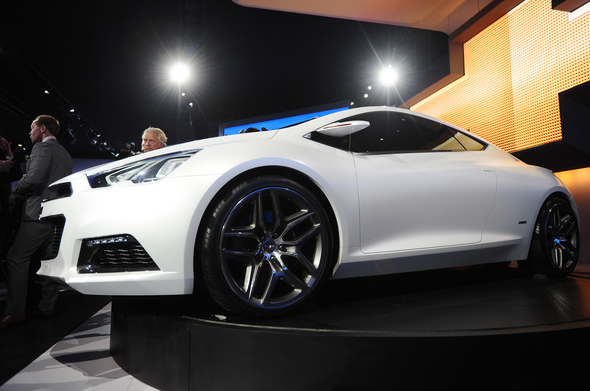
General Motors integrated input from young adults into the design of two new concept vehicles, including the Chevrolet Tru 140S.
Melanie Maxwell | AnnArbor.com
(Related story: Detroit auto show: Auto companies try to appeal to Millennials)
Here’s a quick way to summarize many young people’s attitudes toward obtaining a driver’s license: Meh.
It may be a welcome development for worrying parents, but it presents a problem for carmakers, which view apathy for driving among teenagers and twentysomethings as a looming obstacle.
Several automakers used their news conferences Monday and Tuesday at the 2012 North American International Auto Show in Detroit to show off their youthful vehicles and boast about how they’re going to appeal to young car buyers.
Their claims come as academic research confirms what many parents have suspected: Getting a driver’s license is not as cool as it used to be.
A University of Michigan Transportation Research Institute study published in the journal Traffic Injury Prevention found that 75 percent of 19-year-olds had their driver’s license in 2008, down from 87 percent in 1983.
Among 18-year-olds, 65 percent have their license, down from 80 percent in 1983; among 17-year-olds, it’s 50 percent, down from 69 percent; and among 16-year-olds, it’s 31 percent, down from 46 percent.
One of the biggest reasons why fewer young people are driving is simple: social media.
“Virtual contact through electronic means reduces the need for actual contact among young people,” study author Michael Sivak said in an email.
That confirms research conducted by John McFarland, senior manager of global marketing strategy for General Motors’ Chevrolet brand.
“Their digital identities are inseparable from who they are in their day-to-day lives, at home, at school and at work,” McFarland said at the auto show. “How those relationships develop and the meaning of digital interactions are quite different than generations that came before, which potentially reduces the need for as many face-to-face interactions. There are simply easier alternatives.”
Sivak said there are other culprits to blame, too. First, the economy “makes it more difficult for young persons to own a vehicle,” he said.
But young adults are also more likely to live in major cities, where mass transportation makes car ownership an option, and they're more likely to be concerned about carbon emitted by vehicles.
Not all of the auto companies are convinced the trend presents a major problem.
“I think most people do need and want cars in our North American vehicle market,” said Bruce Brownlee, senior executive administrator for external affairs at the Toyota Technical Center.
One reason for the automakers to be encouraged is that more senior citizens are driving. Some 70 percent of ages 70 and older had their driver’s license in 2008, up from 55 percent in 1983.
Perhaps more concerning for automakers is the state of their image among young people, including those who do drive.
“While these consumers are passionate about tech brands such as Apple, Google, Facebook as well as some more traditional brands like Nike and Target, what we see is that auto brands as a whole fall somewhere in the middle, somewhere between disinterest and complacency,” McFarland said.
That’s why the auto companies are focused on integrating new entertainment systems and digital connectivity systems into their new cars. It’s part of a bid to change their image and appeal to consumers.
GM is also inviting young consumers to provide input to help shape the future of its vehicle development, which already led to two new concept cars: the Chevrolet Tru 140S and the Chevrolet Code 130R.
“We don’t believe you can lump 80 million people into one group and pretend to understand them,” McFarland said. “Just as consumers before them, this new generation of car buyers has very diverse needs and wants.”
Contact AnnArbor.com's Nathan Bomey at (734) 623-2587 or nathanbomey@annarbor.com. You can also follow him on Twitter or subscribe to AnnArbor.com's newsletters.
Comments
pscsteve
Thu, Jan 26, 2012 : 8:14 p.m.
Most young kids don't work. It's pretty simple. They are required to get good grades and do loads of community service to get into the better universities, which makes actual work difficult. Plus, simply put, most kids are spoiled. They have Kindles, iphones, etc...and most parents don't want to have their precious kids actually have to work for something.
a2trader
Mon, Jan 16, 2012 : 3:26 a.m.
My son didn't get his license until he was nearly 17 1/2. The article, from our experience is right on. Unlike all the arguments put forth in these comments, being able to afford drivers ed, afford a car, or access to public transit didn't apply. We live in the boonies where there is zero public transit. We already had a third car for him to drive. And he had long since finished taking the required drivers ed courses. We are paying for insurance so that was a non-issue. My son only finally got his license because he wasn't about to let his little sister get her license first (how embarrassing would that be?). We didn't push him, but we also didn't enable it. The mantra in our house became, "well we might be able to pick you up at 5pm. Sorry if you are going to be ready at 4pm. Find a ride if you want to come home sooner. Too bad you don't have your license and you could just drive yourself home." Ultimately, I would say the biggest disincentives for getting the license were: electronics (Skype, Facebook, XBox all allow you to hang out) and the ridiculous new license restrictions that don't let this kids hang out and then drive home past 10pm, anyway. Geez. When you were a teen, did you really want to leave your friend's house at 9:45 so you could get home? Might as well just stay home in the first place. His friends were no different. There are several he knows that STILL don't have their licenses.
kathryn
Sun, Jan 15, 2012 : 10:53 p.m.
My young adult children both do not drive. They walk, they ride bikes, or they take the bus or the train. Saves them lots of money! I'm glad to see that they didn't buy into the car-obsessed.
Tesla
Mon, Jan 16, 2012 : 12:44 a.m.
I can see them all waiting in the cold for a bus on christmas morning trying to get to grandmas. lol
scott
Sun, Jan 15, 2012 : 3:57 p.m.
Ahhh the failure of normative speech, "you can't be too safe" is finally crashing down....glad we didn't get to the bubble wrap helmets first....
aamom
Sun, Jan 15, 2012 : 1:51 p.m.
I don't know.......that Pioneer parking lot sure looks pretty full to me on school days.
Rick Neubig
Sun, Jan 15, 2012 : 1:13 p.m.
The train from SEATAC into central Seattle is $2.75 and runs every 10 minutes. No wonder we're losing young people in SE MI.
Melissa
Sun, Jan 15, 2012 : 5:04 p.m.
While an efficient mass transit system is nice, I really don't think that's a major reason why young people are leaving. I and most of my college friends had to move away to find jobs. If there were opportunities in SE Michigan in my field, I would stay in Ann Arbor.
braggslaw
Sun, Jan 15, 2012 : 1:06 p.m.
The boomerang generation of self entitlement is upon us. Live with your parents, have them foot the bill, and play X-box Live or world of warcraft all day.
scott
Sun, Jan 15, 2012 : 3:57 p.m.
Your generation has no right to judge ever....you have failed completely, you are a failure....
eastsidemom
Sun, Jan 15, 2012 : 11:30 a.m.
Since schools quit offering driver's training the cost of such training has risen beyond the ability for families to pay for it in many cases. Then add on the cost of insurance gas and maintenance and kids are overwhelmed with costs they can not afford (or their parents cannot either). New cars costs as much as our first home and at a time many kids are considering college (another run away cost) there is no money for cars :( either.
johnnya2
Sun, Jan 15, 2012 : 6:18 a.m.
Social media as the reason? No, it is the ability to get places without needing a car, and the hassles (insurance, gas, parking ) of actually driving. I have many friends who live in large cities that do not have cars, and some do not have a license. Why? Subway, bus, cabs. The extra expense of paying a couple hundred a month for a parking space, then paying for gas and a few hundred for insurance seems silly. The largest population is int he cities of this country. Have you tried owning a car in NYC, San Francisco or Chicago? I know I could not afford one in those cities as a teenager.
Huron74
Sun, Jan 15, 2012 : 4:47 a.m.
Whoa nelly! How will the PTB in Lansing and DC ever keep track of people without DLs? DLs are in fact America's national ID even if it ain't "official". What next for those crazy kids? No social security number? Why there ought to be a law! Where's Rep. Irwin when you need him?
kathryn
Sun, Jan 15, 2012 : 10:50 p.m.
You don't need a driver's license to have an ID...you go to secretary of state and get an ID card. Both my (non-driving) young adult children have them.
Sallyxyz
Sun, Jan 15, 2012 : 2:50 a.m.
Good for these young people. Insurance rates are through the roof for young drivers, accidents are more likely in this age group, and if they can manage to get around without a car, hats off to them. Not everyone needs to be obsessed with car ownership. Bravo!
mike gatti
Sat, Jan 14, 2012 : 10:10 p.m.
It has to do with parents acting less as parents and more as servants or buddies. who wants independence from your failthful servant?
CynicA2
Sat, Jan 14, 2012 : 9:28 p.m.
It is too bad that cars are out of reach of so many people now... not just young ones - because driving, save perhaps in rush hour traffic - is fun and relaxing. I love being able to take a ride in the country during the fall color change, stop for some cider and donuts, plus run a couple of errands on the way home - all on my own good time, with no waiting for buses, or anything else, save the traffic lights. Freedom is good.
G. Orwell
Sat, Jan 14, 2012 : 9:19 p.m.
"and they're more likely to be concerned about carbon emitted by vehicles." Consequence of pushing a lie that CO2 causes global warming. It has negatively affected Michigan's already week economy and put many more people into poverty. The whole AGW is designed to deindustrialize the US economy by reducing manufacturing. We see the effects here in Michigan and throughout the country. Clean coal power plants are being shut down, airlines are being taxed for carbon, water is being cut off to entire counties in California, etc.
Lovaduck
Sat, Jan 14, 2012 : 7:40 p.m.
When I was young I waited, since I lived in an East Coast city with public transportation which was good. When I came out to Michigan to go to Grad School at 22, the fact that I hardly drove made people consider me the ultimate weirdo. A psych major actually accused me of being afraid of sex, 'cause you needed a car to get any (and to perform in). I used to think that Michigan folks were BORN with a steering wheel in both hands! Anyway, wow, how times have changed. The only sad comment I have is how you say that social media have taken down the need for genuine contact. I find that sad because I see young folks out on dates with everyone on their cell phones. I, if I could be magically young again today, would miss the great conversations we had over coffee and / or a brew of some sort.
YpsiVeteran
Sat, Jan 14, 2012 : 6:36 p.m.
The article's about kids trending away from getting driver's licenses, not about kids not buying cars. Not many people I knew had any interest in immediately buying a car, but they all wanted their licenses as soon as they could possibly get them. They wanted to separate a little from their parents and exercise some independence. I think so many kids not wanting their licenses now has more to do with the fact that we have had a couple successive generations of kids who reach the age of 16 or 17 having never spent any time, other than school, away from their parents. The thought of "independence" is completely foreign, and in many cases terrifying, to them. They get to college and their parents are still doing their laundry, picking them up and dropping them off, solving all their problems for them, communicating with their profs for them. It's pathetic.
Heather Harmon
Sat, Jan 14, 2012 : 4:23 p.m.
I guess the logic here doesn't make sense to me. I got my license when I was sixteen and, just like my parents, have been driving a used car generously loaned to me by my parents for the last year and a half. Since when has the purchase of a new car been a normal thing for young people to do? Even coming from a teenager in the upper-class city of Saline, I don't know of a single high school student here who purchased their own BRAND NEW car. '92 Corollas for a couple hundred bucks is sort of the norm. Only a handful of kids here have a brand new Mustang or BMW purchased out of daddy's pocket. The relationship that that has with not having a license makes very little sense to me.
A2K
Sat, Jan 14, 2012 : 3:39 p.m.
New Car = major expense. Who wants or needs that? Then, if you couple a student loan payment with a car payment and there's $500-$700 out the door every month before you've paid for anything else. My husband and I are in our mid-30s and most of our friends and workmates who are a few years older are OBSESSED with make/model of their (and other people's) cars. Who has the fastest, who has the coolest doohickies on their car, which costs the most, etc. It's ridiculous. We've never cared about any of those things. Some people intensely desire material objects to show the world that they are successful (or at least create a veneer that they are). Most friends and workmates who are younger couldn't care less about what kind of car, cost, etc.
superhappyfunbrett
Sat, Jan 14, 2012 : 5:35 p.m.
"Some people intensely desire material objects to show the world that they are successful (or at least create a veneer that they are). Most friends and workmates who are younger couldn't care less about what kind of car, cost, etc." 100% agree. Every generation has a way of creating exclusiveness amongst it's membership. But for the most part, this current one coming up is a lot less concerned with consumerism compared to the previous couple generations. If anything, young people are information elitists. You can argue why it's happening (they are smarter, they are dumber, the economy stinks so they are taking what they are being given... blah blah blah) but the overall trend is obvious if you're around young people: Content of character/brain is more important than what they or someone else has. Personally, I hope that mentality sticks around.
Technojunkie
Sat, Jan 14, 2012 : 3:30 p.m.
Guess I was ahead of my time, partially. I've bought cheap, high-mileage used cars, driven them as little as possible, and made them last. I figured, correctly, that the expense of living in the city is less than the transportation expense and inconvenience of long commutes. Not having debt from rapidly depreciating new cars saved my neck when everything fell apart a few years ago. If I could get my act together I'd grow much of my own food and have much of the rest delivered, saving the nuisance of grocery runs. Buying from CSAs would probably also work. Then even my minimal car expenses would be tough to justify. If I still had money I'd buy a cargo bike like an Xtracycle. Expensive, but trivial compared to a new car. Had I been really smart I'd have stayed out of the stock market and paid down my mortgage during the fat years. Interesting how many of the things that we're supposed to do merely create expensive dependencies. Anyhow, spending a house down payment on a new car never made sense to me.
Soothslayer
Sat, Jan 14, 2012 : 3:29 p.m.
Welcome millennials. Unless you're talking hight tech communications, entertainment or gadgets they're not at all interested in partaking in the rat race of conspicuous consumption that defined the boomer era (thankfully it's passing). Guess they see driving around all day to work or "entertainment" as wasting time and energy and want to spend their time differently. They're not going to be bothered with the auto show and they think the Dream Cruise is stupid. Go figure as you'll need to.
Rod Johnson
Sun, Jan 15, 2012 : 4:31 p.m.
Coming into their own? Haven't they (OK, we) been pretty much dominating American culture for the last 40 years? Boomer time is drawing to a close, except for their Social Security years.
Blanch DuBois
Sun, Jan 15, 2012 : 2:02 p.m.
@eastsidemom....it taint over, but it has peaked.
eastsidemom
Sun, Jan 15, 2012 : 11:31 a.m.
the boomers are just coming into their own...it taint over Soothy
Rod Johnson
Sun, Jan 15, 2012 : 7:01 a.m.
I'm not a millennial, but I have to agree about the Dream Cruise.
Trevor Staples
Sat, Jan 14, 2012 : 3:23 p.m.
Another reason a teen may not want a driver's license is that now it costs money for the individual. I took driver's ed. around 1983, the year the article and research references. My classmates and I took driver's ed. through the AAPS for "free" (of course, everyone paid for it through taxes). Now, teens must pay a private company to take driver's ed classes. Many teens (and parents) probably look at the cost of driver's ed., as well as purchasing/maintaining a vehicle, and consider other transportation alternatives. Also, with the Graduated Driver's License in Michigan, teens cannot get a full license until they are 17 years old (as long as they have 12 months of safe driving under their belts). Back in '83, a full license was awarded at 16. In that extra year a teen has to wait to receive their full license, they surely find other modes of transportation, and see driving their own car as less essential. Rising insurance costs, fuel prices, and the increasing costs of purchasing and owning a vehicle probably encourage teens to view driving as a non-essential part of their lives. The other reasons listed in the article and comments are valid as well. However, everything I've seen and heard from the auto companies reeks of "used car salesman". They see the reasons for teens not wanting cars, and their top solution is slicker advertising. Adding Facebook and Pandora to cars to attract young drivers is hilarious. Why would any teen who can already use those features anywhere/anytime through their phone, get excited about it being in an expensive car? If the auto companies would focus on making their cars reliable, economical, energy-efficient, comfortable, AND fun (in that order), they'd probably be able to inspire more teens to want to drive.
spm
Sat, Jan 14, 2012 : 6:38 p.m.
All true. AA schools had half semester driving classes that my parents didn't need to shell out more money for. On my 16th birthday in 1979 I got my drivers license and my dad's 1969 Olds to drive to school. I'm not sure kids who aren't seniors can even drive to school nowadays. With all the hoops (ans costs) they jump through now I can see why they might not be as interested to drive.
dexterreader
Sat, Jan 14, 2012 : 3:13 p.m.
@Urban Sombrero ... I echo your sentiments. Both of my kids got their license within the past 7 years and could not wait to turn 16, while I sat back and watched several of their friends take a very "laissez-faire" attitude about the whole thing. I also wondered why mine didn't fall into that category!! But I must say ... I did appreciate not having to chauffeur them everywhere!! Way back when I turned 16, it was "the thing" to do on your 16th birthday .... go and get your official license. It was a huge step in the passage to adulthood. The current trend toward not driving does surprise me.
jcj
Sat, Jan 14, 2012 : 3:03 p.m.
Nathan "the impact of tougher restrictions on young driver's and the higher cost of driver's education" I was about to post the same thing when I saw your post. This to me was the first thing I thought of. I am surprised no posters have mentioned this.
hank
Sat, Jan 14, 2012 : 2:59 p.m.
This is an easy read. Probably the greatest deterrent for young people to own a car falls on the insurance companies. These guys are squeezing the average driver let alone the younger driver. Years ago your auto insurance cost was based on the type of car you choose and your individual driving record,that was it. Now the number cruncher's have placed people into risk pools with everything but the kitchen sink to set a rate for you. Your own good habits and skills are mute because of these slots. Now you lessen the liability for ins. companies because you help pay for a poor driver. When they say read the fine print these guys are not kidding.
Nathan Bomey
Sat, Jan 14, 2012 : 2:42 p.m.
Here's a 2008 story on the statistics that the U-M Transportation Research Institute cites in its story. This story also discusses the impact of tougher restrictions on young driver's and the higher cost of driver's education: <a href="http://www.nytimes.com/2008/02/25/business/25drive.html" rel='nofollow'>http://www.nytimes.com/2008/02/25/business/25drive.html</a>
Trevor Staples
Sat, Jan 14, 2012 : 3:25 p.m.
Good call. Was writing about that when you posted!
Blanch DuBois
Sat, Jan 14, 2012 : 2:24 p.m.
I haven't been a teenager for some time now (I won't elaborate); about ten years ago I did some math and figured that owning an automobile would cost me approximately $300 - $500 month. I'm not talking about the latest model, just a decent clunker that is dependable. When you figure in gas, regular maintenance, insurance, licensing fees, parking, and any other miscellaneous costs; I realized I would need a second job to "support" the automobile. Thanks to safe and dependable public transportation, my transportation costs for the entire year are less than $500.
A2James
Sat, Jan 14, 2012 : 2:09 p.m.
LOL at this survey. I'm sure if younger people don't have cars, it isn't because they would rather stay at home on Facebook, or over any environmental concerns. It's because THEY CAN'T AFFORD THEM. Ann Arbor might have a decent bus system, but having a car is a must when it comes to going anywhere else in Metro Detroit/Michigan. I'm sure most teenagers would still want their own car (I certainly did, and have been driving since I was 15). It's the same thing with housing: lots of young adults would like to own their own house (especially with relatively low house prices), but the mortgage lenders require perfect credit and/or massive down payments, which young adults might not have. Especially in this economy, where you live paycheck to paycheck...if you're lucky enough to have a job...
Jeff Gaynor
Sat, Jan 14, 2012 : 2 p.m.
I would put three factors ahead of Social Media: Cost, Availability of other modes of transportation (walk, bike, bus, etc.), and Environmental awareness. And while not having a driver's license (hopefully) means not driving; the opposite is not necessarily true. I got my license the day I turned 16. I am now 61, and while I drive occasionally, I have not owned a car for the last 4 years. In fact, I chose not to own a car until I was 42. Still, this is an era in which one's 2nd home is a car - with all the comforts and conveniences, let alone blessed peacefulness, who minds an hour long commute? Just don't complain about traffic jams and unplowed roads. Which leads to my last point. Why are we subsidizing automobiles with so many roads - and wide streets at that, so much more than we do public transportation?
hank
Sat, Jan 14, 2012 : 3:07 p.m.
I agree with your observation. Let me add that owning a car for the wealthy is not prohibitive but for them to repair roads without the help of taxes from the middle class is. You can't make public transportation an alternative for the middle class without revenue loss to build new roads.
superhappyfunbrett
Sat, Jan 14, 2012 : 1:58 p.m.
Honestly, I think it has less to do with kids not wanting cars, and more to do with them not wanting to pay for 'em. Not just buying them, but maintaining them. A lot of younger people are weighing their options and simply choosing other things. (Both teens and college age kids.) "If I live in a city with decent public transportation, do I need a car? Can I take a bus? Or if I do have a license, could I rent a zip car for a day I need a car? Could I save a decent amount of money not having to take care of a machine that at this point is more of a luxury for me than a necessity? Would it help the environment? Would I pocket some extra money to put towards technology, vacation or my savings?" There will always be people who think more traditionally. But I find there are a lot of younger people who seemingly do not have owning a vehicle on their list of priorities. There are a lot of other things competing for their limited resources, and they don't feel as socially restrained now. (ie - Technology means teens communicate on net - oppose to cruising around town aimlessly.) It's pretty fascinating. To see something that has always been a rite of passage in a sense becoming more and more of a "MEH...". I'm considered on the later edge of this current generation, but I still see a huge difference in mentality from my age to that of the technically younger half of my peer group. Like someone just pointed out, there was a time you were considered odd as a teen if you didn't desire or have a car to drive. But I see kids now and... they don't really care. (It's more odd if you don't have a smart phone...) But like I mentioned, I still believe it mostly has to do with the economy. I suppose if economy was better for parents AND their offspring, not sure as many people would be turning down car option.
Chase Ingersoll
Sat, Jan 14, 2012 : 1:52 p.m.
More commuters are using their phones for data rather than talking. At some point there is a value of spending that time on the bus, online, than in your own car and being email-incommunicado. Chase Ingersoll
Silly Sally
Sat, Jan 14, 2012 : 1:48 p.m.
"and among 16-year-olds, it's 46 percent, down from 31 percent." We need an artilce on the new math I hav a friend whose daughter waited until she was almost 18, and a son who is 21 and still has no license. Both are college grads or in college. Strange, very strange. How does a guy take a girl out on a date.... By bus?
Rod Johnson
Sun, Jan 15, 2012 : 6:59 a.m.
Gosh, yes, it's amazing the human race didn't just die out while they were waiting for the internal combustion engine to be invented. My son just got his license at 19, and the first thing he said to me was "that's over, now I never have to drive again." I think at least some kids realize that the world is likely to be very different in a few years, and cars will likely play less of a role in it... and they certainly see what a destructive role they've played in the last century. So: big downside, diminishing upside--I can see how they're not as enthusiastice as we were.
Thaddeus
Sat, Jan 14, 2012 : 4:48 p.m.
People meet by bus, foot, bicycle, etc. Freedom is not owning a car. Guys who aren't spending countless $1,000s-$10,000s on a car are left with a lot more money to spend on the ladies in their lives.... Increasingly what is left of the job market is ever more customer service-oriented in nature which tends to favor women. As it has finally become PC to empower, rather hold girls and women back, companies often are very eager to promote and highlight women in higher-earning positions. It is not too surprising that when we exclude the top tier of earners (something that most statistics do NOT do) and look at the 80% or so of those in the middle that women are increasingly out-earning their male peers. This is particularly true for young adults without children. <a href="http://www.time.com/time/business/article/0,8599,2015274,00.html" rel='nofollow'>http://www.time.com/time/business/article/0,8599,2015274,00.html</a> So today, if anyone should be picking-up anyone by car for a date, one could easily argue that it should be the higher-earning young lady picking-up her boyfriend....
Tesla
Sat, Jan 14, 2012 : 3:33 p.m.
The date is playing Call of Duty or some other video game. I feel sorry for the young women these days. Car? The girl will be lucky if he even washed his face.
Nathan Bomey
Sat, Jan 14, 2012 : 2:22 p.m.
@Silly Sally, thanks for pointing out that those numbers were reversed. The article has been corrected to reflect that.
superhappyfunbrett
Sat, Jan 14, 2012 : 2:03 p.m.
It seems strange to me, too. My friends and I wanted that control that came with having a car. Independence and such. But you know, it IS a luxury. I think kids are just reasoning that they'd rather invest in other luxuries or just save money if they can. Instead of picking date up in a car... guess you walk. Or meet up. Or... chat online. Ha ha! Fascinating changes in culture!
Craig Lounsbury
Sat, Jan 14, 2012 : 1:11 p.m.
My daughters (now all beyond their mid 20's) all got their license as soon as they could. If I remember any of their peeps who didn't were considered "Odd".
Rob MI
Sat, Jan 14, 2012 : 1 p.m.
I didn't want a license until I had my own car to drive. For me, that meant waiting until my senior year in high school. I did want one, though.
Urban Sombrero
Sat, Jan 14, 2012 : 11:27 a.m.
"among 16-year-olds, it's 46 percent, down from 31 percent." Huh? What? And, as to the headline: who are these children and why am I unfortunate enough to not have one? All my kids, even my 8 year old, cannot wait to drive. Maybe I'm doing something wrong.
overfiend1976
Tue, Jul 2, 2013 : 9:11 a.m.
LOL! I completely agree with you, there. My little girl is nine now, and she's been itching to drive since she was four years old. I believe that a lot of her interest lies in the fact that she sees how much I enjoy driving, and, that we go for road trips CONSTANTLY (even though we can't afford them). To me, it's important to show her the world in person, something that social media, as great as it is, can never do. Less than a decade old, and I've already brought her to twenty-two states.
easy123
Thu, Jan 19, 2012 : 6:54 p.m.
sorry - kids - (sp)
easy123
Thu, Jan 19, 2012 : 6:53 p.m.
My kiad could care less to get a license. I had to push them. There was no thrist. However, I thnk they glad to get the license for the ned to get from point A to point B
Urban Sombrero
Sun, Jan 15, 2012 : 10:46 p.m.
@ Nathan Bomey: My pleasure. I'm just glad my comment wasn't deleted. I seem to excel at that.
Nathan Bomey
Sat, Jan 14, 2012 : 2:22 p.m.
@Urban Sombrero, thanks for pointing out that those numbers were reversed. The article has been corrected to reflect that.
cmotdibbler
Sat, Jan 14, 2012 : 12:55 p.m.
My daughter was over 18 before getting her license, son was 17 when he got his. In our case, social media was not really behind the delay since they didn't use FB then. Maybe the idea of a $50 fill up for the $4,000 "clunker" puts them off, maybe they were too busy with other activities.