

Did Rick Snyder ship jobs overseas while at Gateway?
Ann Arbor venture capitalist Rick Snyder, the self-proclaimed “job creator” running for governor, is fighting accusations that he sent jobs overseas at computer-maker Gateway Inc.
The political rhetoric portrays Snyder as responsible for the outsourcing that occurred as Gateway shed thousands of jobs while he was serving on the company’s Board of Directors from 2001 to 2005.
An extensive review of government records, media accounts and interviews paints a more nuanced picture of the situation.
Computer industry experts said the jobs cuts and outsourcing were necessary to help the company survive the industry's dynamic restructuring. They also questioned whether an individual member of the 10-person Board should be blamed for the company's downfall.
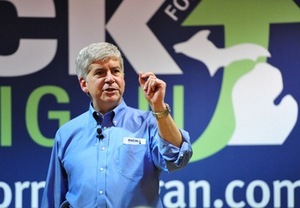
Michigan gubernatorial candidate Rick Snyder, an Ann Arbor venture capitalist, speaks at a town hall forum this spring.
"It really had to happen if they were going to stay in business," said Rob Enderle, president and principal analyst at San Jose, Calif.-based Enderle Group. "It was either ship some jobs overseas or lay everybody off and close the doors."
Not in dispute is that the PC company grew exponentially while Snyder was actively leading the company as executive vice president and president from 1991 to 1997.
The firm, then based in South Dakota, went from about 700 employees to about 13,300 during that period, including 10,000 in the U.S. Its sales soared, rising from $1.107 billion in 1992 to $5.035 billion in 1996, the last full year Snyder served as president, according to Securities and Exchange Commission filings.
Still, Snyder’s critics say that he should take the blame for Gateway's outsourcing during the time when he was serving on the Board after exiting day-to-day leadership of the company.
“This is a guy who was watching out for himself when he was at Gateway all along,” said Mark Brewer, chairman of the Michigan Democratic Party. “That’s not the kind of selfish person we need here. We’re looking for somebody that’s going to bring investment and jobs from China to Michigan.”
The accusations are reminiscent of rhetoric that plagued billionaire Amway executive Dick DeVos’ failed Republican gubernatorial campaign in 2006. DeVos, similarly accused of outsourcing jobs, couldn’t escape voters’ wrath as Michigan’s economy crumbled in the face of global competition.

Attorney General Mike Cox, a gubernatorial candidate, is criticizing Rick Snyder's record at Gateway.
File photo | AnnArbor.com
Snyder argued that he created jobs as a Gateway executive and in recent years as a venture capitalist in Ann Arbor. He said he couldn’t stop the outsourcing Gateway did from about 2003 to 2005 when he was still serving on the company’s board.
“I was a minority voice on the board, saying I didn’t agree with several of those steps,” he said.
Gateway’s demise after Snyder’s departure
Gateway started to fall apart about three years after Snyder resigned as an executive but was still serving on the Board.
Industry competition intensified and consumers got more selective during the dot-com bubble bust.
“The PC market hit a wall in late 2000,” said Charles Wolf, an analyst for New York-based Needham & Co. "The company blew up.”
Gateway sold 4.6 million computers in 1999 but that dropped 54.3 percent to 2.1 million in 2003. During that period, competitor Hewlett-Packard acquired Compaq in a deal now seen as critical to H-P's success.
During the same period, SEC filings show that the company’s hiring got out of control. Under CEO Jeffrey Weitzen, who led the company from 1999 through January 2001, the company went on a hiring binge.
By Dec. 31, 2000, Gateway had operations in more than 16 countries, according to SEC filings. About 21,100 of the company’s 24,600 full-time employees were still based in the U.S..
But when the PC market imploded, Gateway founder Ted Waitt, angry at the executive leadership of the company, installed himself as CEO in January 2001 with the support of the board, according to “Fortune” magazine. To help the company survive, he tried introducing a variety of non-computer products and revitalizing the company's struggling retail stores.
But Gateway had a hard time appealing to consumers with its build-to-order model, and the retail stores never took off.
“The stores were crappy. And they were not Apple Stores,” Wolf said. “They were not fun to go into.”

Rick Snyder is trying to avoid the fate of 2006 Michigan gubernatorial candidate Dick Devos (pictured above), whose campaign was haunted by outsourcing that occurred while he was president of Amway.
File photo | AnnArbor.com
In September 2003, the company announced that it would start outsourcing some manufacturing and service operations to foreign companies in a move Waitt described in a news release at the time as vital “to create a more efficient infrastructure as the backbone of the new Gateway.”
Three years earlier, contract manufacturing in the electronics industry was already an $103 billion industry, according to a widely cited report by Massachusetts-based International Data Corp.
As of February 2004, Waitt controlled 32.8 percent of the company's stock, according to SEC filings, meaning he had significant influence over company decisions.
Enderle blamed most of the company's downfall on Waitt.
"He was kibitzing. He would parachute in, make a couple of decisions and parachute back out again," said Enderle, whose firm has provided research services to most major computer companies, including Gateway at one point. "Anybody that was trying to run the company had to deal with Ted Waitt as more of a problem than a help. He was coming in and being disruptive on a regular basis."
Waitt, who became a billionaire through Gateway's rise, now focuses most of his time on philanthropy. He declined multiple interview requests.
Merger changes business model
By the time Gateway was ready to embrace outsourcing, the company had already reduced its personnel significantly due to declining sales. The firm was down to 7,400 employees in the U.S. and just seven overseas by Dec. 31, 2003, according to SEC filings.
After its third straight year of losses, the company acquired competitor eMachines for $289.5 million in March 2004. At the time, eMachines relied almost exclusively on foreign suppliers and third-party retailers to make and sell its computers.
The move was widely seen as a reverse acquisition, because Wayne Inouye, CEO of eMachines, took over as CEO of Gateway after the merger. He decided to shift most of Gateway’s remaining manufacturing operations to foreign suppliers. He also closed the 188 remaining stores, choosing to rely on third-party retailers.
By Dec. 31, 2005, Gateway had only 1,800 employees, all in the U.S. The downsizing, outsourcing and the eMachines acquisition returned the company to a profit in 2005 for the first time in five years, records show.
Snyder said “business realities” forced Gateway to downsize and alter its business model to stay alive.
Inouye left the company in February 2006, and Snyder, who had been appointed chairman in 2005, agreed to step in as interim CEO while the company searched for a permanent replacement. Snyder served as interim CEO for about seven months until the company hired J. Edward Coleman as the permanent CEO.
Coleman led Gateway to a $710 million sale to Asian manufacturer Acer, which continues to sell products under the Gateway brand.
Should Snyder be held responsible?
The accusation that Snyder sent jobs overseas irritates Rob Cheng, who lived next door to Snyder in South Dakota and served as Gateway’s chief marketing officer in the 1990s.
“The exact opposite is true,” Cheng, now CEO of PCPitStop.com, said in an interview from Rio de Janeiro, Brazil. “When Rick was there and I was there, we created so many jobs, it wasn’t even funny. We were very, very successful.”
Chris Rizik, Snyder’s venture capital business partner in Ann Arbor and campaign contributor, said Snyder shouldn’t be held accountable for Gateway’s problems or outsourcing initiatives just because he sat on the company’s board, which also included former U.S. Sen. Elizabeth Dole at one point.
“If I were responsible for what every CEO on every board I’ve served on did, God knows my wife wouldn’t even talk to me,” Rizik said. “The majority of those decisions don’t make it to the board level.”
But Brewer criticized Snyder for not being more vocal.
“Did he not speak up and say this is the wrong way to go?” Brewer said.
Snyder said that once he was named interim CEO, he had the opportunity to make changes. During that stint from February 2006 to September 2006 - when he commuted from Ann Arbor to California - Gateway announced that it would start a call center in South Dakota. The company also announced plans to hire 300 workers for a new manufacturing complex in Tennessee, the Associated Press reported at the time.
Snyder said the call center, which had been outsourced to Asia sometime after he resigned as president, was better done in the U.S.
“I think I was on the front edge of explaining that and communicating that to people in this country,” he said.
Tech analyst Enderle said Gateway was a leader in describing the importance of U.S.-based work.
"Gateway was one of the first to say, 'OK, let's bring the services jobs back here so that people who are buying machines here are talking to service people here,'" Enderle said.
Cheng, who’s contributed to Snyder’s campaign and considers him a friend, blamed Gateway’s demise on poor executive leadership years after Snyder left.
“All of us were in it to make a great company,” he said. “All the people who came in afterwards were in it to make a lot of dough. That hurt the company.”
Contact AnnArbor.com's Nathan Bomey at (734) 623-2587 or nathanbomey@annarbor.com. You can also follow him on Twitter or subscribe to AnnArbor.com's newsletters.
Comments
Snarf Oscar Boondoggle
Wed, Sep 22, 2010 : 2:18 a.m.
@alan goldsmith: "He was silent as a church mouse when it mattered." and you can substantiate this "false-fact" becauese...? @gsorter: I'd rather have a governor that has actually created wealth for employees and stockholers by running a company any time... well of COURSE you (and i) would... h u l l o... out there? @smiley: "The outsourcing of manufacturing jobs from the US is 100% the fault of our federal government dating back decades." a fact conveniently ignored by the profligate destructionists temporarily running stuff, chosing who wil be misreated next. @topcat: "The sole question is, going forward, who is going to make the drastic changes needed to create a pro-growth atmosphere that will bring jobs to Michigan?".. ummm, someone who is future-based sted hacking history? thoght so. @ann arbor guy: "The reality is that business owners have a lot of choices of where to relocate their businesses. They can move to China or Bangladesh, Texas or North Carolina and leave our state of Michigan in the dust to rot as it has been doing under Democratic leadership for years. What can the Democratic politicians do? Nothing." well, they gazed at their navels as general motors abandoned... lansing. oh, wait, that;s bonero's home town. nevermind. @rasputin: "... a billionaire venture capitalist which means an opportunistic creature with a loyalty to money." ummmmm.... :s/success/money/g... you would recommend 'failure'? @insidethehall: "Bomey: You make the comparision to DeVos nobody else does. What do they have in common besides being private sector titans that created jobs and actually know what the term "capital formation" means." make hay when the sun shines....
talker
Mon, Aug 23, 2010 : 10:56 a.m.
Great post. It should be just as much an issue in the general election. It's interesting that those who criticized Snyder in the primary are holding back on their criticism now that Snyder is the Republican nominee.
grodon
Wed, Jun 30, 2010 : 8:07 a.m.
Funny how Snyder and his supporters will cry that outsourcing is out of their hands and really can't do anything about it but want to run a state that is suffering due to outsourcing more than any single issue. Snyder - you couldn't even stand up and fight for Gateway employees, how are you going to do it on a much bigger scale for the whole state of Michigan?? They are also quick to blame Granholm for the woes of Michigan over the last 8 years and all the job losses and jobs sent overseas. Easy to point the finger but when that same finger is pointed at Snyder he is quick to say it's not his fault. Granholm wasn't the answer and neither is Snyder.
David Briegel
Sat, Jun 26, 2010 : 4:28 p.m.
Which part of "that giant sucking sound" didn't you understand? If Rick is evil then you must close down WalMart! You can't have it both ways. Unless you're a Mad Hatter! Jobs will only be created when America becomes that Third World country of our "destiny" and there are enough of our citizens willing to work for $7 per hour and no benefits. So much for the middle class that made our once proud nation great! 20 years of "fiscal conservative" Republican Presidets and not one balanced budget. That is just a tool used to "whip" the Dems. Bi-partisanschip is when Dems go along with the idiotic policies of the Repubs. Repubs just say NO!
Hot Sam
Sat, Jun 26, 2010 : 6:06 a.m.
Back to the article at hand...I find it amusing that Americans keep voting for people who advocate a whole world order, and then complain when some jobs are created around that same world...
Hot Sam
Sat, Jun 26, 2010 : 6:03 a.m.
"""It's called "bi-partisanship". Republicans could take a lesson.""" You mean like No Child Left Behind...Prescription Drugs...Big Bailouts...and I could go on....
JSA
Fri, Jun 25, 2010 : 10:09 a.m.
Ghost, the change to Glas-Stegall was a Democratic policy during the Clinton administration. There is no denying that many Republicans but you really out to place the blame where it belongs. You might also note that it was Mr. Clinton who stated that he wanted to make it possible for people who might not ordinarily qualify for mortgages to be able to become home owners. Thus giving birth to the mortgage foreclosure mess we now face. If you're going to play partisan politics try to be honest about it.
Rasputin
Fri, Jun 25, 2010 : 7:06 a.m.
@ Nathan Bomey, I stand corrected. rick is ONLY worth tens of millions of dollars. My error. It is such an abstract figure to me it may as well be a trillion dollars.
mikesaline
Fri, Jun 25, 2010 : 4:57 a.m.
You democrats are idiots. How can you criticize a CEO for playing by the rules that the government set? Clinton is the culprit for "sending those jobs to China". Gateway, Dell, Apple, and EVERY manufacturer of electronics went to China when the Clinton administration made it economically irresistible. It cracks me up that liberals constantly attack business for acting in a rational fashion as a result of the incentives that GOVERNMENT creates. The government does not create jobs in this country. It either creates a climate where business will expand and prosper, or it creates a situation where business has to do radical things, like move their manufacturing to a country on the other side of the globe, to survive. That lack of basic understanding explains why you democrats, when given the chance, usually run what you're in charge of into the ground. Look no further than Detroit, the State of Michigan, the Auto Industry, and soon the USA under the incompetent, inept, and totally disastrous Barack Hussein Obama.
peg dash fab
Thu, Jun 24, 2010 : 10:20 p.m.
are the minutes of gateway's board of directors meetings available?
WriterLeft
Thu, Jun 24, 2010 : 5:21 p.m.
Maybe next time you'll take a more original topic and look at how many Michigan jobs Rick Snyder's venture capital firm has created compared to the number of companies and jobs funded in California or elsewhere. If he really loves the state, then what are the recent companies he and Ardesta have funded in the Great Lakes State?
Stephen Landes
Thu, Jun 24, 2010 : 4:44 p.m.
What is not in dispute is that Rick Snyder has created jobs in the US and knows how to do it. I think it would be appropriate to find out from each candidate -- Republican and Democrat -- how many real jobs, i.e.: private sector jobs each has created. I discount any public/government jobs because what Michigan needs are real wealth producing, tax revenue creating jobs. Would AnnArbor.com ask each campaign for a list of jobs created by their candidate? Maybe Mr. Brewer has this information handy. This should make interesting reading.
Nathan Bomey
Thu, Jun 24, 2010 : 4:09 p.m.
@InsideTheHall, Whether or not the comparison is fair, it most definitely didn't originate from me. Here are a few other instances in which the similarities are mentioned. http://www.freep.com/apps/pbcs.dll/article?AID=/20100617/NEWS15/6170462&template=fullarticle http://domemagazine.com/features/f20610 http://petoskeynews.com/news/article_65c11042-7ed1-11df-9748-001cc4c03286.html http://www.politico.com/blogs/scorecard/0709/Dick_DeVos_2.html But, to your point, perhaps the more accurate comparison is to former Hewlett-Packard CEO Carly Fiorina, who is running for U.S. Senate in California and faces similar criticism about her tenure at H-P. http://www.latimes.com/news/local/la-me-0624-senate-20100624,0,2060125.story If Snyder wins the Republican gubernatorial nomination on Aug. 3, I'd expect to hear pundits compare his momentum to that of tech-executives-turned-political-candidates Fiorina and Meg Whitman, the former eBay CEO running for governor of California.
InsideTheHall
Thu, Jun 24, 2010 : 3:38 p.m.
Bomey: You make the comparision to DeVos nobody else does. What do they have in common besides being private sector titans that created jobs and actually know what the term "capital formation" means. How about comparing Bernero and Dillion as two prominent Democrats who were in office during the greatest loss of jobs in Michigan history??? As for Mike Cox....well..perhaps he should be mending fences at home with da wife instead of attacking Snyder on a petty ginned up issue!
Macabre Sunset
Thu, Jun 24, 2010 : 3:24 p.m.
The Democrats are doing their best to push us toward the Republicans. What's their message, other than hate? I'm a centrist who has never voted for a Republican. As long as there's a non-Amway candidate on the Republican side, that's going to change rather soon.
uawisok
Thu, Jun 24, 2010 : 3:19 p.m.
as long as the walmart mentality american consumer doesn't care where something is made and who is exploited in making it(including the exploitation of the enviroment) then manufacturing here is dead....but wait when gas /energy is getting scarcer and more expensive then no matter how cheap the labot is elsewhere the shipping costs will prevent importation...can we wait???
Nathan Bomey
Thu, Jun 24, 2010 : 1:35 p.m.
@Rasputin, Just a quick note to clarify something. Former Amway executive Dick DeVos, the 2006 Republican nominee whom Rick Snyder is often compared to, was a billionaire. Rick Snyder, however, is not a billionaire. By all accounts, his net worth is far smaller. The exact amount of his net worth is unknown, but it is believed to be in the tens of millions.
Lokalisierung
Thu, Jun 24, 2010 : 1:31 p.m.
"Whirlpool is closing its last plant in Michigan and going to... wait for it... Mexico!!!!" Oh i did not know that....not good news at all. WEll I'll no longer buy from them.
juice
Thu, Jun 24, 2010 : 1:13 p.m.
No jobs overseas,unlikley, Federal minimum wage 7.40 an Hour, Livable wage according to who? We had the highest standard of living in the whole world and some of us still do,Its up to Luck, education, avalable wealth in a particular area. Michigan is hurting because of free trade but we are still in better shape than the 90% who only make 2.00 a day. Americans toughen up and invent stuff for the future,then outsource it like everything else,STUPID CAPITALIS! Politicians,Religious leaders,War mongrels will never agree on anything,because sake of argument is human nature. As for this gobernatorial candidate he is just another puppett of a system that its hidden agenda is to line his own fat pocket.
Lokalisierung
Thu, Jun 24, 2010 : 1:13 p.m.
Hondas & Toyotas ship jobs to America, unlike Chevy/Ford etc who ship jobs to Mexico.
Rasputin
Thu, Jun 24, 2010 : 1:09 p.m.
@ Pompous, no. My Honda was made in Pennsylvania as were most that are available in Michigan. The only thing manufactured in Japan are some of the engine components and body parts. Please, please, do your homework instead of spreading misinformation. Better yet, go to Howard Cooper and look at the Origins sticker inside the door well of most Hondas or check out the engine compartment?! You should also know that the big three have various components manufactured in Japan, China, Germany, and Taiwan. Enough!
JSA
Thu, Jun 24, 2010 : 1:02 p.m.
The issue I have with this article is why Mark Brewer is involved in any way. Mr. Brewer is the Chairman of Michigan's Democratic Party, you know, the man who gave us the disastrous primary in the last presidential elections. He is not noted for telling the truth but rather as a cut throat politician who smears anyone of either party he does not support. Giving him a forum is unacceptable.
David
Thu, Jun 24, 2010 : 12:27 p.m.
Very nice job explaining this matter, which I'm sure will be reviewed in an ad check at michigantruthsquad.com sooner or later. Perhaps the most interesting lesson here isn't the job outsourcing issue, but one that seems not to have been learned by Mr. Snyder and others. Factory work is dead end work now in the U.S. Even having your factories in states like South Dakota and Tennessee, often hailed as good business sites due to low taxes, won't work when you are competing against $4 an hour labor in foreign nations. Yet we continue to be fixated on how we can cut taxes -- and reduce services bought by taxes, like a quality education, higher education, police services, etc -- to attract more manufacturers. I would have hoped Mr. Snyder would have learned that we need to be competing in the knowledge economy, and that means the number one thing to do is retain and attract young talent. Cutting services will only drive young talent away. You can compare Minnesota and South Dakota...Minnesota is the most successful state in the Midwest...lowest unemployment, highest per cap income. South Dakota per cap income far lower than Minnesota...Yes, you will pay more state and local taxes in Minnesota, but you get more in return... a state that is attractive to young talent and the knowledge industry. You can learn more about the importance of young talent -- the only path to prosperity -- at www.michiganfuture.org.
JimB
Thu, Jun 24, 2010 : 11:27 a.m.
@Smiley, thanks for the link to that great article.
Trepang674
Thu, Jun 24, 2010 : 11:17 a.m.
I'm pretty sure the vast majority of folks going into WalMart on a daily basis aren't concerned about outsourcing, and pretty sure they do care about a job. When you create the large number of jobs Snyder created both home and abroad it gives him a very focused vision of the requirements to create those jobs...Cox is more focused on the trappings of power. Wonder what he was up to when he got involved with Quami K.????
Ann Arbor Guy
Thu, Jun 24, 2010 : 10:25 a.m.
Americans want high wages and want to pay low prices on goods. In my experience, you can have one but not both. Which do you want to give up: high wages or low prices? Most U.S. manufacturing has been outsourced already. We live in the Information Age. The Industrial Revolution has been and gone. If you have a Democratic politician in the governorship, you are going to see higher and more complex taxes on businesses and union-strengthening policies that are going to continue to drive away industry here. The reality is that business owners have a lot of choices of where to relocate their businesses. They can move to China or Bangladesh, Texas or North Carolina and leave our state of Michigan in the dust to rot as it has been doing under Democratic leadership for years. What can the Democratic politicians do? Nothing. You have to attract businesses by making it easier to do business in our state. That is what the Republicans will do. We have 15 percent unemployment only if you count people who are receiving unemployment benefits. The reality is probably at least 20 percent unemployment. That's 1 in 5 people out of work. Thank you, Democrats.
81wolverine
Thu, Jun 24, 2010 : 10:19 a.m.
The rhetoric coming out of this Brewer guy is symptomatic of the malaise that's caused Michigan's economy to sink to the bottom of the nation. It's always easier to criticize the other side vs. coming up with their own innovative ideas. Running a U.S. corporation in a highly competitive market like computers necessitated making the outsourcing decision. But, Brewer seems to be conveniently ignoring all the thousands of U.S. jobs Snyder helped create also. The Democrats have no answer for fixing the state economy so they have to resort to mis-representing and twisting around Snyder's past record to make him look bad. Granted, the Republicans are guilty of the same type of behavior too. But, I'd prefer to give someone a chance at governor who understands business and how to build it. And honestly, we should be electing more representatives and senators to Lansing who have a clue about business vs. the career politicians we have now who have been running the state economy into the ground.
David
Thu, Jun 24, 2010 : 10:14 a.m.
I seem to remember RS chaired Gateway's board of directors finance committee during the outsourcing. Since all outsourcing is done for purely financial reasons this committee would hold sway. This needs to be checked.
Technojunkie
Thu, Jun 24, 2010 : 9:27 a.m.
Great article. If Mark Brewer's ignorance of the authority of a board member vs. CEO is typical of the Democratic Party, it's no wonder that businesses are fleeing Michigan. Every time Snyder has had executive authority he's created thousands of American jobs. His plan to replace the insane MBT with a 6% flat business income tax would create thousands of Michigan jobs. Stop torturing businesses with wasteful paperwork, give them an easy to compute tax bill and get out of the way. Genius! He has my vote.
Nathan Bomey
Thu, Jun 24, 2010 : 9:19 a.m.
One piece of the Gateway history that I meant include (and just added). During Snyder's brief tenure as interim CEO in 2006, Gateway also announced plans to start a new manufacturing complex in Tennessee. The AP story at the time: http://www.ocregister.com/articles/gateway-76569-company-plant.html
LBH
Thu, Jun 24, 2010 : 9:06 a.m.
WRT outsourcing there are many issues associated with this, but two which are pretty closely intertwined are: a) Wal-Mart has convinced Americans that everything should be cheap and disposable. If it costs more than a buck 80, you're being ripped off. b) American workers are too costly to produce cheap, disposable products. Up shot. Americans are unhappy about wages and benefits, demand more, people costs go up, companies cannot produce products which are cheap and disposable *and* make any profit for their stock holders (stock holders such as many of the retirement plans of aforementioned workers) so they send jobs to cheaper labor markets in order to keep low, low, rollback prices. Etc, etc...
belboz
Thu, Jun 24, 2010 : 8:33 a.m.
Outsourcing is absolutely a local issue. Assuming that the federal government, or some other organization is going to take up the issue has been shown to be a sure fire way that nothing gets done. That is essentially what Arizona has shown with the imigration issue. At some point, local laws need to be enacted to drive the issue. What would happen is Michigan did not allow for foreign countries to sell goods in Michigan based on unfair labor practices or working conditions overseas? People may argue with the legality, but at least it would drive the discusion. I agree that the legislation nationally is not helping us manufacturing. But, perhaps we should stop waiting and drive the issue with local laws. Regards to the article, if anyone is in manufacturing, I do not doubt they have outsourced. But, if Snyder isn't open about it, why it happend, the competitive reasons behind it, and why he plans on changing the rules that lead to his outsourcing : then he is no better than any other politician out there.
LBH
Thu, Jun 24, 2010 : 8:31 a.m.
Nathan, thank you for a very thorough story. In a time when people like to grab one catch phrase and shake it to death (sometimes particularly if it is not true), you wrote a piece which clearly took quite a bit of research and presented it in a way that people can draw their own conclusions. What a pleasant change! Keep it up.
Nathan Bomey
Thu, Jun 24, 2010 : 8:14 a.m.
Rick Haglund weighs in with analysis on whether Rick Snyder's role in Gateway's outsourcing should matter. http://www.micheconomy.com/2010/06/rick-snyders-role-in-china-job.html
Top Cat
Thu, Jun 24, 2010 : 7:50 a.m.
Obviously Mark Brewer and the Democrats cannot run on their record of the last 8 years. Now they are grasping at straws. The sole question is, going forward, who is going to make the drastic changes needed to create a pro-growth atmosphere that will bring jobs to Michigan? I wish I were more sure of the answer.
Jeremy
Thu, Jun 24, 2010 : 7:48 a.m.
Looks pretty cut and dried to me. So many business owners and independents are so quick to rush to Snyder's side in a town that is admittedly more progressive than his politics is. Pay attention to who it is you are supporting. He is attempting to come off as a docile, middle of the road "geek" running for office. He is not. For those centrists looking for someone who is fiscally responsible, and on our side on social issues, you should REALLY take a hard look at Lansing Mayor Virg Bernero's campaign. He's kept Lansing without a deficit, is a social progressive like many of us here in the Ann Arbor area, and has a fiery work ethic. Let me be clear, since Snyder will not, on a few things, as the following *is* true: A) he was on the board of Gateway while it shipped American jobs to China. There is no evidence of him defending the American workers at all. He should release the Board minutes to confirm his support and vote for the American workers. I don't want a "CEO" of our state who will idly sit by if further job loss in this state happens. B) Snyder has repeatedly affirmed his conservative bona fides in the areas of equative rights for same-sex couples to marry, share bank accounts and health benefits (i.e. all the same luxuries that married straight couples share). I am an Episcopalian and my church (based in the 1400s in England) will marry same sex couples -- why does Snyder think that laws preventing my church from freely operating are OK and should stay on the books. C) There is overwhelming support in this town for a Woman's right to choose in this town, and Snyder is wholly against the idea. I have a feeling that it wouldn't be too hard for him to sign a bill restricting women's choice rights in this state if one were presented to him. He has said, in an emailed response to me that "social issues aren't important to this campaign." While I agree that we cannot take our laser like focus off of the economy these days, we absolutely, absolutely must keep in mind the social policies that make our state what it is. Though he may not believe it, the two are very tangibly and directly linked.
Smiley
Thu, Jun 24, 2010 : 7:39 a.m.
...The point being, even if this is true about Rick Snyder, in all liklihood it's most not his fault, or even a voluntary decision for that matter.
Smiley
Thu, Jun 24, 2010 : 7:36 a.m.
AlphaAlpha is right on. The federal government sets the rules on trade, and companies have to compete within those rules. In most cases, the decision to outsource is one of survival. While certain protectionist approaches are not good (or even permitted under international treaty), trade policies need to be fair, and the fact is right now they aren't. The outsourcing of manufacturing jobs from the US is 100% the fault of our federal government dating back decades. I've followed several matters facing the DOC and the ITC over the past several years, and our federal government has a propensity for free trade, as opposed to fair trade. Believe it or not, there are companies and industries trying to get the federal government to protect domestic industries - nearly all would prefer to be based at home than somewhere else. There is a belief by our federal government that free trade is better for the US in the long run, but this belief seems to blind them to the effect on low to middle-class working Americans. One of my favorite proposed solutions from Warren Buffet.. http://money.cnn.com/magazines/fortune/fortune_archive/2003/11/10/352872/
Forever27
Thu, Jun 24, 2010 : 7:24 a.m.
It seems as if the only thing that will win this election for the Democrats is Republican self destruction. This little hick-up won't ruin Snyder's campaign but if the primary battle intensifies the Republicans could very well shoot themselves in the foot here.
The Picker
Thu, Jun 24, 2010 : 7:07 a.m.
Pathetic! In Brewers eyes, only career politicians need apply.
stan
Thu, Jun 24, 2010 : 6:22 a.m.
Brewer really needs to get a new schtick. This kind of nonsense talk got Jennifer Granholm a second term when she didn't deserve one. He should be focusing on why he thinks Bernero or Dillon are better than any of the Republicans. The fact that he's already going negative is quite telling. Michigan would do well to elect a businessman of Rick Snyder's caliber to be this state's chief executive.
AlphaAlpha
Thu, Jun 24, 2010 : 5:54 a.m.
Did he not speak up and say this is the wrong way to go? Brewer said. For clarity, Brewer is incorrect: whether one likes it or not, due to the existing rules, outsourcing is not the wrong way to go. Existing federal legislation has most US citizens on a path of lower wages, and a lower standard of living. Look around. We're on our way.
AlphaAlpha
Thu, Jun 24, 2010 : 5:46 a.m.
Mr. Bomey - Outsourcing, H1B visas, currency issues, etc., wold perhaps be more appropriate for a national, not local, campaign. You can be sure that the actions of the current and past crops of elected leaders are also quite responsible for tremendous outsourcing. Repeat for clarity: existing legislation encourages outsourcing. It's a bit inappropriate to blame any business for appropriately responding to the legislated economic rules of play.