

Does Obama support Rick Snyder's emergency managers, education reform?
In the aftermath of Gov. Rick Snyder's decision to give emergency managers more power to address crises in Michigan's distressed public school districts and municipalities, Snyder faced a barrage of criticism.
Activists ranging from the Michigan Education Association to the Michigan Democratic Party to liberal MSNBC commentator Rachel Maddow slammed Snyder and Michigan Republicans, saying the emergency manager legislation dismissed democracy in favor of dictatorial politics.
But it's becoming increasingly clear that Snyder's emergency managers — whose existence has inspired an effort to place the issue on the ballot in 2012 to allow voters to repeal the legislation — have more political support than previously thought.
Exhibit A: Washtenaw County Board of Commissioners Chairman Conan Smith, a Democrat.
Exhibit B: Flint Mayor Dayne Walling, another Democrat.
Exhibit C: President Barack Obama?
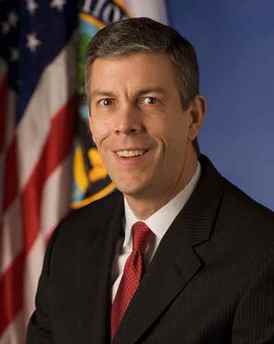
U.S. Secretary of Education Arne Duncan
Perhaps. But then I ask you this: Why did U.S. Secretary of Education Arne Duncan, an Obama appointee, participate in Snyder's press conference today by satellite, praising Detroit Public Schools emergency manager Roy Roberts' leadership and lauding Snyder's efforts to uproot the "status quo."
Duncan — the third speaker at the press conference, behind Snyder and Roberts — praised the initiative to establish a statewide system to revitalize Michigan's worst public schools by transferring them to a new autonomous authority, requiring teachers to reapply for their jobs and giving principals more authority to make their own decisions.
The new initiative starts with Detroit's approximately 100 failing schools in 2012-13 but it will extend to the other 100 failing schools in Michigan in 2013-14.
"This city has no viable future if the status quo is allowed to stand," Duncan said. "Detroit has the potential to be a model not just for the state, but for the entire country."
Fair enough.
Bad news, though: Without the strengthened emergency manager law, Roberts would find it much harder to make all the changes he wants to make — and that Snyder is supporting.
"I want to be a good partner to folks in Detroit who want to take that school system to a whole new level," Duncan told reporters this morning.
I believe him. Because if he actually opposed the emergency manager powers, he'd basically be opposing Roberts' right to take control of the district, which makes much of these reforms possible.
That's why it was startling to see Duncan post this to his Twitter account after the press conference:
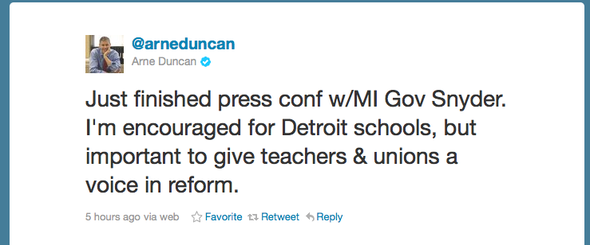
Emphasizing that it's "important to give teachers and unions a voice in reform" is a puzzling caveat to add, considering that under Snyder's new Education Achievement System, teachers at Michigan's 200 failing schools will be fired and forced to reapply for their jobs.
It's always fascinating to watch back-tracking occur in real time through the modern lens of social media.
So I directed my questions to Duncan through the same medium he chose to add his caveat:
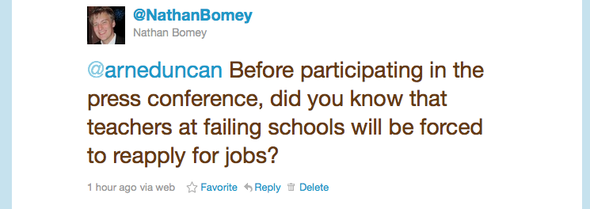
Seems like a fair question, right? No answer. So I pressed further:
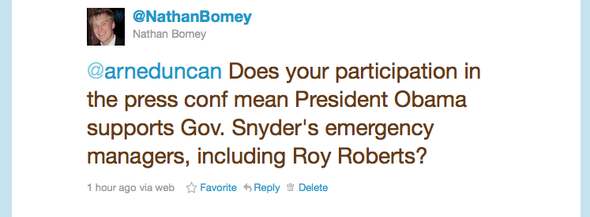
Still no answer.
So I decided to go the traditional route. I called his communications office in Washington.
I asked Daren Briscoe, deputy press secretary for the U.S. Department of Education, whether Duncan's participation in the press conference means he supports Snyder's emergency managers.
"The way to understand what the secretary was saying was, more so than endorsing that as a specific blueprint, he was expressing his support of thematically what they’re doing in Michigan, which is taking urgent action, to remedy a situation that is not serving the students there well," Briscoe said.
Duncan participated in the press conference to endorse "the kind of collaboration that you have to have in a situation like that in order to come to the kind of agreement that they’ve come to, which involves administrators, parents and teachers," Briscoe said.
Briscoe added: "That’s what he was endorsing and praising, was the broader-stroke urgency, collaboration and that sort of thing, rather than line by line" approval of Snyder's reform policies.
That's strange: So, you're publicly supporting a theme of change but the details make you uncomfortable?
I asked Briscoe whether Duncan — which, by extension, means the president of the United States — supports forcing teachers in failing public schools to reapply for their jobs as part of a broader reform initiative.
In situations where schools are "persistently failing," the Department of Education sometimes supports "all of the teachers being fired and principals being fired."
"That's not a blanket description for each school, but that is among the options that the department endorses, given a certain set of circumstances," Briscoe said. "Where you have dramatically underperforming schools, persistently underperforming schools, yeah the department does endorse actions that are both dramatic and urgently needed."
Here's my takeaway: President Obama supports firing teachers when schools are failing — and, if he had a big problem with Snyder's emergency managers, he wouldn't have allowed his education secretary to lend his political clout to an event trumpeting one of the biggest education reform initiatives to sweep through Michigan in decades.
What about you?
If Obama despised Snyder's emergency managers and firing bad teachers, why would he allow a key member of his cabinet to sing the praises of a reform initiative that is partly possible because of Snyder's policies?
Contact AnnArbor.com's Nathan Bomey at (734) 623-2587 or nathanbomey@annarbor.com. You can also follow him on Twitter or subscribe to AnnArbor.com's newsletters.
Comments
Trepang674
Thu, Jun 23, 2011 : 3:08 p.m.
With the depth of the crisis of the failing schools in Detroit, the terrible Admin system, tenured but terrible teachers. Why do we want to recall Snyder. He was elected to fix the problem. If a teacher is worth their weight - they will get their jobs back. If you stink as a teacher...it wasn't your calling and should move on for the sake of the children. Damn the contract.
Disco D
Thu, Jun 23, 2011 : 2:43 p.m.
The systemic problem that run through, not only schools but all of the public sector, is the failed concept of collective bargaining with the unions. In the private sector, owners bargain with the unions and have a vested interest in the outcome. In the public sector, our elected "representatives" and their administrators are charged with the responsibility of bargaining with the unions. The problem is the majority of elected officials and administration are of the same political persuasion and ideology. They have no vested interest except their own jobs. The first they think of with budget shortfalls is to tax their constituents. This creates a situation where the group with the vested interest, us taxpayers, have no voice in the collective bargaining process. Well, the time has come for this sacred cow of public sector unions to be butchered. It will be interesting to see how President Obama, who rode on the backs of the NEA and the SEIU members into the White House, will react to the busting of unions in non-performing school districts.
John B.
Wed, Jun 22, 2011 : 9:24 p.m.
Looks like the attempt at 'gotcha journalism' didn't work.
snapshot
Wed, Jun 22, 2011 : 5:21 a.m.
If these "protesting" organizations had been functioning in the best interest of education there wold be no need for EFM's. Instead of being adversive why don't they try offering some real solutions to the problems facing education other than "more money".
Dan Rubenstein
Tue, Jun 21, 2011 : 5:19 p.m.
Nathan, your angle implies the EFM law is primarily a Republican issue, when it was initially instituted by democrats. The Detroit schools EFM was placed by Granholm. So what exactly is being done under Snyder that couldn't have been done before? More specifics, please, on what issues you're trying to air.
Dante Marcos
Tue, Jun 21, 2011 : 3:31 p.m.
Duncan, and therefore Obama, would like for our public school system to gradually be replaced by an American Charter School system. This cat's been out of the bag for a couple years now. The installation of an "Emergency Manager" suggests to [largely ignorant] citizens that something is "wrong" with a school district (usually, that it's comprised of working-class and/or students of color—when in fact what's wrong is inadequate funding and support); this paves the way for an eventual transition of public schools into Charter (read: for-profit) schools.
John B.
Wed, Jun 22, 2011 : 9:27 p.m.
Do you really believe that President Obama feels that way? What you describe is a fundamental plank of the RepubliKan 'privatize everything as soon as possible' platform.
Greg Gunner
Tue, Jun 21, 2011 : 10:38 a.m.
Interesting that the blame is placed upon the dedicated teachers who are working at the grassroots level. The real culprit is the poverty afflicting Detroit, poverty encouraged by the "trickle down economics" of Slick Rick and his Republican cohorts for the last three decades. If you really want to deal with the problems facing Detroit and all other inner-city schools, you will have to quit blaming the people on the front lines trying to help and start dealing with the underlying problems of poverty, drug use, alcoholism, unemployment, and lack of hope for anything better. The great Slick Rick, himself, could be teaching in Detroit and the results would be no better. In fact, he wouldn't last a semester, let alone the 20-30 years of Detroit's dedicated teachers. The problem won't be solved if we continue to look for scapegoats. It's society's problem, not one created by teachers.
macjont
Tue, Jun 21, 2011 : 10:04 p.m.
grye, throwing money at the problem might be the only thing that will work.
Mike K
Tue, Jun 21, 2011 : 5:21 p.m.
Well Greg - you have my attention. What are the underlying problems of poverty, drug use, alcoholism, unemployment and the lack of hope for anything better, AND how do we "deal" with them? Good teaching is only half the equation. Families valuing education is the other half. Now you can say all you want about scapegoats, but good education and good families have nothing to do with the city of Milwaukee paying 2x their yearly budget on retiree healthcare. <a href="http://www.latimes.com/news/nationworld/nation/la-na-milwaukee-teachers-20110518,0,7295248.story" rel='nofollow'>http://www.latimes.com/news/nationworld/nation/la-na-milwaukee-teachers-20110518,0,7295248.story</a>. Some argue that this type of thing is abuse of power.
andys
Tue, Jun 21, 2011 : 2:59 p.m.
"The problem won't be solved if we continue to look for scapegoats. It's society's problem, not one created by teachers." Where does personal responsibility come into the equation? People are free to screw-up their lives. Some poverty is intractable. Its sad. Can society solve this?
andys
Tue, Jun 21, 2011 : 2:40 p.m.
Yes, the decades of liberal policy / programs that have been tried in Detroit, the money wasted on these programs have just not gotten it right. I suggest an annual "basic needs" grant to each family in poverty, maybe like $20k to $40k per household. You just need to bring in 3 years of tax returns or swear that you have lived in poverty, and you get a check. That might do it.
grye
Tue, Jun 21, 2011 : 1:23 p.m.
The teachers are not getting the blame. It is due to inept and corrupt administrations. However to correct the missteps of the past, letting go all teachers may be the only way to get rid of those teachers that really needed to go but were protected by union agreements. Interesting that you claim the problems lie with poverty, unemployment, alcohol abuse, etc. Are you suggesting throwing money at these people so the are no longer in poverty and smoehow, magically they will want their children to succeed and they will succeed?
xmo
Tue, Jun 21, 2011 : 2:51 a.m.
President Obama is an empty suit! He would not know what Gov. Snyder was talking about! So the answer would be no!
johnnya2
Tue, Jun 21, 2011 : 4:17 a.m.
If Obama is an empty suit, Rick Snyder is an empty head.
Charlie Brown's Ghost
Tue, Jun 21, 2011 : 1:56 a.m.
Not interested in whether Obama supports Rick Snyder's emergency managers and education reform. It's a state issue - none of his business. Good Night and Good Grief
Charlie Brown's Ghost
Fri, Jun 24, 2011 : 5:20 p.m.
Through his own actions, we see that Obama is in favor of at least a monarchy.
Dan Rubenstein
Tue, Jun 21, 2011 : 5:26 p.m.
If a president condones dictatorship within states (or countries), he sends the message that there's nothing wrong with it and that he might condone it at the federal level. Voters deserve to know where he stands.
Dawn Marie
Tue, Jun 21, 2011 : 12:47 a.m.
The problem really isn't with emergency managers for me. The problem is with them getting to make unilateral decisions on behalf of corporations and other rich people while the voters of that township, city, etc. have little or not input.
macjont
Tue, Jun 21, 2011 : 10:02 p.m.
An interesting idea, grye. The "rich folks" have been in charge the last few years and look at the mess they've made.
grye
Tue, Jun 21, 2011 : 1:18 p.m.
Then why not let all the "poor" people try to figure out how to save the situation. Do you think that will work?
Basic Bob
Tue, Jun 21, 2011 : 9:58 a.m.
The difference between elected government and EFM, Emergency Managers act on behalf of the State of Michigan. Nearly all elected governments do their jobs properly. The State only assumes responsibility for the ones who don't. In fact, there is more consideration of conflict of interest in an appointed manager than in elected officials, unless you count Hatch Act offenders like the Pittsfield Clerk who was forced to quit his government job to run for office.
1bit
Tue, Jun 21, 2011 : 1:04 a.m.
Dawn: Actually, I think you meant to put a period after "unilateral decisions". On the other hand, for better or worse, I am unaware of any constitutional right we have to local government. The courts will figure this out, but apparently the EFMs can act on behalf of corporations, rich people, poor people, or whomever they desire.
Basic Bob
Tue, Jun 21, 2011 : 1:04 a.m.
This is a straw man. No corporation or rich people have input (unless you think someone like Robert Bobb is rich). The EFM legislation does not specifically exclude the homeless, serial killers, absentee fathers, or Afghan warloads, either, but that doesn't mean they would be seriously considered.
Dawn Marie
Tue, Jun 21, 2011 : 12:47 a.m.
That should be no input.
Homeland Conspiracy
Tue, Jun 21, 2011 : 12:27 a.m.
If it gets him votes then he's for it.
Cash
Mon, Jun 20, 2011 : 11:38 p.m.
"Does Obama support Rick Snyder's emergency managers, education reform?" Says a lot, Nathan that your headline uses Rick Snyder's first name but refers to the President of the United States by his last name only. Speaks volumes.
Will Warner
Tue, Jun 21, 2011 : 11:21 a.m.
It is very common in journalism to dispense with honorifics. Common, but sometimes confusing: for awhile a reference to "Clinton" made me think of William Jefferson, when Hillary Rodham was meant. NPR calls the president simply "Obama" beginning with the second or third reference to him in a story.
Cash
Tue, Jun 21, 2011 : 10:23 a.m.
It is disrespectful to not use the President of the United States title or at a minimum his first name if you are using the governor's first name. This site has been Rick Snyder's 2nd campaign site since he announced he was running. This is yet another example of Nathan's slant.
Tom Whitaker
Tue, Jun 21, 2011 : 4:20 a.m.
What Cash is saying is that referring to the President of the United States by only his last name is rude and shows a lack of journalistic integrity, if not outright bias. Out of respect for the office, the President should always first be addressed by title, as in "President Obama," or "President Barack Obama." After that, it may be shortened to "Mr. Obama" or "Barack Obama" or "the President". More troubling to me is that the headline and the lead paragraphs imply that President Obama supports Governor Snyder's EFM law, but after reading the column, we come to find that the only connection to the President is a statement by an appointee who didn't return Mr. Bomey's tweets.
Betty
Tue, Jun 21, 2011 : 1:43 a.m.
Maybe I'm deaf-but I can't hear the "volumes". What are you trying to say?
Mike K
Tue, Jun 21, 2011 : 1:39 a.m.
You're joking, right? Of all the things to discuss............. I think most agree; the penalty for non conformance / non performance is intervention. Really, it has almost always been that way. No one likes it - conservatives or liberals.
1bit
Mon, Jun 20, 2011 : 10:57 p.m.
Nathan, I appreciate your persistence in trying to get a straight answer. However, Obama does not have an all-seeing eye that gazes over the comments of every cabinet member. Moreover, the EFM law is broader than just education and the Secretary of Education may be unaware of its full ramifications. The administration has been fairly consistent in its desire to help underperforming / failing schools including firing everyone if necessary.
Bogie
Mon, Jun 20, 2011 : 10:38 p.m.
I think that the President, and his administration have figured out you can not spend your way out of fiscal problems. It did not work for FDR, and unfortunately; it has not worked today. With last year's electorial results, the administration may be taking a different approach.
macjont
Tue, Jun 21, 2011 : 11:20 a.m.
Obama's spending, such as it was, was the equivalent to giving a severely constipated person a stool softener when the correct remedy is (was) a sustained course of laxatives. The "spending" you refer to was simply too little given the depth and size of the problem. And by the way, we did spend our way out of the Great Depression --- WWII forced us to do what we should have done much earlier.
johnnya2
Tue, Jun 21, 2011 : 4:15 a.m.
The problem with the "spending" Obama did was that it was a LOT of tax cuts and instead of being used on infrastructure was used to fill holes in state budgets that were decimated by falling sales, property and income tax revenues.
Mike K
Tue, Jun 21, 2011 : 1:47 a.m.
The problem with "spending your way out of fiscal problems" is that this time around, much of the money simply filled budgetary holes in state governments. Few assets were created let alone productive assets (I say that without pages of "facts"). I spent a great deal of my childhood at a park made by the WPA. It is an asset that generations have enjoyed. This time around, we get a road repaved. More thought needs to be put into what really stimulates our economy (maybe 5000 health centers armed with the latest equipment which the private sector can use for a small fee paid to uncle sam???).
KJMClark
Tue, Jun 21, 2011 : 12:36 a.m.
FDR tried to spend his way out of fiscal problems??? FDR did a fairly timid job of trying to spend his way out of a Depression. When he finally got serious about spending, in the buildup to WWII, it worked. To deal with the fiscal problems, he raised taxes on the rich. That worked too, and after the war helped us to one of the strongest economic performances in modern history.
Stephen Landes
Mon, Jun 20, 2011 : 10:20 p.m.
Interesting take on SECY Duncan's participation in the press conference today. I think you are on the right track in concluding that the Administration "is supportive" of GOV Snyder"s and the Legislature's actions, but they will have to keep an arm's length distance from actions over which they have no control. On the down side, I knew that the press conference was coming up at 11:00 AM today, so I turned on the TV to watch the conference. FOX TV in Detroit carried GOV Snyder's comments, but cut away to their regular programming when Roy Roberts stood up to speak. The other Detroit stations carried NONE of the press conference; opting for their usual run of game shows and junk. I guess that speaks volumes about how much the media in Detroit care about this issue and what they think about the priorities of the citizens of Detroit.