

Groupon co-founder Brad Keywell at U-M: Government should 'get out of the way' of entrepreneurs
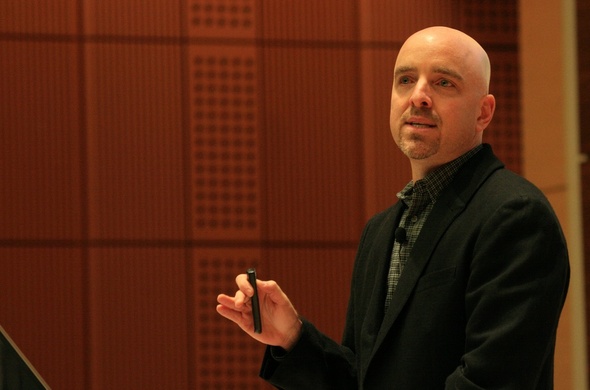
Groupon co-founder Brad Keywell, who earned bachelor's and law degrees from the University of Michigan, spoke to a crowd of students and entrepreneurs this morning at the Ross School of Business.
Photo courtesy of Kai Petainen
Keywell, who earned bachelor’s and law degrees from the University of Michigan in the early 1990s, returned to campus this morning to address a packed auditorium of students and business leaders at the Ross School of Business’ Entrepalooza conference.
Keywell, a venture capitalist and entrepreneur credited as one of three co-founders of daily deals website Groupon, said that startup companies would help the U.S. dig out of its unemployment crisis.
“The question is where are we going to find the jobs that not only will save our country but pave our future?” he said. “Without getting too political, there’s not much question about the fact that infrastructure jobs are not the key to our future. The keys to our future are new innovation, new entities.”
His advice on how the government can help encourage entrepreneurs was simple.
"I’m not sure how much government can do other than get out of the way" as well as "be a big cheerleader" and "a connector," he said.
Keywell’s speech at Entrepalooza, an annual event organized by the Zell Lurie Institute for Entrepreneurial Studies, comes as Groupon is nearing an initial public offering.
Analysts have reportedly valued the Chicago-based company in the range of $25 billion — a valuation that would make Keywell a billionaire on paper, according to documents filed with the SEC.
Due to SEC guidelines regulating the IPO process, Keywell said he had to limit his comments about Groupon “explicitly to what’s already in the public domain.”
Groupon, described by Forbes as the “fastest growing company ever,” went from 37 employees in mid-2009 to more than 9,600 today, Keywell said. The company went from 152,000 subscribers and 212 merchant clients in one country two years ago to 150 million subscribers and 78,000 merchant clients in 45 countries today.
“The numbers speak for themselves,” Keywell said.
One of the key lessons of Groupon’s surge is that successful startups can take off with few resources.
“Groupon started on WordPress. WordPress is a free piece of technology,” he said. “It does not take a ton of capital to start a great business. It takes a great business and execution.”
Keywell displayed a distaste for a lingering distrust of entrepreneurial ventures.
“Our government and our media are extremely late to the game,” he said. “While Silicon Valley grows, thrives and continues to create jobs and be a hotbed of innovation, the rest of us wonder where our jobs and mojo has gone. If you fail at business, the popular press, generally speaking, burns you at the stake. In Silicon Valley, the question is what’s next?”
He added: “Underneath every failure is buried an opportunity. Some are immediate opportunities, some require investigation, but the opportunities are there. The question is whether you can see it.”
Keywell had a high-profile failure of his own with a business called Starbelly.com, which he co-founded with lifelong business partner, Groupon co-founder and U-M grad Eric Lefkofsky. Starbelly took off, and the founders sold it to a public company called Halo Industries in 2000. But Halo went bankrupt soon thereafter.
“The bad news is Eric and I took largely stock in exchange for our founding shares in the company,” he said. When Halo collapsed, “what I thought was $60 million quickly became next to zero. The question then became, how do you pay your bills?”
Instead of giving up on entrepreneurship, though, Keywell and Lefkofsky regrouped and found new opportunities. One of the companies they went on to found, a Chicago-based company called Echo Global Logistics, now employs 1,000 workers six years after it was launched.
“It’s not win or lose in entrepreneurship. The real proposition is win or learn,” he told the crowd of entrepreneurs. “The surest thing in life that you will experience is failure. “We need you to pave the path despite the fact that our government is not helping, and our society does not appreciate the risks you are taking.
“You will go through a series of challenges, of risks, of failures. You will ultimately be rewarded with success. … You hold the future to the vibrancy of our nation.”
Keywell advised students to tap various resources at U-M to accelerate their path toward an entrepreneurial career.
“School wants to use you to achieve its ends,” he said. “But my emphatic advice is for you to use your school for yourself. Mine your education for the tools you need to be an entrepreneur. Ask yourself, are you using your school and this wonderful city of Ann Arbor to help you explore opportunity and to learn and to explore risk?”
Contact AnnArbor.com's Nathan Bomey at (734) 623-2587 or nathanbomey@annarbor.com. You can also follow him on Twitter or subscribe to AnnArbor.com's newsletters.
Comments
AA
Sat, Sep 17, 2011 : 2:50 p.m.
Try opening a business in Ann Arbor and then tell me who should get out of the way.
Mike
Sat, Sep 17, 2011 : 1:29 p.m.
As a small business owner I have seen regulations cost us jobs, forcing lay-offs due to us having to increase prices for UNFUNDED mandates that we are somehow supposed to absorb. As long as the government has all of these regulation cheerleaders and continues to play the "rich" vs. the rest of us game jobs will continue to go to lower cost producers. People who don't own a business and have a real understanding of the cost of all of the taxes, fees, and regulations (i.e. paperwork) are going to continue to find jobs difficult to come by especially if they support all of this government intrusion. Instead of attacking this guy you should be contacting your representatives and supporting him before we become Greece or Europe. We may be too far down that path already........
rinmem10
Sat, Sep 17, 2011 : 12:27 p.m.
Did he provide specific ideas as to how the government could get out of the way? I my be able to agree with some of them, but all I ever hear from the business community is that there are to many rules and regulations, but never specifics. It sounds like towing the party line without any real thought.
Mike
Sat, Sep 17, 2011 : 1:43 p.m.
In my business if you remodel your kitchen you are required to put smoke detctors throughout your house ($1500), if you add onto your home you are requred to put a silt fence around it even if the water has to run up hill to leave the site ($1000), our license fee increased from $55 to $500, if you have lead paint in your house be prepared to pay double what it used to cost in labor to replace your windows, if you have lead and are remodeling your house be prepared to pay 10% more for the cost of your remodel, be prepared to have your project delayed by many weeks since the building dept. requires two weeks to do an inspection, $5000 per year in tax preparation fees since it's complicated, $1700 or more for a license plate for a truck, building permit, plan review, zoning review, grading permit, electircal permit, plumbing permit, heating permit, increase in your tax assessment, safety equipment and tarining for employees, fines and fees. Is this what you mean by examples? I have more......increase in energy saving requirements, government subsidies of same, green job factories guaranteed by taxpayers that go bust, foreign aid, United Nations, famine relief, wars. It's no wonder we're broke as a nation and can't afford anything. How sad; I miss our country and the way it was.
Tru2Blu76
Sat, Sep 17, 2011 : 4:05 a.m.
As one who worked as an executive in S.E. Michigan manufacturing, I can say that the way these modern "entrepreneurs" run their businesses would have gotten them nowhere (or maybe somewhere called prison) before the Reagan Era took hold. I don't buy it: proper business methods have been known for a long time and those methods don't include complete failure in training employees or things like dumping a thousand or more families on the public dole (and then blaming the employees for needing public assistance). Keywell's comments to these students give every indication that he's detached from reality. He shirks reasonable accountability and reasonable caution like an 18 year old on his first motorcycle ride. That the U of M School of Business invites this kind of Wild Child to speak there is frankly - appalling. Time to get back to Earth, Mr. Keywell, your tour of the outer planets has lasted too long already. Encouraging the idea that, because you took risks and paid a price - everyone should accept this as the American way is nothing short of "bull dung" - most people need stability and a business environment based on honest dealings.
Veracity
Sat, Sep 17, 2011 : 12:35 a.m.
I ask of those who want government out of the way of entrepreneurs and small business owners to list specific regulations and laws that are considered unjustifiably restrictive. Lowering taxes will not lead to more jobs as was explained in a recent opinion piece published at annarbor.com: <a href="http://www.annarbor.com/news/opinion/why-corporate-tax-reduction-will-not-increase-jobs/">http://www.annarbor.com/news/opinion/why-corporate-tax-reduction-will-not-increase-jobs/</a> Most entrepreneurs will create tech-related jobs requiring advanced training in engineering, math and computer sciences. Few of the over 500,000 presently unemployed Michigan citizens have the background to contend for such jobs. Only infrastructure jobs can utilize the skills and training of many of our unemployed and certainly enough infrastructure repair and replacement projects exist to provide work for many. However, since new roads and bridges do not generally provide financial returns to investors, the federal government will need to finance these projects. Such federal funding will jump start our economy so that GDP increases as will tax revenue that will repay stimulus funding and reduce the national deficit. Considering the record profits being reported by many corporations and the expected high earnings of the S&P 500 this year, identifying laws and regulations that significantly hamper private enterprise may be a difficult task.
Mike
Sat, Sep 17, 2011 : 1:45 p.m.
Infrastructure jobs ONLY benefit unionized employees who make up a very small percentage of the workforce and by the way it does take skill to run equipmnet well.........
Wystan Stevens
Fri, Sep 16, 2011 : 10:58 p.m.
I wonder if others have had the problem with Groupon that finally forced me to cancel their daily email bulletins? I signed up for some nice discounts on restaurant specials. But that is all that I wanted from Groupon. Instead of more tempting food deals, I got an inbox glutted daily with Groupon offers for yoga lessons, pet grooming, and other nonsense I had no use for. I wish they had a system that would allow one to elect to receive only items of interest, while sending the other stuff to a spam file. This same gripe applies to other vendors of Groupon-style deals.
Jeff LeBrun
Fri, Sep 16, 2011 : 9:45 p.m.
Headline - Ann Arbor News: "Get out... entrepreneurs" . It's funny how the message can change when parts of sentences are used selectively. This article's headline is a misleading summary of the actual talk and message. The quote, in response to an audience member's question was, "I'm not sure how much government can do other than get out of the way" as well as "be a big cheerleader" and "a connector," he said. When one considers the whole statement, it is actually not entirely negative. Although this may help generate quick clicks, to I don't think that will inspire other Michigan entrepreneurs to discuss their opinions with Ann Arbor news reporters in the future. Keywell took the time to visit his alma mater when he have spent it attending to his companies or Groupon's pending IPO. The last thing any entrepreneur needs to consider when donating their time to University students is the possibility of a headline like this, especially when they can avoid those pesky (but lasting) articles headlines by staying at home.
Kai Petainen
Fri, Sep 16, 2011 : 9:59 p.m.
with regard to the comment you made about headlines.... i thought... one really good segment of his speech... dealt with media. ironic?
say it plain
Fri, Sep 16, 2011 : 9:30 p.m.
Groupon's business model should flop on its own in no time, unless the entrepreneurs and consumers continue to buy his 'marketing', while the SEC ineffectually allows him to discount marketing expenses from his marketing company lol... More and more you see cogent analyses like the one referenced here: <a href="http://www.theatlanticwire.com/technology/2011/09/more-evidence-groupon-bad-business/42348/" rel='nofollow'>http://www.theatlanticwire.com/technology/2011/09/more-evidence-groupon-bad-business/42348/</a> about why Groupon doesn't even do what it purports do, help businesses market themselves well. He'd better get that IPO out fast before word spreads further! I think people dislike them/ distrust them without necessarily being able to articulate fully why...but it's so clear, it's parasitic and nakedly so. Even here in the quotes excerpted from his speech...telling students that they need to be sure they ask themselves whether they are *using* their city and their school to their own ends enough lol. Hey kids, he's saying, have you asked yourselves what your country/school/neighbor/teacher/client can *do for you* today yet?! Lovely...we need more of him in the world? Risk, too, is easy to run when government/school/teacher/country is there to rescue you, as the government clearly has done with a bunch of the financier-'entrepreneurs' recently!!
Kai Petainen
Fri, Sep 16, 2011 : 8:38 p.m.
He gave a really nice speech. It had nuggets of advice and it was entertaining. I was worried for him, for his speech... due to the Groupon IPO... but from what I can tell, he didn't say anything that could jeopardize that. Some of it was practical advice, but some of it was challenging advice to students, universities and the media.
puncturedtime
Fri, Sep 16, 2011 : 7:40 p.m.
Ray is absolutely right. As someone who attended the lecture, government interference in entrepreneurship was an incredibly minor aspect of the whole speech, and this title misleads any reader who didn't actually attend it. Brad addressed how we as individuals, a society, and analytical thinkers can utilize modern day tools (software, specialized human capital, venture capitalist funding) at a much lower cost and ease of access than in any age ever before. The overall message -- we must embrace risk, have courage in pursuing our idea to an end, and create something original that both stimulates our economy and enables us to be leaders -- is overshadowed by this deceiving title. Clearly aa.com's chief concern is generating the highest number of clicks on a provocative title, and while this is understandable, it undermines the objectivity of the actual story and misleads readers into opening what appears to be a juicy and politicized statement. Two different times Brad deferred the political implications and conversations that surround such a multi-faceted issue like promoting and funding entrepreneurship. The objective of his speech, to motivate, encourage, and shed insight on what it takes to build a successful and fulfilling business (and which he clearly delivered on), quickly becomes muddied when a journalist soliciting site traffic puts his objectives first.
lumberg48108
Fri, Sep 16, 2011 : 7:56 p.m.
well said ... he took questions from the audience and answered and this story makes it seem that was the focus.... his focus was "win or learn" ----that was my take
Glen S.
Fri, Sep 16, 2011 : 7:28 p.m.
" ... there's not much question about the fact that infrastructure jobs are not the key to our future." I can't wait to see how "Groupon" is doing five years from now, when many people find they can no longer easily travel to stores, restaurants, etc., to redeem their fantastic discounts -- because we, as a society, decided to "get government out of the way" of maintaining infrastructure -- including roads, bridges, etc.
Ignatz
Fri, Sep 16, 2011 : 7:27 p.m.
Yes, by all means, get out of the way, government. That way we can run roughshod over the people, develop our companies, them move them offshore or sell them to someone who will.
RayA2
Fri, Sep 16, 2011 : 6 p.m.
You can really see the bias of the article's author, as well the bias of AnnArbor.com. The title is a gross distortion of the Groupon founder's statement "I'm not sure how much government can do other than get out of the way". The "I'm not sure how much government can do" does not agree with the title "Government should 'get out of the way' of entrepreneurs" Besides, what would you possibly expect a business owner to say? Would you expect him to say that he needs more government oversight so that his financial statements are more transparent? Would you expect him to say that he thinks OSHA needs to be more involved in workplace safety? Get serious, capitalism is not the hand of God and needs government oversight to protect society from the collateral damage caused by the narrow pursuit of profits, which is the sole purpose of business.
lumberg48108
Fri, Sep 16, 2011 : 4:57 p.m.
Do the readers of these pages truly understand how hard it is to be successful as an entrepreneur and the risks and sacrifices they make before they "get rich" cause most do not get rich and lest we forget before they were rich they were kids with an idea --- nothing else. No money! He could have gone and become a lawyer after he graduated (like we need more of them) and no one would have heard of him. Instead, he went "all-in" and is a success. Living without security, chasing a dream, being broke -- most dont have the guts to do this. He thinks more should have the guts and be celebrated win or lose ... People are critical of Groupon for strange reasons - what do you care if his company fails? What do you care if its not profitable? Don't invest in the IPO then - jeez He said many profound things this morning but the best comments were "win or learn; not win or lose" ... everyone should take something positive from his comments
RayA2
Sat, Sep 17, 2011 : 12:56 p.m.
I agree that starting a business is risky business. I don't agree that such risk taking makes entrepreneurs heroes. People don't start businesses because they want to create jobs. In fact, if they are business people at all, they will minimize the number of jobs they create. People start businesses because they want the rewards that business ownership provides them, and they see the corresponding risk as worth taking. From what I have read and heard from honest business owners, government oversight is an insignificant factor in the decision to start a business. I think also that your Horatio Alger model of people who start businesses is way too naive, although it is what business owners and their representatives would like us to believe.
Michigan Man
Fri, Sep 16, 2011 : 4:53 p.m.
Right on Brother! Keep on preaching!
Townie
Fri, Sep 16, 2011 : 4:46 p.m.
5c0++ H4d13y: So go ahead and invest in it... Someone has to make sure the liars don't become the norm and who's going to do that? The 'free' market. The insiders know who's a fraud but the normal (really working) people don't. They did a great job on the housing / mortgage bubble so I guess you don't see a problem there. Nice when the rich get richer by privatizing profits and 'socializing' losses when we get to bail out the 'too big to fail' banks, etc. when their gambles didn't pan out.
5c0++ H4d13y
Fri, Sep 16, 2011 : 8:47 p.m.
@andys I was being sarcastic BTW. Fan/Fred are bailed out for 100s of billions. Funny we don't hear about the AG going after them. Now they want to do it with the Infrastructure Bank. Just say no.
andys
Fri, Sep 16, 2011 : 7:15 p.m.
"They did a great job on the housing / mortgage bubble so I guess you don't see a problem there." That was caused by the govt, the private sector did exactly what the govt wanted them to do, issue mortgages like crazy to anyone regardless of income / assets / down payment. Ever heard of the Community Reinvestment Act, Freddie Mac, and Fannie Mae. You think all those mortgages would have been granted without a govt guaranty? So yeah, the Govt needs to get out of the way!!!!!!!!!
5c0++ H4d13y
Fri, Sep 16, 2011 : 4:59 p.m.
I may already be investing. The government did a great job making the housing bubble. Go look up Barney "roll the dice" Frank. If I had my druthers those banks would have liquidated back in 08. Then Obama cemented "too big to fail" into law. Is that what you voted for? You know what's interesting is many companies stay private and off the stock market so they don't have to deal with the government regulations. Or a company is bought and delisted. Is that what we wanted?
hut hut
Fri, Sep 16, 2011 : 4:45 p.m.
get out of the way so unregulated corporations can purposely rip off consumers without any penalty?
Common Sense
Fri, Sep 16, 2011 : 4:14 p.m.
Keywell wants government out of the way so he can foist made-up accounting methodologies like "adjusted CSOI" on the unsuspecting investing public. Groupon is irreparably unprofitable, mostly because they need to pay so much in marketing to acquire users. They're paying much more per user than they generate in revenue, and the gap widened per their last S-1, so it's getting worse, not better. They created an accounting metric called "adjusted CSOI" which basically removed marketing as an expense, which isn't appropriate for a company which depends exclusively on continuous marketing to generate revenue. The SEC exists to protect investors from creative accounting like "adjusted CSOI."
Kai Petainen
Sun, Sep 18, 2011 : 4:26 a.m.
about the CSOI <a href="http://www.forbes.com/sites/tomiogeron/2011/07/14/groupons-updated-s-1-clarifies-adjusted-csoi-buries-andrew-masons-letter/" rel='nofollow'>http://www.forbes.com/sites/tomiogeron/2011/07/14/groupons-updated-s-1-clarifies-adjusted-csoi-buries-andrew-masons-letter/</a>
5c0++ H4d13y
Fri, Sep 16, 2011 : 4:21 p.m.
Yea because the government is so good at accounting that the need to dictate to private businesses on how to do it.
AnnArbor Anonymous
Fri, Sep 16, 2011 : 4:05 p.m.
$25B? Seems a bit excessive.