

Ann Arbor retailers say stakes are high for local stores during holidays
Local retailers head into the biggest sales months of 2009 knowing that
the shopping decisions made during this time could affect which local
stores survive.
Retailers that count on fourth-quarter sales - particularly after a
dangerously soft spring and summer - to hit annual goals are watching
sales trends closely.
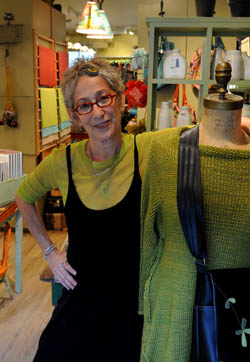
“The last five weeks of the year, it’s do or die for all of us,” says Vicki Honeyman, owner of Heavenly Metal boutique on E. Ann St. in downtown Ann Arbor.
That’s happening on a national level, too.
But in Ann Arbor’s independent stores, owners and advocates say the stakes may be higher.
“The last five weeks of the year, it’s do or die for all of us,” said Vicki Honeyman, owner of Heavenly Metal boutique.
|
A national movement: Buying locally
|
Seasonal sales will define many stores’ futures.
“If you don’t want to see more businesses close, then this is it: This is the time right now (to shop in the independent stores),” said Ingrid Ault, director of Think Local First in Ann Arbor.
And, she adds, she’s already fearful for some operators.
“What people need to understand is they really have the power to make a difference with how they spend their money,” Ault said.
Some in Ann Arbor are mobilizing behind Ault’s Think Local First, which grew from 148 members to 207 in the last year. Membership extends beyond traditional retailers and outside of downtown.
Others are advocating for increased local spending through their retail associations, chambers of commerce and trade groups that help bolster sales of like items for members throughout the U.S.
They hope efforts like the “Buy Local” slogan and the new 3/50 project take hold during this shopping season and result in consumer awareness of how spending choices influence the community.
But for area retailers, the results are personal. It means they can pay the rent, pay employees, even pay themselves.
And they recognize that chain stores have merchandise and pricing that appeals to a mass audience, especially during a recession.
They also draw connections to what it means for the area’s commercial landscape when shoppers don’t spend a small proportion in locally owned stores.
“It’s pivotal to keep the community charm that we have,” said Ault.
“What I ask people to do is think about one of their favorite memories that they have of downtown. Everyone has a favorite store or favorite restaurant.
“If they were gone, how would you substitute that?”
Honeyman agrees with Ault’s assessment that Ann Arbor should be alarmed over the prospect of losing more unique retailers.
“What makes the city cool is its small, independently owned businesses,” Honeyman said. “That’s not chain stores. They don’t make a city cool. What people would lose is what people love about Ann Arbor. The cool businesses, the unique businesses that you can’t find anywhere else.”
Honeyman has made adjustments: She’s buying a lot of the fast-sellers that resonate with buyers this fall. She’s aiming for a lower price point. She’s holding more in-store events, and - since she also cuts hair in the retail space - she’s stocking items to attract those customers, too.
“I’m trying to stay positive,” she said. “It was hard in the summer. It was very, very difficult. I was questioning whether I was going to be able to make it, but I didn’t want Ann Arbor to lose another small business.
“… I’m standing firm. I don’t want to be a statistic.”
Taking fewer risks
Some level of attrition is inherent among local retailers, since they make operations decisions for many reasons.
But this year, the economy is driving many of them. It’s an obvious factor - with over 9 percent local unemployment and a national recession, it’s hard to miss the signs of economic struggles.
The spring and summer yielded acute revenue drops for many local retailers, they said. And in the past year, Ann Arbor witnessed a wave of closings: Fresh Seasons Market, an Espresso Royale on the east side, Shaman Drum Bookstore, Bella Vino, Dream On Futon.
In October, Pear Tree closed after three years on North Main Street. Its owners said that slow sales early in the year destroyed their confidence that renewing their lease for the storefront would be worth the risk.
They’re shifting their business to online sales after absorbing a 50-percent drop in sales and low sales during the 2008 holiday.
“(Sales earlier this year) were the worst we’d ever had in business … furniture sales were really down,” said Jenny Schroer, a co-owner.
“We thought about renewing and seeing if things got better, but in the end … I don’t think they’re going to get better,” she said.
But many retailers are optimistic - based not on sheer hope, but on their attention to sales trends and the strategies they’ll use to weather economic factors.
Like shoppers, store owners are more budget-conscious.
“We have to be particularly selective with how we’re investing our money right now,” said Hans Masing, co-owner of Tree Town Toys.
In previous years, he’s taken more risks with new products. This year, there’s a focus on proven sellers - games are hot in his store right now - and attention to the window when faster-selling items can be reordered.
Honeyman is hoping the Baggu reusable shopping bag stays a hot-seller, and she’s already on the fourth order of a popular dress style.
Heidi Parent, co-owner at Sun & Snow, said that store is targeting in-store events, packages that tie products to experiences, like teaching kids to use snowboards, and repositioning its popular ski swap of used items because of the intense interest.
“We’re doing what we can to get people active,” she said.
But Parent said she feels like she’s fighting a wave of emphasis on “deal-deal-deal” that encourages customers to demand lower prices due to a perception that the retailers are desperate - and able to cut that kind of deal.
“They’re killing consumer confidence and making anyone not want to spend their money at all,” she said. “… That will close the doors of a lot of retailers.”
'We’re rightfully nervous’
Local retailers point out that they’re also customers in this market. Masing, for example, said he makes his own buying decisions based on trying to keep as much money in the local economy.
“That’s worth more than the (limited) savings I may get,” he said.
“We’re all in this together,” Masing added. “It’s not an ‘us-versus-them’ with our customers. If our customers want us to succeed, they have to help us … and we have to help them by running our business as honestly and straightforward as we can, and make sure we have products that they want.”
The retailers also seem to share some unity with other local merchants.
Parent said other similar outdoor-merchandise retailers in the area are exploring what collaboration could do to improve their businesses.
Honeyman speaks of other boutiques, like Sole Sisters Shoes, that also work hard to retain their place in the local retail landscape.
Tree Town Toys staff will encourage customers to try Learning Express if they don’t have a wanted item available.
The strategies, they hope, will get them through the season - and beyond.
“We’re rightfully nervous,” said Masing. “Customers are nervous, too. So we share that.
“The question is: How do we address that nervousness as business owners, and how do we help ensure that as things pick up … that we are positioned to have weathered this story and come out of it thriving?”
The one thing they can all be sure of in the next weeks is that the volume of shoppers hitting the stores will increase, and they at least have a chance to have a part of it.
“It is tenuous times,” said Honeyman. “But I’m not hearing anyone saying, ‘I’m not buying Christmas presents this year.’”
Paula Gardner is Business Director for AnnArbor.com. She can be reached at PaulaGardner@annarbor.com or (734) 623-2586.
Sign up here for the weekly Business Review email newsletter, sent every Thursday.
Comments
bunnyabbot
Mon, Nov 2, 2009 : 9:08 p.m.
I frequent the Kerrytown area weekly for shopping and the market. I know many shop owners now. They remember you by name or for some other reason and ask about relatives and vacations etc. It's great to see little shops flourish and terrible when they disappear. You just don't get the same service and friendliness with big box stores. I go out of my way to support small businesses, local businesses. The Walmarts of the world might have locals working there, but like a Starbucks on every corner their other locations help to float ones that generate less revenue. For them it's about presence and market share. For small businesses it's about the passion for a product line, the owners ties to the city, did they grow up here? go to school here? or meet their spouse and moved back here to the spouses hometown? It's just so much more interesting talking to a person than to someone that just scans stuff mindlessly and only knows what the register lights up and says to them. also, who wants something to give or be given that everyone else will have as well?
Ann Arbor Mom
Mon, Nov 2, 2009 : 10:21 a.m.
Don't let Ann Arbor turn into another empty-storefront town surrounded by big box stores and mediocre themed chain restaurants, or another "Generica" town.
beegee19
Sun, Nov 1, 2009 : 9:28 p.m.
I work at a small store downtown, and I cannot tell you how invaluable our customers are to us. We greatly appreciate those who think to buy local, and we--as well as many other downtown retailers--will do everything we can to get our customers what they want. Not only do small stores try their best to keep prices reasonable, but they often make up in quality what they lack in quantity. I love our usual customers and the connection that I get to have with so many Ann Arborites! Unfortunately, there is nothing out there like Arbor Bucks. There used to be Ann Arbor Gold Certificates, but the company that helps to supply them went bankrupt. It certainly would encourage people to spend money locally. However, many locally-owned stores downtown are willing to do gift certificates, which provide a great opportunity to help your friends support small businesses, too!
ogel1209
Sun, Nov 1, 2009 : 2:05 p.m.
Please shop at Heavenly Metal! There is no other store in Ann Arbor like it. It is uplifting to go into the store, not to mention all the novel items the store has. It is a store that would be missed!
11GOBLUE11
Sun, Nov 1, 2009 : 1:50 p.m.
Whatever happened to the idea of Arbor Bucks? I give gift cards, so I am often limited in local options. I ALWAYS try to favor local business though. As I envisioned the Arbor Bucks program, you buy a card and the money goes into the program fund, and then less admin expenses of some set percentage, the local retailer makes a claim to the fund and gets paid for purchases (or even the retailer and the purchaser split the admin expense...justifying the purchaser allocation due to convenience). If it were something like this, and there was wide participation, I would buy around 75% of Christmas spending in Arbor bucks (the other 25% being gifts to those not in the area!). It would be great if it was restaurants, retail, etc.
Barb Roether
Sun, Nov 1, 2009 : 1:24 p.m.
The real issue is that we can each make a difference by shopping local as much as possible. The small local shops are the places to find different, unusual, and thoughtful gifts. These are places that give true customer service and a relaxing place to shop.
Rita
Sun, Nov 1, 2009 : 1:02 p.m.
I agree that we need to "buy local" whenever possible to help the local and state economy. Think about this: A house and a vehicle are usually the largest purchases a person will make. Buying a Ford, GM or Chrysler vehicle would help our state and local economy. These domestic auto companies pay taxes to support our local and state economies. With auto sales down, our state has lost a huge corporate tax base. As auto workers lose their jobs, the taxes they used to pay are gone. S.E. Michigan is heavily dependent directly or indirectly on the automotive industry. We all have to stop and think, "What is my customer base?" I want my business supported by local folks, but am I supporting them?
Paula Gardner
Sun, Nov 1, 2009 : 11:30 a.m.
No, that's not new. What is concerning this year is how the retailers who need to sell that much in the next two months can't project - or assume - they'll be able to hit it, even after making adjustments in their operations after the soft spring/summer. And if they don't, there's high potential in Ann Arbor for the city to lose more stores that many of us consider part of what makes the town unique.
15crown00
Sun, Nov 1, 2009 : 11:14 a.m.
Is this suppose to be new knowledge?Retailing 101 tell you 30-70% of MOST retailers business comes from mid November to X-Mas Eve.Have a little knowledge of tis since i've been in the business for 35 years.
Macabre Sunset
Sun, Nov 1, 2009 : 10:55 a.m.
It's great that these retailers recognize the challenges. Not only from the big chains, but from the Internet. They have to stock items that can't easily be found elsewhere, and they have to focus on great service and even lower margins a bit. Back in Brighton, downtown is becoming empty because all the merchants do is whine about buying local. When all they offer is the same pair of jeans for $100 that you can find elsewhere for $30.
Paula Gardner
Sun, Nov 1, 2009 : 8:35 a.m.
Thanks for sharing how you enjoy shopping in that area of town. We'll be visiting as many local stores as possible as we cover the Holiday09 shopping season and these are some great suggestions for our followups, too!
Dr. I. Emsayin
Sun, Nov 1, 2009 : 8:17 a.m.
The women in my family love the novel items at Heavenly Metal. When we come out of the Ann St. side of the Hands-On Museum, they stop in there for their "grown up gift shop" items. That whole area on 4th Ave/Ann St has independent stores for holiday items. The Dogma store makes me laugh every time I go in there and see the unusual things I never thought to buy for my pet owner friends. Instead of a bottle of wine at a holiday party, you can get a $10 delightful gift at one of these stores. Or tea, or a Co-op gift certificate. Or go to Kerrytown down the block.Hollanders has wonderful holiday cards, no matter your religious or non-religious affiliation. The independent store choices are endless in that area of town. And I am not associated with any of these stores, this is just my friendly response.