

Mary Sue Coleman defends Johnson & Johnson board membership after conflict of interest questions
University of Michigan President Mary Sue Coleman this morning defended her membership on the Board of Directors of health care giant Johnson & Johnson after the New York Times placed a spotlight on her relationship with the company.
"I don’t think it’s a conflict at all," Coleman told AnnArbor.com after a forum where U.S. Secretary of Commerce Gary Locke named her to a National Advisory Council on Innovation and Entrepreneurship. "And, in fact, I sought approval from the (U-M) board years ago before I joined the company. They were thrilled that I was going to be there, so I don’t view it as a conflict."
Coleman's involvement with J&J has become a topic of discussion after the university last month decided to reject funding for continuing medical education from pharmaceutical companies and medical device manufacturers.
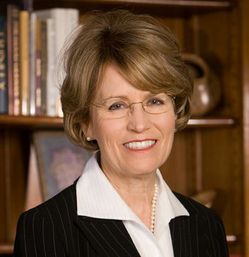
University of Michigan President Mary Sue Coleman
The decision, which reportedly could lead to a $1 million funding drop for the university, was aimed at eliminating potential conflicts of interest for doctors who could be pressured to promote specific products over others. J&J is a massive conglomerate that sells various drugs, devices and diagnostic products.
The New York Times story questioned whether Coleman's relationship with J&J is being properly scrutinized in light of the new rules. Coleman was paid $229,978 in stock and cash in 2009, the Times reported.
"Conflict of interest? Conflict of policies? If the med school and mere professors could be tainted by drug money, what about the university president?" the story said.
But Coleman told AnnArbor.com that she believes her membership on the J&J Board of Directors is fruitful and said she isn't doing anything unethical.
"We have strict policies, I adhere to all those policies, so I’m not at all concerned about it," she said. "In fact, I think it’s my duty to be out there understanding what the commercial world is doing and I think if it perfectly aligns with what we do in terms of our engagement in economic development, I think it’s important."
She added: "I don’t treat patients, I’m not an MBA, I have no control over any interactions or anything, so I’m very far removed and I feel very comfortable with the relationships, as I believe my board does."
Coleman said she endorsed the university's new policy of rejecting commercial funds devoted to postgraduate medical education.
"That’s an issue that was debated by the faculty," she said. "The clinicians decided that’s what they wanted to do, and I fully support them."
Contact AnnArbor.com's Nathan Bomey at (734) 623-2587 or nathanbomey@annarbor.com. You can also follow him on Twitter or subscribe to AnnArbor.com's newsletters.
Comments
michigan48103
Fri, Jul 16, 2010 : 12:37 a.m.
It just goes to show you it is not what You know it is who you know. If you work for the University and sell Avon, or other products and try to sell while working, I have seen people give time off without pay. And even fired, but they are a hourly worker. There is a administrator at the Medical Center that does own a Flower shop in Ypsilanti, I said to her congradulations on the new store that you own and she said, I do not own a store what do you mean and I had the article in the Ann Arbor News Laminated and I gave it to her as a gift and soon later, I was fired after working for the University for over 16 years. When you have something wrote about you in the newspaper, it is news and not a rumor. She said I spoke to her to loud about the rude Supervisor that would sleep when working on the midnight shift and her friends would sleep also and a patient almost died. So,it is not what you know, it is who you know and can get away with. When I wrote to the Pres. Coleman, she did nothing and the workers are still sleeping and the sleeping supervisor has been promoted to manager and one of her sleeping friends has been promoted to supervisor. In the position that Mary lou is in I am sure nothing will happen, she is even on the board of the Shelter Association in Ann Arbor. You would think she would be too busy to do any thing other that be a President. A wonderful Doctor that was with the U of M for years, did not give alot of his profits to the University when he wrote a book and he was fired. It just goes to prove it is not what you do, it is who you are and what you can get away with because of your position and your friends at the University of Michigan.
Lady Audrey
Wed, Jul 14, 2010 : 4:58 p.m.
No one ever recognizes their own potential conflict, but often will see the potential for conflict in others. "O would some power the gift to give us to see ourselves as others see us." Robert Burns, Poem "To a Louse"
Bill
Wed, Jul 14, 2010 : 8:08 a.m.
This is another example of a public employee taking advantage of their position for personal gain.
A2lover
Wed, Jul 14, 2010 : 5:58 a.m.
I knew we couldn't trust the "little sparrow" from the moment she attended the clandestine meeting in a diner in Ohio to recruit Rich Rod. Whether it's a conflict of interest or not, the fact she's receiving $200-odd thousand is outrageous. Double-dipping I think it's called. And, she must be putting time in at J J to justify getting that enormous amount of compensation (when she should be working for the U of M), and J J must be getting something back for coughing up the $200k. It's all very fishy. I don't think they can put a band aid over this one. It's no wonder Ms. Coleman can afford to give money back to the university, not accept certain raises, etc. I'm continuously appalled at the disingenuousness of the leaders of this university. They profess integrity, sincerity and being a worthwhile academic institution, while all along they practice deceit, self-serving actions and taint the name of the U of M at every given opportunity.
Stuart Brown
Tue, Jul 13, 2010 : 10:17 p.m.
trespass said, "@steve pierce- It takes guts for a politician to criticize Mary Sue Coleman. She has a long history of retaliation. When the Michigan Daily criticized her on this topic, her public relations person was all over them, telling them that "People in the Fleming building are very upset". I appreciate your guts and I hope the voters do as well." I concur. UofM under Mary Sue Coleman has a disturbing history of pulling out all the stops when it comes to retaliation. I remain hopeful that Rich Rod's lousy record and Mary Sue's slow response in removing him will get the alumni association motivated to have her removed. Did anyone notice that the Michigan Daily did not cover the recent story of a distinguished professor in the education department who was removed without due process? These methods and the organizational culture permitting them are coming straight from Mary Sue's office.
Mikey2u
Tue, Jul 13, 2010 : 9:13 p.m.
Back in 1998 GE Medical Systems bought a company called Critikon from the Johnson and Johnson family of companies. Critikon Inc was one of the worlds largest manufacturers IV devices. Earlier this month Ann Arbor dot com reported that Tangent Medical Technologies Inc., one of two startup companies created by fellows from U-Ms Medical Innovation Center is working on the development of a prototype of a new type of IV device. Johnson & Johnson stands to benefit a great deal from the tax payer funded research being conducted by the U-Ms Medical Innovation Center. Perhaps President Coleman isnt aware of the connection between U-Ms Medical Innovation Centers research and the Johnson & Johnson line of products. Perhaps the connection between U-Ms Medical Innovation Centers research and Johnson & Johnson is innocent and nothing more that a coincidence.
Hypnotique
Tue, Jul 13, 2010 : 8:52 p.m.
The University of Michigan will circle the wagons and defend all of this ridiculousness. The President's communications team should be advising her that "perception is reality" and the perception is that it's a conflict of interest.
cook1888
Tue, Jul 13, 2010 : 8:45 p.m.
I hope she is not doing J & J work on UM (taxpayer) time.
treetowncartel
Tue, Jul 13, 2010 : 7:55 p.m.
Maybe she can gwet some of her cronies at J & J to buy those last remaining luxury boxes. Once the airport runway is expanded they can fly in and out from the east coast for game day.
trespass
Tue, Jul 13, 2010 : 6:24 p.m.
@melissa- "Any board made up solely by business/financial interests will not have the public's interests anywhere near their radar." The FDA is reported to be considering criminal charges against a J&J subsidiary, McNeil Labs, for all kinds of manufacturing problems leading to contaminated products. Where was the public's interest considered when the J&J board & MSC were supervising those operations?
Cash
Tue, Jul 13, 2010 : 5:20 p.m.
@Steve Pierce, I concur with @trepass. I appreciate your post and your honestly. Your no nonsense approach is refreshing.
Cash
Tue, Jul 13, 2010 : 5:16 p.m.
"I have no control over any interactions or anything, so Im very far removed"..... Wow. The president of the university and she says that? For once I'd agree with her. She obviously is far removed....from reality. She should quit one of the two positions immediately. Last time I looked UM was still a public university, taking taxpayer's money. Clean it up, Mary Sue.
trespass
Tue, Jul 13, 2010 : 5:08 p.m.
@steve pierce- It takes guts for a politician to criticize Mary Sue Coleman. She has a long history of retaliation. When the Michigan Daily criticized her on this topic, her public relations person was all over them, telling them that "People in the Fleming building are very upset". I appreciate your guts and I hope the voters do as well.
Melissa
Tue, Jul 13, 2010 : 5:06 p.m.
Companies like J&J should have accomplished scientists and researchers sitting on their board, not just MBAs and people interested most with finances. Prof. Coleman has a doctorate in biochemistry with numerous contributions to the field. You can always play the conflict of interest card with her position, but when it comes down to it, don't you want a person with actual knowledge of the workings of their products making the decisions? Any board made up solely by business/financial interests will not have the public's interests anywhere near their radar. And as for the campus-wide smoking ban, it's ridiculous to think that Dr. Coleman's decision had anything to do with whether or not J&J would make money selling cessation patches to maybe 5000 people. Remember the restaurant smoking ban? People didn't quit or leave; they just don't smoke inside anymore. And for those who don't agree with the ban, rest assured it will be impossible to fully enforce (see any of the numerous other "smoke free" campuses).
Steve Pierce
Tue, Jul 13, 2010 : 4:52 p.m.
There are a number of U-M doctors that have repeatedly said their activity with drug company sponsored speaker bureaus and continuing medical education programs were not a conflict of interest. These doctors have repeatedly told President Coleman that they should be trusted when making decisions over ethics and conflicts of interest. President Coleman and the Board of Regents have said these U-M doctors cannot be trusted to judge on their own if there are ethical conflicts when it comes to continuing medical education (CME), so the U-M has implemented an outright ban. Dr. Coleman, if you can't trust a U-M doctor to make the right decision when it comes to evaluating conflicts of interests and CME's, then how can we trust you to make the same decisions regarding board membership? We can't. Dr. Coleman, you should resign from the J&J board effectively immediately or rescind your recently implemented CME policy. If you won't resign from the J&J Board Dr. Coleman, then how about letting those same U-M doctors you don't trust with an ethical decision to decide what you can do when it comes to conflicts of interest and membership in corporate boards? Don't worry Dr. Coleman, you can trust your U-M doctors to make the right decisions for you, just like the U-M doctors can trust you to make decisions for them. Steve Pierce Ypsilanti, Michigan
Veracity
Tue, Jul 13, 2010 : 4 p.m.
Apparently the role of President of the University of Michigan does not provide enough work or excitement for Mary Sue Coleman so she added the job of a director for Johnson and Johnson. Perhaps President Coleman finds her salary of $553,500 (2009-2010) insufficient for her needs and, therefore, augments it with the $229,978 from Johnson and Johnson. She and her eleven director colleagues are paid well for the seven or so meetings each must attend during a year. I wonder what unique skill President Coleman brings to the board meetings. Possibly, Johnson and Johnson is satisfied just to have the name of a distinguished major University associated with its company.
Jay Thomas
Tue, Jul 13, 2010 : 3:22 p.m.
So Mary Sue Coleman has free time to advise corporations in return for hundreds of thousands of dollars in remuneration? She is also a trustee and board member of other organizations as well. University President must not be that demanding of a job... @Ignatz: That would seem to be a very real conflict of interest. She's been on the J&J board since 2003.
runbum03
Tue, Jul 13, 2010 : 2:55 p.m.
Ms. Coleman is an example setter. Watch closely young people. Watch actions - not the words. The message is clear: one must cheat a little in Michigan to get ahead. This is not academic. This is real life. After all, why can't big business and big academia be a little friendly? This is no different then when Roger Penske "loaned" Ex-Mayor Kwame Kilpatrick $240,000 to get out of Dodge, isn't it? Look to your "betters" to see how life is supposed to happen. Than follow their good example.
iamwrite
Tue, Jul 13, 2010 : 2:49 p.m.
Article: She added: "I dont treat patients, Im not an MBA, I have no control over any interactions or anything, so Im very far removed and I feel very comfortable with the relationships, as I believe my board does."...and she was hired why????
trespass
Tue, Jul 13, 2010 : 1:46 p.m.
The New York Times also reported recently that the FDA was considering criminal charges against a J&J subsidiary, McNeil Labs. What role did the J&J Board and President Coleman have in that scandal? Isn't this enough for President Coleman and the Board of Regents to reconsider the benefits of her participation on the J&J Board?
trespass
Tue, Jul 13, 2010 : 1:35 p.m.
J&J isn't stupid. The must be getting value for what they pay President Coleman. Can she explain what that value is? Also, her description of the value it provides to UM is pretty vague. Certainly this controversy is costing the UM something in the way of reputation. I think the Board of Regents should look at this again. Mary Sue Coleman has never given a clear answer to the question of who propsed the smoking ban. If her conflict is being managed in a transparent way then why doesn't she admit it was her idea? The two members of the Regents who are up for re-election in the fall, Andrea Fischer Newman and Andrew Richner were on the Board when her confict was approved. It doesn't look like they are doing their job of supervising the Administration. They need to be voted out of office in the fall.
Ignatz
Tue, Jul 13, 2010 : 1:33 p.m.
Let's try this on for size: President Coleman is a primary force behind the Smoke Free University Initiative. Part of this initiative is that the U will continue to provide help to those who want assistance in quitting smoking. Banning smoking on campus will likely increase these efforts. Johnson and Johnson makes nicotine patches. Will this company be banned from selling these patches to University staff participating in these programs?
kmgeb2000
Tue, Jul 13, 2010 : 1:29 p.m.
"But Coleman told AnnArbor.com that she believes her membership on the J&J Board of Directors is fruitful and said she isn't doing anything unethical." It doesn't require an advance degree to grasp this, as it's fruitful for her to the tune of $229K plus another $137,167 from Meredith Corporation. The question is what benefit does the University receive for her not doing her "real" job? In the age of crackberry and Internet, aren't jobs essentially 24/7/365. Especially when you make $700K in annual salary.
Mikey2u
Tue, Jul 13, 2010 : 12:57 p.m.
President Coleman should not have involved herself in any situation that might be construed as inappropriate. Her actions have a direct reflection on the University and her involvement with Johnson & Johnson has now cast a shadow across that great University. Who was it that said: greed is the great unraveler?
Top Cat
Tue, Jul 13, 2010 : 12:03 p.m.
She must have a lot of time on her hands. I wonder how many hours per week the U of M gets from her for the $700,000 annual salary she receives.