

Michigan proposes retirement plan to help balance state budget
A plan aimed at enticing a few thousand state workers to retire that could save the state $60 million in its first year is part of a tentative budget deal that Michigan's key legislative leaders formally agreed to Wednesday.
The proposal to help balance state government's budget could face its first tough votes in the Legislature next week. The plan does not call for general tax increases, but it does include a still developing tax amnesty plan and budget reductions of about 3 percent for many state departments.
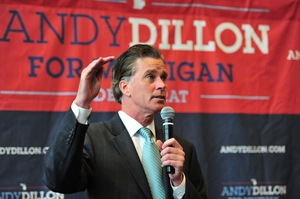
Democratic House Speaker Andy Dillon, shown here addressing a crowd on the campus of the University of Michigan in July, agreed to the latest budget proposals, some of which were recently proposed by Democratic Gov. Jennifer Granholm as part of a budget fix.
Ryan J. Stanton | AnnArbor.com
"We're just at the tip of this process right now, and we'll do the best we can to move forward with the agreement," Republican Senate Majority Leader Mike Bishop said. "But we're all cautiously optimistic at this point."
Michigan lawmakers have already taken some key votes to balance the budget for the current fiscal year. On Wednesday, the Republican-led Senate voted 21-14 to transfer more than $200 million of a surplus in the state's school aid fund to help cover a $302 million shortfall in the state's general fund. The Democratic-led House approved the bill last month, a move made easier because Michigan will get more than $300 million in additional and unexpected federal schools money.
Although the funding shift will help wipe out the current fiscal year's funding gap, the state faces a projected $484 million general fund shortfall for the fiscal year that starts Oct. 1. Still, the state's school aid fund is in decent shape and school districts should be safe from cuts in the current budget negotiations.
Bishop and Democratic House Speaker Andy Dillon agreed Wednesday to the latest budget proposals, some of which were recently proposed by Democratic Gov. Jennifer Granholm as part of a budget fix. All three leaders are term-limited and will leave office at the end of this year.
"These changes are essential if we are to maintain our critical investments in job creation and education and provide the services citizens need during this time of economic transition," Granholm said in a statement.
Bipartisan committees of Senate and House members will iron out specifics of budget proposals before putting them up for votes in the Legislature.
One of the tougher proposals to pass — at least in the Democratic-run House — may be the retirement proposal for state workers. A similar plan approved earlier this year for public school employees was fiercely opposed by labor unions.
The state employee retirement plan would slightly sweeten pension benefits for those already eligible to retire. Workers who aren't eligible to retire but meet certain age or years-of-service requirements also could get better pension benefits if the plan is approved. More than 12,000 workers might be eligible, and officials estimate that roughly 3,500 to more than 6,000 might retire if offered the deal.
Employees staying on the job would have to contribute more to retiree health care plans. The contributions would start at 1 percent in the plan's first year and increase to 3 percent in five years.
That's less costly for employees compared to the schools plan, and legislative leaders are hopeful that the change will make the program more palatable to state employee unions.
If the state employee retirement plan doesn't pass, legislative leaders said they would make up the difference by trying to reduce tax revenue sharing payments that go to local governments to help pay for public safety and other services.
"If we don't get that retirement (plan), then revenue sharing cuts are going to hit," Dillon said.
Michigan lawmakers have missed the annual Oct. 1 budget deadline in two of the past three years. The worst consequence of missing budget deadlines was a partial government shutdown of about four hours in 2007.
Comments
AlphaAlpha
Thu, Sep 9, 2010 : 6:31 p.m.
The long term fix is to lower wages paid to state workers, not to pay them more to stop working. BLS data show government workers now earn more than their private sector equals; normalizing their pay to private sector levels would be quite prudent. Appropriate pay for civil servants would eliminate the budget shortfall, as well as allow hiring of additional state employees to reduce workload and improve service for the citizens.
jondhall
Thu, Sep 9, 2010 : 2:31 p.m.
Andy should have been the next Governor of this state! The Union thugs came in with big dollars at the last moment. Oh well Snyder is the man now!