

Regulatory maze allows state-licensed limousines to impersonate taxis in Ann Arbor
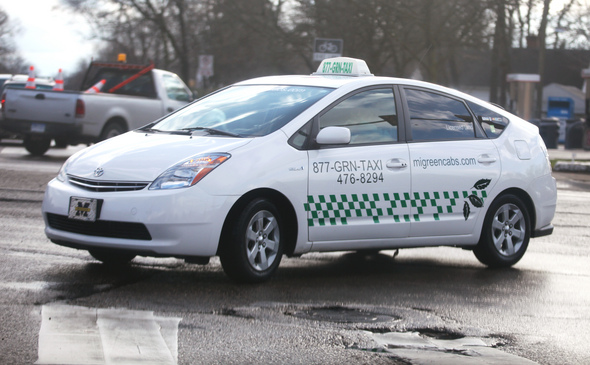
Michigan Green Cabs is actually a state-licensed limousine company. Recent changes to the Ann Arbor taxi ordinance will prevent limo companies from advertising like taxis.
Jeff Sainlar | AnnArbor.com
Observers say demand for cab rides is high for a number of reasons. “Ann Arbor has a lot of students who don’t have cars,” said John Lane, an Ann Arbor taxicab driver. “There’s also a lot of bars. Then, you’ve got the business people, kids late for class and airport trips.”
But taxi drivers and city officials say that a regulatory loophole is allowing drivers technically licensed by the state as limousines to impersonate taxis, escape city regulations and take business away from licensed taxi drivers. Ann Arbor has 203 licensed taxi drivers and 112 licensed vehicles, said police officer William Clock, who handles taxi licensing for the city.
What most cab riders don’t know is that the light on top of a car or a bright yellow color doesn’t necessarily mean it’s licensed as a taxicab. In fact, a lot Ann Arbor’s cabs are classified as limousines. They’re not the kind of limousine rented by a bride and groom to serve as an escort to the wedding reception. These are cars licensed as limousines that look and act much like taxicabs.
While the city of Ann Arbor regulates taxicabs, the state of Michigan regulates limousines. The state’s Limousine Transportation Act, passed in 1990, states that any car “with a seating capacity of 15 passengers or less” can be classified as a limousine if it receives a limo license from the Michigan Department of Transportation.
“Limos can be anything from a little tiny car to a stretched out Hummer,” said Lane. “A Prius can be a limousine.”
Limousine vs. taxicab licensing
To get a limo license from the state, a driver must annually submit an application with an equipment vehicle roster, certificate of insurance and proof of a commercial driver’s license. Drivers must have an annual vehicle safety inspection and have their driving record monitored by their company. A small sticker is then placed in the window of the car to prove it’s licensed.
Taxi drivers are subjected to more restrictions. In addition to the state regulations applied to limousines, taxi drivers must submit their criminal histories and driving records directly to the city.
State law says licensed limos only need to comply with a city’s “vehicle for hire ordinance(s)” if the city has a population of 750,000 or more. Since the population in Detroit has shrunk to less than 715,000, no Michigan cities have more than 750,000 residents.
This statute allows limos to operate similarly to taxicabs but with fewer restrictions and regulations.
Limos operating like taxicabs
Earlier this year, Ann Arbor’s Yellow Cab changed its name to Yellow Car and switched the majority of its cars to state-licensed limousines instead of city-licensed taxicabs.
Dave Ried, president of Select Ride - the company that owns Yellow Car - said the flexibility in pricing for limos is better for both customers and drivers.
Licensed taxis in Ann Arbor charge a flat $3 fee and an additional $2.50 per mile or 40 cents per minute for waiting time. But limo drivers are free to determine their own rates.
“We have multiple types of pricing now and we’ve got a tiered pricing that goes down with longer trips,” Ried said. “As a limo, we are compliant with the law when we charge a flat rate. We can also alter prices based on the cost of fuel, so drivers can afford to feed their families.”
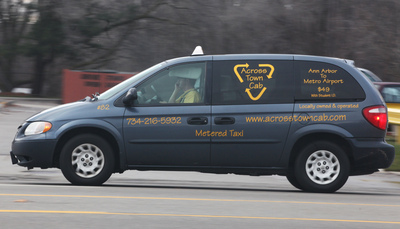
Across Town Cab advertises that it's a "metered taxi" on the side of the vehicle.
Jeff Sainlar | AnnArbor.com
In addition, limos can travel in between cities and work in the entire state of Michigan, whereas a taxicab can only pick people up in the city of Ann Arbor.
Because of these laws, many licensed limo drivers have been coming into Ann Arbor on busy bar nights and football game days and charging higher than normal rates, Lane, an Ann Arbor taxi driver, said.
“Limos can just rip people off and it reflects on us,” he said. “People will get into my cab and ask how much it will cost and I explain that I can’t tell them because taxis use a meter. Then, they get angry and won’t use us.”
Select Ride’s Ried said customers appreciate knowing the cost of a ride up front.
Lane also said limos are parking at Ann Arbor’s prearranged taxi stands - specific parking areas for taxis in downtown hotspots - and soliciting passengers, which is against a city ordinance.
According to the ordinance, “No person shall operate a motor vehicle and solicit or accept passengers who have not previously arranged to be transported in the motor vehicle,” unless it’s licensed as a taxicab. Taxi stands are also only designated for licensed taxicab vehicles to park, said Clock, the Ann Arbor police officer.
But Clock pointed out that while “previously arranged” passengers are required for limos, it’s a vague requirement, making it difficult to enforce.
“We’re trying to prevent these cars with a limo tag that are picking people up and driving downtown looking for passengers,” he said.
‘Gypsy cabs’ and unmarked cars
It’s not uncommon to see cars in Ann Arbor with no marking and a light on top of the vehicle. These unmarked cars are actually licensed as limousines.
Unlike the city’s taxis, the state only requires vehicles to mark the car with company lettering or a registered logo if it weighs more than 5,000 pounds, according to the Limousine Transportation Act.
The problem with unmarked cars, Lane explained, is that anybody is capable of buying a “for hire” light at the store and acting like a taxi driver.
“People don’t look at the kind of taxi they’re getting into,” he said. “Any criminal on the street can pick people up and do whatever he wants.”
Clock said that although he hasn’t had many complaints of driver misbehavior, it’s “obviously a concern.”
“I’m a big fan of trying to educate people about what car they’re getting into,” he said. “Do your education on what’s out there.”
In addition, Clock said it’s easier for licensed limos to operate illegally by not annually renewing their insurance to avoid fees.
“I think it’d be a lot easier for a company to violate the limo law than taxicab ordinance,” he said. “The state has a lot of responsibilities and it’d be difficult to enforce.”
“I’m the only person who handles taxicabs full time in Ann Arbor,” he continued, “and officers are so busy, it’s difficult to get them to enforce these laws unless there’s a major issue.” The Michigan Department of Transportation has a list of licensed limo carriers on its website, and spokeswoman Janet Foran said she encourages consumers to always check the list.
“There may be a few limos that are operating illegally,” she said, “but for the most part, the companies we work with are knowledgeable. But a lot of it is up to the consumer to make sure they do their homework. Remember that the lowest price is not necessarily the best price.”
She said passengers can ask limo drivers for a current copy of their driving records, and they should always check for an MDOT limo decal in the window.
Easier enforcement and a call for increased cab use
As the Ann Arbor Downtown Development Authority continues to try to increase modes of transportation in the city, DDA executive director Susan Pollay said she’d like to see a day where taxis can be easily hailed in Ann Arbor.
“In our view, the more modes of transportation that people have available to them, the better,” she said. “Taxicabs are used throughout the world as a great way to get through downtown without the need of your own vehicle.”
As the possibility of increasing taxi operators and taxi use looms in the future, the Ann Arbor City Council recognized some of the issues with the varying laws for limos and taxicabs and recently adjusted the city’s ordinance.
Among the changes: Limos in the city cannot advertise as a taxicab, which includes putting the words “taxicab,” “cab” or “taxi” on the vehicle and using “for hire” lights on the roof of the car. Also, the ordinance bans vehicles that aren’t licensed taxis from taking passengers without a prearranged fare.
But the changes, Clock said, have yet to be enforced.
He said that to help enforce limo and taxicab laws, it’d be ideal if only taxicabs could operate in Ann Arbor or if the city had the power to regulate limos.
“This is our community and the taxis are regulated by us,” he said. “We keep a good product and make sure vehicles are inspected and drivers are responsible. I’d also like to see the limo act be a little more descriptive. I’d like more guidance.”
Lizzy Alfs is a business reporter for AnnArbor.com. Reach her at 734-623-2584 or email her at lizzyalfs@annarbor.com. Follow her on Twitter at http://twitter.com/lizzyalfs.
Comments
R Grosinsky
Mon, Jan 30, 2012 : 8:07 p.m.
Just so ya now not all limos are rip offs, there is one who offers a low flat rate. anywhere in town for $7.00, anywhere around Eisenhower, and Ann/Saline from town for 10 to $15.00 depending on plus or minus miles from that point. $50.00 to the airport, one pickup point, and up to 5 people. 20 to $30 dollars to Ypsilanti (plus or minus mile 20 to west side 30 to east side)most of this is flat rates. these rates rise and lower with gas prices. oh and by the way these limo's are also responsible for gas, oil,cleanliness inside and out. How about this one this Limo driver picked some one up IN CRISIS (someone had drug his girlfriends drink) delivered them to the hospital at NO CHARGE ! ! ! Has stopped on the side of the highway and gave a stranded motorist a ride to get gas and put them back at there car at NO CHARGE. How many cabbies are willing to do that, I'm guessing , ahhhhh, not many. Another big the Snow storm that hit last week only 1 or 2 cab co. were out the rest were limo's. So let me get this straight cabbies are crying cause limo take there jobs but they don't want to work in inclement weather. talk about capitalism at work. by the way the name of the limo co was MUSTANG SALLY try them some time more fun than a TAXI.
Jonas B Williams
Sat, Jan 14, 2012 : 3:04 a.m.
The problem here, moving forward is going to be Obamacare. It used to be, many decades ago, in the 70's and 80's, at least in some larger cities, that driving a cab was a real job -- workman's comp, W-2, retirement, health insurance, etc. Then, everyone went non-union, and now it's an atrocity. The right thing to do is to have these employees be real employees. To pay them a living wage, to give them access to something other than Medicaid, and so on. The "status quo" with regards to how most taxi companies operate (not naming any names, btw) is antiquated, unregulated, and unethical. Good luck getting so much as a 1090. Independent contractor? That's a joke. Hopefully the companies in Ann Arbor will have the ethical and moral fortitude to do things the right way. That's where this needs to go -- where the "driver" is a real employee. There is no other way. Any other way it's just a car rental agency, cramming as many cars on the road as they can get their hands on. Less cars, more experienced drivers, computer software helping cars be routed in the most efficient manner, and drivers as real employees with full benefits. C'mon, it ain't that hard. Everyone else does it. Well, almost everyone else.
Crystal
Sun, Dec 25, 2011 : 12:09 a.m.
Wading through all the comments posted, it seems there is too much irrational animosity between the two industries. There are advantages and disadvantages to each, and really looks like they need to learn to share. If a taxi comes up to a stand where a limo is parked, the limo needs to leave. Taxis need to stay in their city limits. The thing that bothers me the most is that rates in limos are negotiable. Really? So what this tells me is that the driver can discriminate based on anything they like, whether one of the items protected by law or by how a customer looks in general. (Oh, that suit is expensive, maybe I can charge them more. Hey, that dress gives a great view, less money for them!) I'd rather deal with a meter and an educated guess on the price than have to haggle for a fare. No one wins with that. Either the driver makes off with your money or they eat their take-home pay. Cabbies don't make tons of money other than tips that people are less forthcoming with than they should be. With regulation and up-front driver cost being high for actual taxis, there's fewer able to pick up fares so the wait is longer. I've talked to a few cabbies from different companies outside of their work environment. They are expected to bring their own change, clean up their cab if someone soils it (hooray drunk fares), pay for their own gas, and just generally take lots of expenses out of pocket. They can't change their rates to compete because they don't set them. Limos have their fair share of regulatory costs up front, and in the interest of honesty I'm not sure what their driver experience is like. It looks inconsistent to me anyway. As for insurance, state-mandated insurance minimums are as follows: $20,000 bodily injury liability for one person, $40,000 bodily injury liability for all injuries in one accident, $10,000 property damage liability. It's nice to see that professional drivers carry more for property damage, but they need better personal injury coverage.
Class B Limo Owner
Sat, Dec 31, 2011 : 12:27 p.m.
especially when the city taxi board only requires maybe250 to 350 thou? hmmmmmmmmmmmmmmmmmmmmm? imagine that
Class B Limo Owner
Sat, Dec 31, 2011 : 12:26 p.m.
So what does that say about a guy like me who carries a min of One million per car? hmmmmmmmmmm?
Midwest Taximeter
Thu, Dec 22, 2011 : 12:59 a.m.
This article is not very informed and is very bias and pro taxi. I own 1 of to authorized dealers for Centrodyne Taximeters and have owned both Limo and Taxi companies. There are advantages to both. Limos are not less regulated actually they are monitored very close by M.D.O.T. the drivers must carry a copy of their driving record and show the passengers if asked (It is a $500.00 fine if failing to do so). As far as one being more honest I have saw both good or bad. Companies can tamper with meters as well as limos overcharging. I tell anyone to ask upfront. The limos should be $2.50 a mile or less. If they charge more than that they are greedy and will not be around long. There are many good choices for customers in both cab and sedans in Ann Arbor resulting in faster service and better rates. Thanks MT
Andy T
Tue, Dec 20, 2011 : 2:55 a.m.
I find it rather amusing that this weblog was the site that broke the "news" about Michigan Green Cab's arrival upon the scene here in Ann Arbor. <a href="http://annarbor.com/business-review/green-cab-company-offers-clean-rides-to-corporate-travelers/">http://annarbor.com/business-review/green-cab-company-offers-clean-rides-to-corporate-travelers/</a> How ironic that the original article didn't include the fact that these were really not taxis at all, and have really been limousines all along!
Rob T
Mon, Dec 19, 2011 : 11:16 p.m.
I called Michigan Green Cabs a few weeks ago because I was under the impression that they were a taxi and was surprised to see that they had no meter when they came to pick me up. I negotiated my rate but when I looked it up later I ended up paying about 20% more than I would have paid in a metered taxi. Next time I call for a ride, I'll make sure to use a licensed taxi. I'd much rather have pricing transparency when I ride--otherwise, I'm negotiating at a significant information disadvantage relative to the driver.
rusty shackelford
Mon, Dec 19, 2011 : 2:01 p.m.
Prearranged fares are far better given how outrageous the taxi fees are in A2--it costs more to enter and per mile than NYC and Chicago, which is ridiculous given how much lower salaries and CoL are here. Oh, and if don't happen to be a "Skeeps" kind of person, calling a taxi in this town often means waiting over an hour to get picked up.
Class B Limo Owner
Mon, Dec 19, 2011 : 1:38 p.m.
Good Morning A2! WOW ok where to start..............hmmmmm I've been in the transportation industry since 1989 I'm married , a father of 5, and work probably 10 -15 hours a day I own one of the larger independent class b limo fleets that operates in A2 as well as the greater Washtenaw county area as well as Livingston, Jackson, and Wayne counties. And I'm here to tell you this business has a real tendency to suck on a major level. I personally have been stuck up, Shot, as well as stabbed multiple times performing my duties in this industry over the years. Essentially I'm saying I've paid my dues. So needless to say I tend to get rather disgusted at people telling me how this business should operate when they actually don't have a clue as to the reality of the job. But then they sit in an office while I am actually out here in the streets every day. So do me a favor.........................save the armchair quarterback crap for someone else and listen to a guy who knows the business. This business is sooooooooo dirty it's to the point of ridiculous. And so are many of the people involved (regulatory and otherwise). I've sat and watched this commentary continue since yesterday and figured maybe you folks would like to hear the opinion of someone actually involved in all this BS from the start of it all. What all this really is ............................is a huge pissing match between the Ann Arbor Taxicab board and owners/operators. Quite a few of us basically got fed up with being regulated by people that do NOT know what they are doing in regards to this business. So we jumped ship and went to the state level for operating authority. Which by the way is the best thing we could have ever done. We can now operate state wide under one authority rather than having to go to every single municipality in 4 counties or more. To do so would be a logistical and financial nightmare.
Class B Limo Owner
Sat, Dec 31, 2011 : 12:24 p.m.
"I would seriously consider a career change if this indeed the case. Or a personality change!" Yeah thats an easy answer lol I dont want to be here in the first place. But when my 4,5,6,12,and 13 year old tell me they are hungry and its my job to provide for these helpless innocents then I do what I have to do. I didnt invent this economy Im just trying to survive it like everyone else. So dont act like Im the bad guy. I run a legitimate business and this left wing liberal govt seems hell bent for me and mine to suffer. Sorry but I aint with that vibe at all. So I guess we go to court and sue A2 and take money out of its citizens pockets for infringing on my constitutional rights. Who knows maybe I can become a millionaire suing the fine people of A2. I thank all you fine people for allowing me the oppurtunity to make lots of money off your taxes because your city govt doesnt respect my personal rights to pursue commerce in a legal manner :)
pest
Mon, Dec 19, 2011 : 6:23 p.m.
".......... And I'm here to tell you this business has a real tendency to suck on a major level. I personally have been stuck up, Shot, as well as stabbed multiple times performing my duties in this industry over the years." I would seriously consider a career change if this indeed the case. Or a personality change!
Class B Limo Owner
Mon, Dec 19, 2011 : 1:41 p.m.
I could go on and on and on. This such a joke. This ordinance is a violation of constitutional rights, freedom of commerce, and in direct contradiction to state laws, rules, and regulations on many levels. And it possibly leads to a class action lawsuit against the city of Ann Arbor. More millions for the citizens of A2 to pay that they can't afford. A2 govt is not business friendly. Hey Where did PHIZER go? Go ahead and digest that for a minute. Now you know whats going on from someone involved.
Class B Limo Owner
Mon, Dec 19, 2011 : 1:40 p.m.
My company and several others transport people to the airport from A2 to DTW normally for $39 to $45. We dot charge extra money for vans or extra people like some A2 licensed taxi companies do. An A2 licensed taxi will typically cost from $55 to $68 to go from A2 to DTW. They may give you a flat rate but legally according to state law they are not supposed to unless licensed by MDOT with at least a Class B limo license. So basically LIMOS COST LESS MONEY. Wow imagine that. Our drivers are required to carry a current driver's record at all time available to the client if they wish to see it. A2's are not. Imagine that. Often we give flat rates to customers to save them a buck or two. All of our vehicles are GPS equipped so the customer can see the actual mileage traveled and know exactly what they are paying for rather than taking a chance on a meter that may be rigged to cost more. Ann Arbors meter seals are easily broken and replaced and do not prevent tampering by any means. And if any one doubts me I can show them how. Also there are multiple ways to do this. I install and calibrate meters so I have seen this done on many levels. Also meters carry multiple rate buttons so how do you know what rate your paying………hmmmm? LIMOS acting like Taxis? How about taxis acting like limos and advertising flat rates on vehicles and A2 allowing it when they supposedly inspect the vehicles themselves and supposedly adhere to regulation so well? Monitoring of drivers? I don't know about other people but my insurance company won't allow me to hire any driver with over 5 or 6 points. Yet I have personally seen the taxicab board approve and license drivers with more points than that.
Class B Limo Owner
Mon, Dec 19, 2011 : 1:39 p.m.
As far as how strict the enforcement is...............???? The state has much stricter monitoring. As well as a roster for the general public to check online whenever they so choose to verify the operating authority of any company in question. All mechanical inspections are thoroughly checked by the mechanics license # on a state data base to insure the mechanic is properly certified and up to date in all areas required to insure the safety of the public at large. While Ann Arbor may do this on occasion it is not standard practice. So don't believe the BS. I know this because for years they approved one guys inspections and (unknown to the company owner) they were Not done by a certified mechanic. They didn't bother to check until they wanted to get rid of the guy. So basically they didn't care until it was convenient for them. If they had done their job they could have informed the businessman in question so that he might have corrected the problem. But that would be too much like right I suppose…. eh? When it comes to insurance also state licensed vehicles such as my own carry at least a minimum One million dollar liability per vehicle. While Ann Arbor licensed taxis carry less than half that amount in liability insurance Also the minute a company's insurance lapses the state immediately pulls they're authority. Also they fine the company $500 for the lapse before they can be reinstated. But Taxis are better?
15crown00
Mon, Dec 19, 2011 : 12:18 p.m.
What's your point? Were they following the law or not? If they were and it sounds like they were there is really nothing that can be done.
Albert Howard
Mon, Dec 19, 2011 : 10:12 a.m.
Transparency: Flat rate and excellent customer service is the new monopoly game in Ann Arbor!
diagbum
Mon, Dec 19, 2011 : 4:09 a.m.
"Opposition to liberalization Rent seeking and bureaucratic self-interest currently dominate the making of taxi-market policy. Existing companies try to limit competition by potential new entrants. For example, in New York City the monopoly advantage for taxi license holders was $590 million in the early 1980s. The city has 1400 fewer licenses than in 1937. The main losers are the car-less poor and the disabled. Taxi owners form a strong lobby network that marginalizes drivers and taxi users. It also pays to corrupt the officials to uphold regulation. The regulators usually do not wish to rise against the taxi-owner lobby. The politicians do not want taxi drivers to have a negative opinion of them." The myth on harms of liberalization "Taxi companies have a strong incentive to oppose liberalization. According to the study by Kitch, Isaacson and Kasper, the companies have therefore created a myth that in competition taxi companies would be irresponsible and unstable. This claim ignores the U.S. free taxi competition up to 1929. Taxi companies claim that deregulation would cause problems, raise prices and lower service level on certain hours or in certain places." <a href="http://en.wikipedia.org/wiki/Taxicab" rel='nofollow'>http://en.wikipedia.org/wiki/Taxicab</a>
diagbum
Mon, Dec 19, 2011 : 6:07 p.m.
The point I was trying to make is that more competition in the market place is better for the consumer.
diagbum
Mon, Dec 19, 2011 : 5:55 p.m.
"He said that to help enforce limo and taxicab laws, it'd be ideal if only taxicabs could operate in Ann Arbor or if the city had the power to regulate limos. " It sure sounds like Officer Clock would like one...
John Q
Mon, Dec 19, 2011 : 4:37 p.m.
Nice copy and paste but it has nothing to do with the situation in Ann Arbor. There's no taxi cab monopoly in the city.
diagbum
Mon, Dec 19, 2011 : 4:08 a.m.
Benefits of liberalization According to theoretical and empirical studies, taxicab deregulation causes the following benefits: lower prices, because more taxis are competing on the market; lower operating costs, incentivized by the competition; the competition adds quality and the pressure to enhance one's reputation; new innovations such as shared-ride markets and special services for the disabled, new market niches; the demand for taxi services increases, as the prices fall and the quality improves. Usually the service level increases most in the poorest sections of the city. The effect is highest in peak hours and bad weather, when the demand is highest. In New Zealand taxi deregulation increased the supply of taxi services and decreased the prices remarkably in big cities, whereas the effects in smaller cities were small. In Ireland, taxi deregulation decreased waiting times so much that the liberalization became very popular among the public. The number of companies was increased and the quality of cars and drives did not fall. Irish experiences suggest that the regulation should be completely abolished immediately, not just cut down. Research usually ignores other benefits of liberalization such as: black market taxis become legal, possibly eliminating their problems, cities save money, as they do not have to plan and enforce regulation. In almost all deregulating cities the number of taxis increased, more people were employed as drivers, and apparently needs were better satisfied." <a href="http://en.wikipedia.org/wiki/Taxicab" rel='nofollow'>http://en.wikipedia.org/wiki/Taxicab</a>
diagbum
Mon, Dec 19, 2011 : 4:06 a.m.
"State law says licensed limos only need to comply with a city's "vehicle for hire ordinance(s)" if the city has a population of 750,000 or more. Since the population in Detroit has shrunk to less than 715,000, no Michigan cities have more than 750,000 residents." Ann Arbor doesn't have the population required to enforce local "vehicle for hire" regulations, so how can Ann Arbor's newly revised taxicab ordinance be applied to vehicles that are registered with the state as class b limousines?
roadsidedinerlover
Mon, Dec 19, 2011 : 2:16 a.m.
None of this story speaks to people who are handicapped and live outside Ann Arbor. We need a cab service for handicapped people that will go back and forth from Ann Arbor and Chelsea and points in between. Any takers out there?
Andy T
Sun, Dec 18, 2011 : 10:54 p.m.
Is John Lame holding a cell phone up to his ear while driving that Across Town Cab, in the photo? It sure appears that way, and is a very unsafe practice. As a professional driver he should know better. Also is this the same John Lame that is on the voice mail recording in this you tube video I dug up? <a href="http://www.youtube.com/watch?v=JD-YQ-YkcwI" rel='nofollow'>http://www.youtube.com/watch?v=JD-YQ-YkcwI</a> I hope not, because leaving that voice mail was very unprofessional!
Mike D.
Sun, Dec 18, 2011 : 9:20 p.m.
This is simply an issue of lack of enforcement. If livery services were ticketed for soliciting passengers and using taxi stands, they would revert to being licensed taxis. As someone who takes cabs (or livery vehicles posing as same) frequently, I can assure you that the rates are higher now that they aren't regulated. For those who want more choice, you will always be free to call a livery company. Nobody is suggesting that prearranged transportation shouldn't be allowed by livery services.
Epengar
Mon, Dec 19, 2011 : 12:16 a.m.
shadow wilson, the article says that there is a law against a limo using a cab stand: "According to the ordinance, "No person shall operate a motor vehicle and solicit or accept passengers who have not previously arranged to be transported in the motor vehicle," unless it's licensed as a taxicab. Taxi stands are also only designated for licensed taxicab vehicles to park, said Clock, the Ann Arbor police officer."
shadow wilson
Sun, Dec 18, 2011 : 9:34 p.m.
Except for downtown taxi stands are obsolete. There is no law against a limo sitting at a cab stand.They can not openly solicit riders.They can I believe accept any one that wants to hire them on the spot why should they not be allowed to do that?
Stuart Brown
Sun, Dec 18, 2011 : 9:16 p.m.
With Smart Phone technology, the issue of "prearranged" will be much less of a problem going into the future. I'd say the cab stand days are numbered.
rs
Sun, Dec 18, 2011 : 8:37 p.m.
Good! If the existing cab companies could keep up with demand this wouldn't be a problem. I can't tell you how many times I've called for a cab down town and had to wait for at least an hour. I say the more the merrier.
pest
Sun, Dec 18, 2011 : 8:20 p.m.
How many "limos" are fully licensed and insured? What is the background of the drivers? What is their knowledge of the city? Limos can, and often do, charge inflated prices. I've used both limos and legitimate taxis and will now only use real taxis because I feel safer and I don't feel that I should have to give simple directions to a driver and many of the limo drivers have very limited knowledge of Ann Arbor. Then there is the safety factor. No way to identify the company or driver especially when those limos are trolling the streets late at night. I'm often downtown at night and see this happening often.
Concerned Party
Sun, Dec 18, 2011 : 5:54 p.m.
Seems to me that city leaders have little power of what happens in Ann Arbor. They pass an ordinance and the police ignore enforcement. This would be a great sting operation as the other poster said. On any given Thursday, Friday or Saturday they could net and impound at least 20 cars that are ignoring the rules of engagement. At $200 a pop that would net the city $4,000.00 - what are they waiting for. The real issue that no one is discussing is safety. If you have no way of knowing who the limo is, where it is from, who is driving it? Well that is very dangerous in an environment of drunken co-eds to jumping into a car that has a lit "hire me" sign on top of it. Both the Ann Arbor and University police should consider how simple it would be for someone to come into town impersonating a limo and pick up an intoxicated co-ed. Bet the parents of the students would have something to say about this. The University and City both should be concerned about the potential lawsuit that would arise from such a scenario. The cities job is to ensure safety. The lack of enforcement of these ordinances is creating an environment that is extremely unsafe for citizens and students. If Ann Arbor is to become a town where you can hire a cab it will need to regulate the industry. New York City has the best cab service in the world. They enforce the laws, regulate the industry. The limos only show up during Thursday, Friday and Saturday bar rushes. You won't see them any other time. Does not sound like a plan to me. The longer these laws are not enforced, the poorer business becomes in Flint and Detroit, the more un-regulated, un-known strangers will come to town with their limos. Why not enforce the ordinances' on the books. Otherwise the Mayor and the City council have no power. The riff / raff of declining cities will continue to flock to Ann Arbor. In the end it will require a great effort by the police to clean it up.
Billy Bob Schwartz
Mon, Dec 19, 2011 : 3:57 p.m.
I'm not sure, but I think maybe there is riff / raff actually residing in Ann Arbor. They are not allowed here, but they sneak in anyway.
Paul Epstein
Sun, Dec 18, 2011 : 8:48 p.m.
As a driver myself, I can assure you that only a minuscule percentage of rogue limos come from Detroit, or other faraway locations. The vast majority are stationed here, and do in fact show up on the "off" nights, but just not in the numbers that you see during heavy bar nights. Also, though Yellow Car is now technically a limo service, we are tightly regulated and monitored by our company, which I feel is good.
cornelius McDougenschniefferburgenstein jr. 3 esq.
Sun, Dec 18, 2011 : 8:44 p.m.
im concerned,now the cats out of the bag,evil genius read also now they know they can buy a $9.99 toplight+troll for coeds.AAPD PLEASE BUST GYPSY CABS BEFORE.
Richard C
Sun, Dec 18, 2011 : 3:48 p.m.
While this article clearly favors locally regulated "taxis" over state regulated "limos", it certainly fails to make the case for local regulation - other than maintaining local control. I can appreciate Mr. Clock's frustration over the inconsistency of the laws involved here. However, what I see from local regulation of taxicabs is a protected monopoly. The article would be better if it had compared how well the different laws protected passengers and the general public.
Epengar
Mon, Dec 19, 2011 : 12:12 a.m.
No monopoly, there are at least several licensed taxicab companies in Ann Arbor, and no barrier others entering the market as far as I know. The article does mention that taxis are held to a higher standard than limos, but I think it could have been more clear on this: "To get a limo license from the state, a driver must annually submit an application with an equipment vehicle roster, certificate of insurance and proof of a commercial driver's license. Drivers must have an annual vehicle safety inspection and have their driving record monitored by their company. A small sticker is then placed in the window of the car to prove it's licensed. Taxi drivers are subjected to more restrictions. In addition to the state regulations applied to limousines, taxi drivers must submit their criminal histories and driving records directly to the city."
Fat Bill
Sun, Dec 18, 2011 : 3:46 p.m.
Perhaps a sting operation or two would help sort out the scofflaws. Undercovers would hail "limos" or get into them at cab stands, and the drivers get detained and their rides would be impounded. Between the ticket and the impound fees, it would slow down the folks trying to skirt the city ordinance. The same thing goes on out at the airport; limo drivers who unlawfully solicit rides at the terminal get arrested and their cars get hooked.
DonaldTheUUGeek
Mon, Dec 19, 2011 : 2:13 a.m.
Running a sting requires having officers, and the populous paying taxes to pay for it.
cornelius McDougenschniefferburgenstein jr. 3 esq.
Sun, Dec 18, 2011 : 5:27 p.m.
stings would work.aapd turns a blind eye yo all gypsy cabs.im not sure why,my guess is plainclothes cops (detectives)work 9-5+the gypsies are mostly nocturnal.again,the citys cryin broke+these scofflaws could bring in revanue,why the cops witness + ignore these lawbreakers id like an answer to.
Yurmama
Sun, Dec 18, 2011 : 3:19 p.m.
On a taxi ride home: As we passed one of the frat houses on Hill St. , the driver pointed one out and remarked that he had made a lot of money on a fare he took from there. An intoxicated minor was put into his cab with a $20. He claimed that he extorted another $150 cash from the passenger by threatening to take him to the police station. And he kept the change. He went on to say that he had done it twice. Now that's really nice isn't it?
Paul Epstein
Sun, Dec 18, 2011 : 8:38 p.m.
Could it have been the penalty for vomiting inside the vehicle? There is, rightly, a pretty hefty price for that, and I understand the city stands behind it. Perhaps the driver neglected to mention this "small" detail.
cornelius McDougenschniefferburgenstein jr. 3 esq.
Sun, Dec 18, 2011 : 5:30 p.m.
what company?cab #?
Concerned Party
Sun, Dec 18, 2011 : 3:17 p.m.
Any cab driver can tell you what the fare is going to be. What is not said is that limo fares are typically 50% to 75% more than a taxi. If this is unclear just try a limo and then a cab. Two weeks ago I took a limo (the white migreen cab) from the Marriott in Ypsi to Arbor Land. $35.00 plus tip. I told the restaurant owner. He said that is insane. He called me a cab for my return. It cost me $20.00 on the meter. Perhaps the City of Ann Arbor should run some test of limo cost versus taxi meter costs. This would show how much these limos that look like taxis are ripping people off. Limos will always be more than a taxi.
Mark
Wed, Feb 20, 2013 : 4:45 p.m.
We are Ann Arbor's premiere transportation company. And yes, we are now regulated under the State of Michigan Limousine Act - a higher standard of regulation than does the taxi industry here in Ann Arbor. We have a higher standard of background check and Secretary of State Driving record requirement than does the AAPD for our drivers. Our insurance is higher ($1,000,000) than is required by AA. Our vehicles are inspected and certified by the State. Our vehicles have interior cameras and are continually GPS monitored; for passenger safety as well as driver safety. And this information is openly shared with the AAPD. Regarding "Concerned Party", the flat rate from the Ypsi Marriott (1275 S. Huron St, Ypsi) to the Arborland Mall (Hillers Market - 3615 Washtenaw Ave, AA) is a flat rate of $18.00. Period. Less than your metered/variable taxi rate, which would also be significantly higher on football Saturdays or bad weather days! This is why the passengers clearly enjoy and appreciate knowing the fare upfront. The driver cannot "run-up" the meter by taking wasteful routes or other means. It does not change on football days or due to bad weather or traffic conditions. The price is what it is. And Paul Epstein, as your supervisor it would behoove me to clarify to everyone else that you would not be merely disciplined, rather, you would be terminated immediately for overcharging the customer. That is our standard. Which would you prefer? Market competition is healthy. And with vehicles clearly marked with business name and telephone number customer identification, complaints and driving habits are easily reported - Limo AND Taxi. If you do not know the local company or if the vehicle is not clearly marked - DO NOT GET IN! Neither a top light nor city ordinance will be able to define a good or safe company. Only competition does. So, let the drivers (taxi and limo) do their jobs here in Ann Arbor.
Concerned Party
Mon, Dec 19, 2011 : 1:57 p.m.
In reference to "shadow wilson" reply saying my statement is untrue. NOT. I filed a complaint with the police. Just call them and see. Secondly I believe that a simple rate test would reveal the truth. LIMOs charge what they can. If people are from out of town, they will rip them off.
Paul Epstein
Sun, Dec 18, 2011 : 8:41 p.m.
I drive for Yellow Car, and if we were to charge 50 to 75% percent more for a trip, the company would discipline us for it if they found out. Our company sets prices ahead of time and that is what we are expected, no...required...to charge, and no more (barring long waits or extra stops off-route). Careful when asserting that all limos are the same.
pest
Sun, Dec 18, 2011 : 8:23 p.m.
@ shadow I completely agree with Concerned Party and believe what he said about being over-charged. I've seen it happen on several occasions by Green Cab and other limo companies. They advertise themselves to be a "Taxi" in their name and writing on their vehicle. IF they were a legitimate taxi company, as they falsely advertise, then they should charge the city regulated price. But since they are limo, they can charge what they want.
shadow wilson
Sun, Dec 18, 2011 : 6:56 p.m.
Your contribution here is categorically untrue.If you(or anyone) knows a cheaper way to use livery service do it no one is stopping you but don't make stuff up about what is being charged. A legitimate limo service should tell you what the charge is going to be before you engage them.If you don't like it offer a lesser amt or call a cab.The truth is the prices are not going to be that far apart.
cornelius McDougenschniefferburgenstein jr. 3 esq.
Sun, Dec 18, 2011 : 5:36 p.m.
i think migreen is the only"cabs" ypsi marriot lets sit there.if you call blue cab or vets you would pay way less.(p.s. you must call yourself+not have employees call).
Watcher
Sun, Dec 18, 2011 : 2:53 p.m.
That's a nice piece of advertising for Michigan Green Cabs. Phone number clearly shown in the photo.
Go Blue
Sun, Dec 18, 2011 : 2:48 p.m.
As usual, the city and its wisdom (greed) strike again. Is there ANY pocket they do not have their hands in? Control control control so they can take take take. Good grief.
Homeland Conspiracy
Sun, Dec 18, 2011 : 10:37 p.m.
Let me tell you how it will be There's one for you, nineteen for me 'Cause I'm the taxman, yeah, I'm the taxman Should five per cent appear too small Be thankful I don't take it all 'Cause I'm the taxman, yeah I'm the taxman If you drive a car, I'll tax the street, If you try to sit, I'll tax your seat. If you get too cold I'll tax the heat, If you take a walk, I'll tax your feet. Don't ask me what I want it for If you don't want to pay some more 'Cause I'm the taxman, yeah, I'm the taxman Now my advice for those who die Declare the pennies on your eyes 'Cause I'm the taxman, yeah, I'm the taxman And you're working for no one but me.
Peter
Sun, Dec 18, 2011 : 2:39 p.m.
There's a delightful irony to cab drivers complaining about being ripped off because they use a meter...
Arielle82
Sun, Dec 18, 2011 : 2:32 p.m.
As someone who wears very high heals and goes out down town I love that there are more transportation options. I do not ever drive drunk so standing on the side of the street down town in heals and freezing temps for a shorter period of time is a sure plus to me. I have been in these "limos" many times. There are usually around waiting for a fair which is nice. I have also noticed they are usually clean and the last one I was in had heated back seats. The drives are great and since they can be flexible with their price my husband usually negotiates the fair with them. More available cabs/limos means it's easier to get home and not drive drunk.
Arielle82
Sun, Dec 18, 2011 : 2:33 p.m.
I mean less drunk drivers out there, I would never drive after drinking.
shadow wilson
Sun, Dec 18, 2011 : 1:53 p.m.
If the A2 taxi board ( is a board necessary ?)were realistic the city would not have this situation.Instead the taxi board in a miserly way would begrudgingly allow for paltry fare increases even as the price of gas went up significantly.Keep in mind a taxi co is not required to raise rates. The cab board would not allow it. These drivers limo cab or otherwise are not living on easy street
cornelius McDougenschniefferburgenstein jr. 3 esq.
Sun, Dec 18, 2011 : 1:47 p.m.
aapd should enforce the ordinance.i thought a2 could use more REVANUE from scofflaws.
golfer
Sun, Dec 18, 2011 : 1:47 p.m.
welcome to metro airport. those who do not have meters can pocket the money without paying taxes. they need meters and to be licensed by the city. wounder how many are not from the city. taxes bring money which we can use.
xmo
Sun, Dec 18, 2011 : 1:42 p.m.
Thank Goodness we have smart people in the US who know how to get around every law that the Government passes. If not, we would still be in the horse and buggy age! Less Laws and Smaller Government!
clownfish
Sun, Dec 18, 2011 : 2:54 p.m.
Thats right XMO, those pesky seatbelt laws have held back the auto industry for decades. Same with mandated turn signals, headlights etc. Those pesky mercury limits set on coal plants have decimated the industry, and really, how many lives can less mercury in our water really save! Having baby safe cribs also put an end to the baby accessory industry. Having building codes was the end of construction in the USA. When will the horrors of government intervention end!?
Usual Suspect
Sun, Dec 18, 2011 : 1:25 p.m.
"People will get into my cab and ask how much it will cost and I explain that I can't tell them because taxis use a meter. Then, they get angry and won't use us." Such a potential has a question you can't answer, and a preference you can't meet. That's not the fault of either customer or the limo system. Give the customer what he wants or lose his business.
Craig Lounsbury
Sun, Dec 18, 2011 : 12:19 p.m.
"Limos can just rip people off and it reflects on us," he said. "People will get into my cab and ask how much it will cost and I explain that I can't tell them because taxis use a meter. Then, they get angry and won't use us." So limos rip people off by telling them upfront how much the ride is? But a cabbie is a straight up guy because he has a little machine that kicks out an ever increasing number as he drives?
Smart Logic
Mon, Dec 19, 2011 : 12:03 p.m.
I'm with Craig on this. While there are dishonest limo drivers there are dishonest cabbies as well. Just because they work "on the meter" does not make them honest. If you think that, I'll gladly be your home contractor as long as you pay me hourly.
Towanda
Sun, Dec 18, 2011 : 8:35 p.m.
Taxi meter rates are set by the city. Taxi drivers can't give you an exact price because the meter may tick up a quarter while sitting at a stop light or some unforeseen traffic problem, but any taxi driver should be able to estimate what a fare will be within a buck or two. The problem with limo drivers is that the more unscrupulous among them will quote one price at the beginning of a trip and then try to charge a higher price at the end, or a higher price than a passenger was quoted on the phone.
johnnya2
Sun, Dec 18, 2011 : 3:35 p.m.
Actually they do not. If you think something is a taxi, and a person gets in, they might know what the approximate cost is. If you are ever downtown on a weekend night, these companies are NOT prearranged pick ups, which the law requires. They are trolling for fares. They pick up the unsuspecting and then when its time for drop off, they give an inflated fare. You may ask how I know this. I was picked up by one of these guys. I generally take Green Cab, but they had a wait of over 90 minutes. I know what the fare should be and this guy tries to charge me double. I told him I would not pay him that, and for any contract to be binding there must be a meeting of the minds. I gave him what the proper fare should be and exited the limo posing as a cab. He threatened to call the police. I said, if he wanted, I would do so myself and started to dial on my cell. Funny thing, the guy sped off when I did this.
bruno_uno
Sun, Dec 18, 2011 : 12:07 p.m.
hurray for capitalism and open markets everywhere. the ann arbor taxi companies need this competition to get up to speed, or off the speed with other cities. ive been in numerous taxis in town where i think the drivers are under the influence of something.
Towanda
Sun, Dec 18, 2011 : 8:30 p.m.
Get the cab number and company name and report the driver to Officer Clock.