

St. Joseph Mercy Ann Arbor returns to its farming roots by using hospital land to grow produce
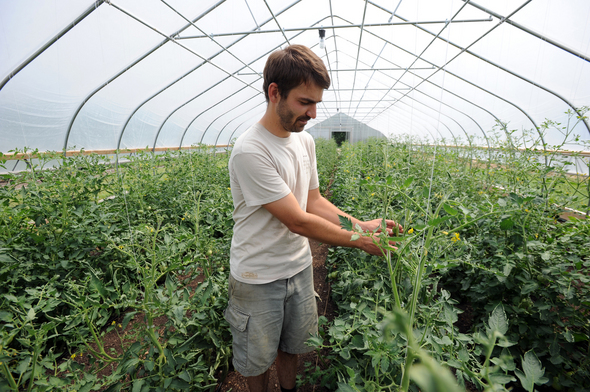
Dan Bair, farm manager for St. Joseph Mercy Hospital, looks over tomato plants in the hospital's hoop house, just east of the hospital off Hewitt on July 15. The vegetables grown in the hoop house are sold in the hospital's farm market.
Lon Horwedel | AnnArbor.com
As urban sprawl has connected cities to suburbs, making it difficult to determine where one municipality ends and another begins, it has become common to hear folks recall when all this — wherever "this" happens to be —Â used to be farm land.
Soon, though, motorists driving along Huron River Drive might glance over at St. Joseph Mercy Hospital Ann Arbor and recall when all of its campus used to be hospital land.
St. Joe has become one of the first — if not the only —Â hospitals in America to hire someone as a "farm manager." Dan Bair, the bearer of that title, patrols St. Joe's campus not in scrubs or a white coat, but in shorts and a T-shirt, out in the field, where he's transforming at least a portion of the hospital's 354 acres back to its farming roots.
"This was just a big grassy field until we tilled it and started to build up the soil," Bair said on a recent 90-degree afternoon.
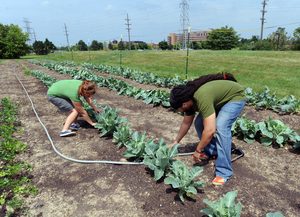
Allissa McPhail of Lansing, left, and Atiba Steward of Ann Arbor weed the vegetable garden.
Lon Horwedel | AnnArbor.com
St. Joe is in the midst of Phase 1 of a project to farm up to 30 acres of its campus. The hospital began planting produce —Â things like tomatoes and peppers —Â in April, and is beginning to harvest it for sale to staff, patients and the general public. St. Joe has applied for several grants to help cover the $20,000 cost, and has used mostly volunteer labor to manage the farm.
The hospital held its first farmers market in July, and sold out of its produce in less than a half-hour, disappointing many staffers who expected it be open for seven hours.
St. Joe will continue to hold a farmers market at 11 a.m. each Wednesday, but it is no longer promising an end time. "Now, it's 11 a.m. until we sell out," said Lisa McDowell, manager of clinical nutrition for St. Joe.
If the notion of a hospital farming and selling its own produce sounds jarring, it's meant to. St. Joe's farmers market represents what CEO Rob Casalou hopes is a paradigm shift, not only for his hospital, but also for the health care sector at large.
"When people think of St. Joe's, they're thinking of the hospital and sick care," Casalou said. "But we're really a health provider. So we decided to take a significant part of our land and turn it into production for health and wellness."
"Organic food is one of those basic staples of a healthy diet and healthy eating. It provides a resource to the patients, as well as to the community. This is part of an overall theme for the campus."
St. Joe's Chelsea hospital also has launched a farmers market, but it doesn't sell its own produce. St. Joe's Ann Arbor hospital is the only one Casalou is aware of that handles produce from planting to sales.
While St. Joe exists in a self-contained campus, not easily accessible to the public, it isn't operating the farm on an island. St. Joe plans to encourage consumption of fresh produce — theirs and that of other local farmers —Â to combat obesity in the community. St. Joe also purchases goods from the Ann Arbor Farmers Market and manages a honey bee hive for the Ypsilanti Food Co-Op.
St. Joe considers the farm a way to give back —Â literally —Â a portion of itself to the community.
"We don't want to spend money cutting grass," said David Raymond, a project resource leader for St. Joe. "We'd much rather put it into food production that we could share with the community. That's what we're doing."
The vegetables grown in the hoop house are sold in the hospital's farm market.
Lon Horwedel | AnnArbor.com
St. Joe has begun by converting 15 acres of its campus to farm land, including a hoop house — a versatile, environmentally friendly greenhouse that makes it possible to grow out-of-season produce. St. Joe also plans to plant in an exposed field and add an additional hoop house, expanding its growing capabilities to include things like flowers and pumpkins.
St. Joe anticipates large harvests in the fall that will provide a boost for its farmers market.
"We did have a good share of visitors (who) came by, but because we sold out in 20 minutes, we didn't make a dent in the demand," McDowell said.
That should become less of a problem. The plan next year is to develop an additional 15 acres of land for a total of 30. As the hospital harvests an increasing amount of produce —Â and purchases more from the Ann Arbor Farmers Market —Â the plan is to offer it to patients.
"It's been a dream we've had," Raymond said, "to see how we could use the property for community education, as well as our staff education and in helping treat our patients."
So far, the only setback has been hungry deer —Â St. Joe has set up an electric fence to keep them from mauling the crops. Perhaps St. Joe's initiation into the fraternity of farmers is now complete.
Casalou hopes so.
"We want to support the area farmers," he said. "We're not suggesting for one minute that our hoop houses are going to produce all the produce we need for the hospital or the community. We want to encourage people to use our area farmers."
Comments
Julie Martin
Wed, Aug 4, 2010 : 7:01 a.m.
Well done, Dan & St. Joe - very progressive!
dading dont delete me bro
Mon, Aug 2, 2010 : 5:28 a.m.
@justathought, i think it's great that the land is getting put to good use. organic isn't all that, but a good start. not too long ago this was the only way to get food. raise your own, go to the local farm market, etc. but we (i) wonder why medical co$ts are so high? i think it's a reseaonable question. what is a major reason small businesses are going out of business? health costs for their workers... maybe i'd better change my picture before i found out i hurt someone's feelings...i'm not offended of it. i think it clearly represents a lot of people around here. dading!
justathought
Sun, Aug 1, 2010 : 8:35 p.m.
OK Dadlng...first of all, how about a new picture? Secondly, are you always such a sun downer? St. Joe is working on an amazing venture to bring fresh farmed produce to the nearby community. America in general is losing sight of home grown, farm fresh produce that is locally growing. How about some cheers for the efforts into planning and carrying out such a great new process? Maybe in the future, these healthy foods could be served on the plates of the patients!
dading dont delete me bro
Sun, Aug 1, 2010 : 4:11 p.m.
ahhhh......who's paying for this? who's paying these salaries? is it self sustaining? i.e. are profit$ from selling the vegetables paying for all this? or, is yours and my healthcare paying these salaries?
kittybkahn
Sun, Aug 1, 2010 : 3:43 p.m.
When I first heard about this garden, I was happy because I thought they would finally start serving healthy food to the patients in the hospital. Now it seems they are selling the produce instead. How about using it to make healthy food and serving it to the patients instead of the trash they serve now???
A2anon
Sun, Aug 1, 2010 : 10:59 a.m.
THANK YOU, St. Joes!!!! This is an inspired, creative, ingenious project. Thank you!
amazonwarrior
Sun, Aug 1, 2010 : 9:58 a.m.
James- Thanks for writing such a great, positive article. Congratulations to St. Joes' for their cutting-edge program. One question though, since the St. Joes' campus is so LARGE, where exactly do they hold the Farmer's Market?
michigan48103
Sun, Aug 1, 2010 : 8:59 a.m.
When Mercywood Hospital that was own by the same Nun as St Joes before they became a corporation and Gary Faja was all about making money and not the patient care, the patients would grown wonderful produce and have a big garden and they would give the food back to the hospital and the patients and staff would eat the food in the Cafe. This went on for years and no one sold the food. It is always about money and profit with St. Joes now, I can remember when the patients and workers were treated like friends and family, not do what I say to make money and more money or you will be fired like they now do to the workers and the patient care has been gone for years. After working with a Lady, a Mary Meeks for many years at mercywood, when she got a promotion from a nice man they would take her out to lunch often, she fired me and said I could not do the job and I did the job for years and and before she did the JOB. The administration did not and does not care and she is still there and she will still fire any one and does not care. This type of thing has been done for years until the Administration just wanted to make money and more money for them and the Sisters of Mercy. I hope they make a lot of money selling the food to People like Mary Meeks and Gary Faja that make so much and does not care about others and their feelings.
Laura Meisler
Sun, Aug 1, 2010 : 8:42 a.m.
I'm so proud of Dan Bair and his crew for doing the labor to make this happen!
a2parentof4
Sun, Aug 1, 2010 : 8:10 a.m.
This is such an encouraging article. Thanks so much for running it.
Linda Peck
Sun, Aug 1, 2010 : 7:57 a.m.
Isn't this just great?
AlphaAlpha
Sun, Aug 1, 2010 : 7:56 a.m.
This is a great idea. And it deserves wider utilization: Imagine how therapeutic time spent strolling to, and subsequent lingering in, the garden would be to a hospital client compared to the same client 'resting' in an unhealthy hospital bed. Exposure to fresh air, sunshine, and being among growing things is nearly completely opposite the typical room experience. Let us hope this garden trend becomes common; hopefully hospital customers can enjoy its potentially substantial benefits as well. Congratulations to the visionaries behind this idea. Perhaps an indoor greenhouse for the cooler seasons...