

Michigan's declining unemployment rate provides backdrop for Rick Snyder's State of the State address
- Top 6: Issues for Michigan from Rick Snyder's State of the State address
- Governor's transportation-heavy agenda for 2012 welcomed by Ann Arbor area lawmakers
- Rick Snyder's State of the State: Key points, dashboard, speech outline
- PHOTO GALLERY: Images from Gov. Rick Snyder's State of the State address
Gov. Rick Snyder, delivering his second State of the State address Wednesday night, sought to positively define his accomplishments before his opponents succeed in negatively defining them, declaring that Michigan’s business climate and job market has shifted for the better.

Gov. Rick Snyder delivers his second State of the State address tonight in Lansing.
Angela J. Cesere | AnnArbor.com
But the governor stood at the podium on the floor of the House of Representatives with one ace in his pocket, so to speak: the state’s declining unemployment rate.
Michigan’s unemployment rate dipped to 9.3 percent in December, according to statistics released just hours before the governor’s speech. It marks the lowest the rate has been in 28 months — and it's only 0.8 percentage points higher than the U.S. rate of 8.5 percent.
If the jobless rate continues to fall — and, to be sure, that measurement is the most important factor determining political success or failure — Snyder’s approval ratings will benefit.
“We are being bold in reinventing Michigan but it requires setting high expectations,” Snyder said. “You can only build a brighter future by setting a higher standard.”
That standard — sustained and accelerated job growth — depends on any number of factors that can't all be listed here.
But one of the key drivers of growth is talent and technology generated by Michigan's public universities, whose tuition bills are driving heated debate in Lansing.
The performance of Michigan's universities, their role in driving the state's turnaround and the cost of their tuition is bubbling up as a key issue in 2012.
The auto industry's comeback deserves much of the credit for the state's declining unemployment rate. But if Michigan's economic recovery is to accelerate, Michigan's public universities will have to play a central role.
Snyder offered nary a word about the cost of tuition at Michigan's public universities. Instead, he outlined his desire for the state's universities to do a better job of producing graduates with the skills that Michigan companies need.
And for good reason: a state database at MiTalent.org indicates that Michigan has about 70,000 job openings — and if they were all filled today, the state's unemployment rate would drop by about 2 percentage points, Snyder said.
Why can't they be filled?
The governor and the Michigan Economic Development Corp. say that the job openings are unfilled in part because the state is doing a poor job of connecting companies with talented employees.
Snyder wants Michigan's universities and community colleges to do a better job giving students the skills they need to succeed. That could come in the form of funding incentives in his 2012-13 budget proposal, which will be released in early February.
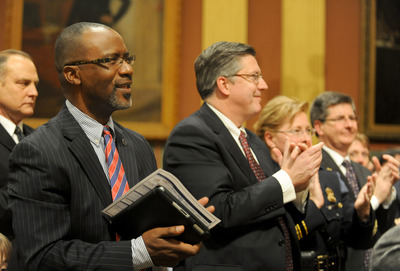
Michigan Economic Development Corp. CEO Michael Finney applauds the governor at the State of the State address tonight in Lansing.
Angela J. Cesere | AnnArbor.com
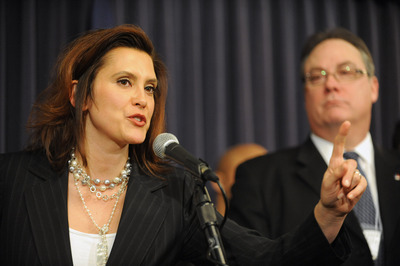
State Sen. Gretchen Whitmer, the Democratic minority leader, speaks at a press conference after Gov. Rick Snyder's State of the State address.
Angela J. Cesere | AnnArbor.com
"Our children are our future and we need to make sure they’re not just college ready, but career ready," Snyder said.
The governor's opposition is arguing that many workers can't access the training they need to qualify for those jobs.
Legislative Democrats, including State Sen. Rebekah Warren, D-Ann Arbor, unveiled a plan last week called Michigan 2020, which would cut billions in tax credits to provide free tuition to Michigan universities and community colleges.
"We can do that without raising taxes," State Sen. Gretchen Whitmer, the Democratic minority leader, told AnnArbor.com tonight.
Republicans' "initial response has been, 'Oh, I’m not sure how that works.' That's encouraging that they can’t find a substantive negative thing to say about it," Whitmer said.
Cost is the first barrier to access to education at a public university — and tuition at Michigan's public universities is far more expensive than tuition at institutions in other states, according to a report released earlier this month by the nonpartisan Center for Michigan's Bridge magazine.
The report, which garnered a meaningful amount of publicity, found that 12 of the state's 15 public universities have net costs higher than their peers in other states.
Yet if the cost of tuition is on the governor's mind, it didn't show at the State of the State.
Snyder seems to be more interested in improving the state's worker retraining programs by redesigning workforce retraining initiatives and "better aligning where careers are with where they will be."
MEDC CEO Michael Finney said he's focused on offering targeted retraining programs for Michigan workers, reshaping the state's workforce development initiatives and managing a pool of incentive dollars to help kick-start growth.
Finney said the state also needs to do a better job of convincing talented recent graduates to stick around.
"Our universities are doing a great job," he said in an interview. "The challenge is getting the young people to stay here and connecting them with the job opportunities, causing them to understand that the kinds of companies that we have here represent just as cool technology as some other company that they may know about in some other community."
Complicating the issue, however, is that most of the opportunity — at least for now — resides with the auto industry, which is driving Michigan's economic recovery.
The state added about 80,000 private sector jobs over the last year — and Snyder acknowledged the role the auto industry has played in that resurgence.
"The automotive industry has made a major comeback," Snyder said, adding that he is "proud to say that Detroit is still the automotive capital of the world."
But convincing young people to stick around and fill some of the state's 70,000 unfilled job openings means convincing many young people to work for the auto industry — a tall task indeed for an industry whose image has been battered in recent years.
The auto industry's comeback will continue to drive Michigan's unemployment rate lower.
But whether Snyder gets any credit for the impact of the auto industry's recovery on the state's unemployment rate remains an open question.
For his part, state Rep. Jeff Irwin, D-AnnArbor, is skeptical.
“There was a fair amount of taking credit for the sunrise in that speech,” he said.
Contact AnnArbor.com's Nathan Bomey at (734) 623-2587 or nathanbomey@annarbor.com. You can also follow him on Twitter or subscribe to AnnArbor.com's newsletters.
Comments
leaguebus
Thu, Jan 19, 2012 : 10:29 p.m.
The only thing the Slickster did to unemployment in the state was to increase it by indirectly laying off 10,000 teachers and a whole bunch of public safety people by giving the $1.8 B tax break to his rich buddies. They are going to get that this year too, and at the same time he is going to but $1.5B into roads. Where is that money coming from? Education, pure and simple.
Randy
Thu, Jan 19, 2012 : 5:04 p.m.
oops, my bad. I apologize to Sallyxyz and any one else I offended with my comment. Sallyxyz was correct and I was wrong. The article's error was corrected before I realized the mistaken word had in fact been used. Please forgive me.
Randy
Thu, Jan 19, 2012 : 4:58 p.m.
Sallyxyz may want to get the quote right before he/she criticizes the writer. The article quote plainly states, "It marks the lowest the rate has been in 28 months — and it's only 0.8 percentage points higher than the U.S. rate of 8.5 percent" -- not "lower" as the commenter is saying. Look next time before you leap.
seasons
Thu, Jan 19, 2012 : 4:25 p.m.
I don't think Rick Synder has had time to have any real effect on the Michigan's economy re: legislative actions, so for the Republicans to take credit for the increase in jobs is inane. In fact, Republicans apparently fought tooth and nail to not have the Michigan automobile industry aided and now want to take credit for it? Time will tell just how effective Rick Synder's agenda will be for Michigan; it isn't going well in Indiana, Ohio, Wisconsin or Florida.
alan
Thu, Jan 19, 2012 : 3:12 p.m.
Here we go again. Nathan says "The state added about 80,000 private sector jobs over the last year...." Not true. Go to bls.gov and look at the statistics. The state has lost jobs. The number of unemployed people has decreased by 80,000 because the number available for work has decreased by 100,000 for various reasons not in the data. If I have 90 jobs on my boat for 100 people the unemployment rate is 10%. If one job is lost and I throw two unemployed people overboard the unemployment rate is now only 9.2%. In fact, I could get the rate to 0% pretty quickly if I wanted to. Quit writing about things you don't or don't want to understand. I have yet to figure out if people really don't understand 4th grade math or they just ignore it to be political cheerleaders. All of the information that anyone cares to look at is there in plain view yet it is routinely ignored for the one piece that makes a good sound bite. Here's a scary statistic recently released. 66% of U of M grads in 2010 and 2011 were Michigan residents yet only 37% stayed in Michigan after graduation. That does not bode well for the future.
DonBee
Fri, Jan 20, 2012 : 1:41 a.m.
alan - Look at my post above your, those numbers are pulled directly from the BLS database, yesterday, based on the most current data. Your 80,000 number is way off base.
DonBee
Thu, Jan 19, 2012 : 1:25 p.m.
The numbers here come from the Bureau of Labor Statistics. They offer 6 measures of unemployment. The narrowest is U-1 the one reported here at 9.8 percent. It does not count a lot of people. The broadest one is U-6, it counts people who are part time and want full time, people working 2 part time jobs that want 1 full time job, people beyond unemployment insurance, people who have quit actively looking (discouraged) but would like a job and all the other people you can think of. At the end of 2010 (Dec 2010) the number for U-6 in Michigan was 21 percent - only California and Nevada were higher. As of the end of September 2011 (the last reported number) it was down to 19.3 percent - 1.7 percent drop. In December of 2010 there were 4,207,697 people with jobs of any sort in Michigan. In November of 2011 there were 4,200,849 people with jobs. A decrease of roughly 6,000 jobs, this includes both public and private sector workers. Employment in the automotive sector is still below what it was when GM declared bankruptcy and large companies are still reporting lower employment than they did at the end of 2009. OBTW - the automotive industry still has FEWER jobs in Michigan than it did when President Obama pushed GM through bankruptcy, so any gain in employment from that time period to now, comes from other industries. Yes, some jobs are returning to the automotive sector and more will. But, we will NEVER see the number of jobs in Michigan that existed in 2000 in that sector.
pseudo
Thu, Jan 19, 2012 : 12:22 p.m.
again, this is what makes me crazy about this guy - we were turning a corner as he was being elected. He has no business (pardon the pun) taking credit for somehting that has been part of the natural rebound of this economic cycle. zero credit - in fact, given the mess he's made with tax burden shifts, he might have even slowed down progress.
local
Thu, Jan 19, 2012 : 12:20 p.m.
It is funny that he wants more trained workers coming from colleges and universities, yet he cuts funding to school districts that are the building blocks for these colleges and universities. Not sure you can have it both ways Governor!!
SMAIVE
Thu, Jan 19, 2012 : 12:16 p.m.
What do you mean "whether Snyder gets any credit for the impact of the auto industry's recovery on the state's unemployment rate ". Of course he and the GOP are taking credit, lucky for them the public's memory is only 12 moths long. All of a sudden his policies are the cause and effect, when we all know if it wasn't for the bailout, this state would have a +20% unemployment rate.
Sally
Thu, Jan 19, 2012 : 7:43 a.m.
Our unemployment rate is calculated by the number of people currently still looking for jobs actively. It is NOT the jobless rate.
Veracity
Thu, Jan 19, 2012 : 5:21 a.m.
Despite the addition of 80,000 new jobs as Nathan Bomey mentions, 420,000 Michigan citizens remain unemployed. And Nathan Bomey is correct that Governor Snyder can not accept credit for the improved employment numbers which are the result of the federal government's bailout of the auto companies and the ingenuity of the auto company executives. What Governor Snyder can do is expand the jobs bank to include a database of skills, education and talent needed for each available job position. Colleges should be encouraged to develop vocational programs that can meet the employment requirements for the available jobs. Universities must be discouraged from training philosophers who will end up as waiters or cab drivers. Petroleum engineers are needed so let us identify appropriate candidates and train them for the job. Long haul truck drivers and software designers are in demand also and each needs entirely different types of training. Corporations can help themselves by sponsoring programs with local educational institutions as is commonly done with great success in Germany. The economy has been slowly improving throughout the country and is accompanied by increased employment. Nathan Bomey's article does not highlight any specific or unique endeavors by Governor Snyder which directly reduces unemployment. However, he has time left in his tenure in office to do something positive for a change. Hopefully, his metamorphosis will come sooner than later if at all.
Historic District
Thu, Jan 19, 2012 : 3:41 a.m.
Kind of interesting to contrast this story's headline and first few paragraphs with this recent Citizens Research Council post. See <a href="http://www.crcmich.org/column/?p=194" rel='nofollow'>http://www.crcmich.org/column/?p=194</a>.
Ed Kimball
Thu, Jan 19, 2012 : 2:31 p.m.
None of the stories I have seen about the decline in the number of jobseekers has addressed the issue of baby boomers, who started turning 65 in 2011. I would like an analysis of how much the decline is due to people who retired or were laid off so close to retirement age that it made no sense to look for another job. In any case, a lot of people will be leaving the work force for these reasons over the next few years.
Sallyxyz
Thu, Jan 19, 2012 : 3:26 a.m.
"Michigan's unemployment rate dipped to 9.3 percent in December, according to statistics released just hours before the governor's speech. It marks the lowest the rate has been in 28 months — and it's only 0.8 percentage points lower than the U.S. rate of 8.5 percent." Lower? do the math, Nathan: 9.3% unemployment in the state of MI is NOT lower than the US rate of 8.5%.
Nathan Bomey
Thu, Jan 19, 2012 : 3:27 a.m.
Yes, I caught that right away and fixed. Thanks!