

University of Michigan broadens research relationship with Chinese university tied to cyber attacks
The University of Michigan plans to pursue advancements in biomedical and alternative energy technologies in partnership with researchers from the Chinese university that’s been linked to global cyber attacks.
U-M announced today that it would launch a joint research project with its longtime partner, Shanghai Jiao Tong University, to pursue advancements in biotechnology and renewable energy. Each university will contribute $3 million over five years to the project.
Stephen Forrest, U-M's vice president for research, said the research collaboration could lead to important technological advancements that would benefit both entities.

Stephen Forrest, University of Michigan's vice president for research
File photo | AnnArbor.com
The move comes as SJTU finds itself under intense scrutiny after U.S. investigators reportedly traced cyber attacks back to computers at SJTU and another school in China. The attacks led to security breaches at several American companies, including Google, which last week announced it would shutter its China-based search engine in protest.
U-M and SJTU in 2005 established their Joint Institute, hastening the interchange of students and faculty members. The institute expanded a partnership that dates back to 1997.
But today’s announcement broadens the universities’ relationship to include a significant joint research initiative. Until now, the partnership mostly involved professors teaching undergraduate students.
Through the initiative, researchers will pursue clean tech advancements through the Collaborative Research Program in Renewable Energy Science and Technology. Among the areas they’ll target: clean coal, alternative powertrain vehicles and energy efficiency in buildings.
"The U.S. and China are the two largest carbon emitters on the planet. We're looking at collaborating to use complementary strengths to solve these problems," Forrest said.
As part of the new research relationship, researchers will also pursue advancements in a variety of life sciences areas, including imaging technology, minimally invasive therapies, nanotechnology, medical devices, neural engineering and medical software.
A focus on electronic medical records technology would mark the first time U-M and SJTU researchers would conduct computer science research together.
“The focus here is really on engineering,” U-M spokesman Rick Fitzgerald told AnnArbor.com last month. “It’s not computer science programming.”
Forrest said the Joint Institute with SJTU may eventually maintain a presence at U-M's North Campus Research Complex, the 2 million-square-foot ex-Pfizer campus U-M acquired for $108 million in 2009.
U-M and SJTU researchers will have to file joint requests to earn grant funding, which will be limited to $200,000 per project.
U-M said it would also leverage the relationship to pursue funding from the new U.S.-China Clean Energy Research Center, a $15 million joint research initiative between the two global economic powers.
“We will be ready to make strong proposals into those programs,” Forrest said.
U-M and SJTU in December struck a tentative agreement to conduct biomedical and energy research, according to details of a video conference meeting attended by Forrest and U-M President Mary Sue Coleman that were published online.Coleman, who in 2005 received the second honorary degree in SJTU's 115-year history, plans to visit SJTU again this summer.
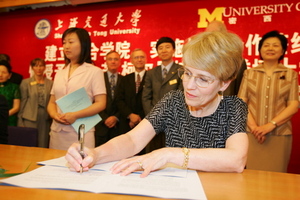
University of Michigan President Mary Sue Coleman in 2005 signs an agreement with Shanghai Jiao Tong University to establish the U-M SJTU Joint Institute.
Photo courtesy of University of Michigan
David Munson, dean of U-M’s College of Engineering, which operates the Joint Institute along with SJTU, said last month that he wasn't concerned about the cyber accusations.
“We don’t know anything other than what we’ve read in places like The New York Times, and there isn’t any indication that the Joint Institute, which is our initiative over there, is involved in any way,” Munson said. “There isn’t any reason to believe that our relationship would be affected.”
SJTU, which has more than 30,000 full-time students, is a sprawling university with a broad range of expertise and initiatives. Some 160 SJTU students are currently studying at U-M in Ann Arbor through the Joint Institute. About 50 SJTU students had received U-M degrees as of 2005.
Contact AnnArbor.com’s Nathan Bomey at (734) 623-2587 or nathanbomey@annarbor.com or follow him on Twitter. You can also subscribe to AnnArbor.com Business Review's weekly e-newsletter or the upcoming breaking business news e-newsletter.
Comments
trespass
Thu, Apr 8, 2010 : 8:51 p.m.
The Chinese government has repeatedly shown that they do not enforce international patent or copyright laws. Thus, a joint program is the same thing as giving away our intellectual property. Now that Mary Sue Coleman has pushed out Pfizer and gotten their property at one sixth its value, what better use for the property than to house our Chinese spies.
David Briegel
Tue, Mar 30, 2010 : 6:50 p.m.
How about paying tribute to the victors of Ronnie Reagans cold war? More than 55,000 names are on that wall in Washington who sacrificed to "stop the spread of Communism". And then along come the Waltons and we are all celebrating the victors and their values, child labor, slave labor, prison labor, plundering the natural resources and polluting the environment. You know, the same vision Republicans and the Chamber of Commerce has for America!! REBBAPRAGADDA, I would say that they picked right up on our "values"!! Are we all just serfs or pawns in their game!!
Anonymous Due to Bigotry
Tue, Mar 30, 2010 : 7:20 a.m.
I don't understand why we have state universities who seem to be doing their best to educate as many Chinese nationals as possible especially when this state desperately needs more educated professions to improve it's horrible economy. Let them get their educations in China or at some private university. Having whole departments with a disproportionate number of Chinese nationals does not spell diversity. We seriously need a law that limits the percentage of Chinese or other foreign nationals in state universities on a per-department basis.
runbum03
Mon, Mar 29, 2010 : 6:34 p.m.
"....electronic medical records technology?" Have the good folks at lost their minds? We're going to "share" the details of our most precious information with the Chi-coms? That's "Chinese communists" for you younger folks. And all Suzy Coleman got was an honorary degree? Was her money was on the dresser? The State's broke and can't even afford keeping the lights on at the U of M. This is a bad idea.
Nathan Bomey
Mon, Mar 29, 2010 : 12:35 p.m.
The university's official press release, now online: http://www.ns.umich.edu/htdocs/releases/story.php?id=7599 Also, @say it on: Yes, the university sends students there during the summer.
say it plain
Mon, Mar 29, 2010 : 11:33 a.m.
Stephen Landes said that well. I agree, and, while I feel it may be a bit irrelevant, I wonder what Google thinks of such a move. They must have felt pretty darn affronted, to say the least, for this attack to have been made on them, particularly given the concessions toward 'good will and improved US-China relations' they made when they allowed the human-rights-compromising restrictions the Chinese government placed on their operations in that nation. If I were Google, I'd be rather displeased with U-M, and with Ann Arbor too perhaps. Why exactly are we conducting joint research operations in cutting-edge technologies with this university?! Do we have students there, or do they only come from China to Ann Arbor? I love the idea of cultural exchange, but I'm feeling a little queasy and uneasy about this association--did the U consider *not* going through with this new 'initiative'? From whence comes the funding? And is there reason to believe that the cyberattack isn't something we should be concerned about vis a vis the institution in question? I think the U-M owes us at least something more thoughtful than "all we know about it is what we've read in the New York Times" and "there isn't any reason to believe that this has anything to do with our initiative"? Please, give us all reason to believe this *couldn't* happen via your connections, or *won't*! The burden of proof just changed, I would like to think, if serious hacking and 'stealing' of data has just been tied to your research partner, even if all the details haven't been made clear yet. Am I missing something?!
bruceae
Mon, Mar 29, 2010 : 11:17 a.m.
@Stephen. You're kidding right? The article says there are 160 students at U of M right now from that university. The Chinese Government is paying U of M top dollar to educate these people so they can hack or PC's and steal corporate data. U of M isn't going to think long term here and pass on all that cash.
Stephen Landes
Mon, Mar 29, 2010 : 10:26 a.m.
I believe it is irresponsible for the University of Michigan to enhance its relationship with SJTU until the allegations around the cyber attacks are clarified. One simply cannot look with a narrow view at the joint institute and say that whatever else that SJTU may be involved in just doesn't touch U of M. Like it or not, we are in a very competitive struggle with China on many fronts and these attacks along with Chinese government's manipulation of their currency have serious implications for our country. The U of M should be more restrained in pursuing additional contacts and programs with SJTU.