

U-M, St. Joe's join new initiative to help Washtenaw brace for federal health care reform, fill coverage gaps
(This story has been updated.)
The largest players in Washtenaw County's health care industry announced this morning that they would collaborate to study ways to handle the sudden influx of patients expected as a result of federal health care reform.
The groups also said they would work together to find ways to broaden health care opportunities for the 50,000 uninsured county residents and bolster a stressed Medicaid enrollment system.
The voluntary collaboration, called the Washtenaw County Health Initiative, includes leaders from the University of Michigan Health System, St. Joseph Mercy Health System and the Center for Healthcare Research & Transformation, a nonprofit supported by U-M and Blue Cross Blue Shield of Michigan.
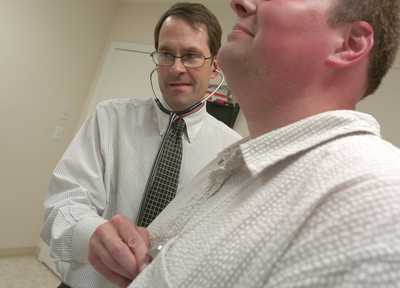
Raymond Rion, a doctor at Packard Health Clinic, examines a patient in 2009. Packard Health Clinic is one of several groups collaborating as part of the new Washtenaw County Health Initiative to help the county expand health care coverage and respond to federal health care reform.
File photo | AnnArbor.com
The broad new coalition also includes many different local entities, including the Washtenaw County Public Health Department, various U-M departments, St. Joe's local hospitals and nonprofits such as the United Way of Washtenaw, Hope Clinic and Packard Health Clinic.
Marianne Udow-Phillips, director of the Center for Healthcare Research & Transformation, said the collaboration was important "because of the critical need there is today and because we know we can improve health care to the locally uninsured."
She described the efforts as particularly crucial because of the effect of federal health care reform, which is expected to add about 25,000 Washtenaw County residents to the Medicaid rolls and to allow another 25,000 to buy coverage through new health insurance exchanges.
Udow-Phillips said health care agencies need to prepare to handle the influx in patients to avoid what happened when Massachusetts extended health care coverage to most everyone in that state a few years ago under former Gov. Mitt Romney. The federal health care law takes full effect in 2014, although legal challenges and political opponents could derail the law.
"We knew what was coming in 2014," Udow-Phillips said. "When Massachusetts did health care reform, the health care system was overwhelmed with new people coming into the system without real good access to primary care. We really believe all communities across the country should be doing this today in preparation for 2014. It’s really not that far away."
Former Washtenaw County administrator Bob Guenzel, former St. Joseph Mercy Health System CEO Robert Laverty and former U-M treasurer Norman Herbert led the creation of the group.
They set up a steering committee with several key players — including Rob Casalou, CEO of the St. Joseph Mercy hospitals in Superior Township, Saline and Livingston County, and U-M Hospitals and Health Centers CEO Doug Strong — and a planning group representing a wide range of groups from throughout the county.
Their early goals include improving the Medicaid enrollment system and expanding access to primary care doctors, dentistry and substance abuse programs — which would reduce expensive emergency room visits by uninsured patients.
For the first six months of the collaboration, the 50 individual members of the group have studied Washtenaw County's health care system to identify coverage gaps and inefficiencies.
"They’re all aligned and they all have a common goal, which is to identify where the gaps are and to work at the county level to fill those gaps," Udow-Phillips said.
Among their findings after six months of work:
— The state employs only 59 workers to handle 55,000 Washtenaw-based Medicaid and Medicare cases, reflecting a caseload of 850 per worker.
— Only five dental practices in Washtenaw County are accepting new patients with Medicaid insurance. But dental-related visits to hospital emergency rooms cost $534,000 in 2008, leading experts to believe that costs could be reduced by providing better access to regular dental care.
—More than 33,000 uninsured Washtenaw residents do not have a primary care physician. But if they end up getting doctors after federal health care reform takes effect, they would take 54,000 annual visits to primary care physicians, leading to even more demand for primary care doctors in a system that already needs more. The county currently has 983 primary care doctors.
Guenzel said the county's existing health care providers "do an excellent job of serving" the population.
"But we think and we know that we can do better," he said. "We can do better as a community if we can come together as a community to align our assets and strategically deliver those assets. The time is right, we have the leadership, we’re developing the strategy, we have the commitment and we care about this community. I think we’re going to make a tremendous difference."
Laverty said the effort is important regardless of the final outcome of federal health care reform.
"People agreed this should be a nonpolitical kind of effort," he said. "There continues to be a lot of debate about how health care reform will ultimately be implemented. Folks said regardless of the outcome of those debates, it’s worth us engaging in an effort of this type."
Herbert said the initiative is currently powered by the volunteer efforts and goodwill of the participants but that eventually the group would pursue funding to develop its recommendations.
Contact AnnArbor.com's Nathan Bomey at (734) 623-2587 or nathanbomey@annarbor.com. You can also follow him on Twitter or subscribe to AnnArbor.com's newsletters.
Comments
pbehjatnia
Thu, Jul 14, 2011 : 11:36 a.m.
I am so over hearing about how we are like Europe now... we are not Europe nor will we ever be. Nor are we Canadians. And, frankly, having spent fully 1/2 of my adult life living on the economy, i.e., not armed forces related, in Germany I can only say that European health care stinks. Even with fancy private payer insurance which I had in addition to state funded health care I was forced to pay for. The wait times are enormous (try 6 months for a cat scan when you hurt your back at work. And, no, you will not receive benefits of any kind in the six months you can't move let alone work whilst you wait for your turn at the scanner), the quality of care is subpar and the facilities make even the worst American clinic look grand. In fact, they are beginning to experience shortages of specialists because those docs are fleeing the continent in droves for better working conditions and pay. Don't get soooo excited because you think you are gonna get something for free because you are not. You are going to pay with falling standards, longer e.r. waits, lower medication coverage and, and and. Oh, enjoy the overwhelmed and lower paid physicians, too. They will be positively thrilled to see your shiny hopeful greedy faces looking for free care, free meds, free everything. Enjoy, cuz it's gonna be a helluva ride.
Ken
Fri, Jul 8, 2011 : 4:04 p.m.
The comments that I hear from those that are against the health care bill show that none of them even have a clue what it contains and what its limitations are; perhaps if they did a little less time listening to political pundits paid to stir up controversy, and internet gossip, and a little more time reading, they'd find a whole lot to like about it. Especially those that care about human compassion, the value of life, and assuring that insurance bureaucrats are not making medical decisions and deciding who is and is not entitled to insurance. The funny thing about all the ranting and raving is that what people complain the most about- the individual mandate- was a Republican creation, a means of preventing freeloading and reducing overall medical costs by catching health conditions early, when they can be treated less expensively, and preventing people from using the emergency room as a health clinic. Come on, folks, it's 2011; there are a zillion independent analyses available online- and no, contrary to what Glenn Beck says as he discourages people from doing their own research to fact-check what he is spoon feeding them, not everything that doesn't agree with his far-right ideology qualifies as "liberal extremism".
Charlie Brown's Ghost
Sun, Jul 10, 2011 : 2:43 a.m.
You've got things confused. "None of them even have a clue what it contains" is how one would accurately describe the moobnats who actually voted for the bill. Good Night and Good Grief
julieswhimsies
Fri, Jul 8, 2011 : 5:36 p.m.
Well thought out post. Thank you, Ken!
clownfish
Fri, Jul 8, 2011 : 12:48 p.m.
Seeing as nobody else was doing anything to help about 30 million US citizens get access to basic health care, this new law is as good as we can ask for. What was the GOP plan? Tax cuts. great. The GOP had 8 years to work on this, as the "christian majority" and did NOTHING. Somehow I don't think that is WJWD. Now they whine and moan. Tough.
Jeremy Engdahl-Johnson
Fri, Jul 8, 2011 : 2:50 a.m.
New healthcare reform video: What are some of the local challenges facing states as they look to establish insurance exchanges? <a href="http://www.healthcaretownhall.com/?p=4146" rel='nofollow'>http://www.healthcaretownhall.com/?p=4146</a>
treetowncartel
Thu, Jul 7, 2011 : 9:43 p.m.
The gap results in lost revenue stream from the newly insured patients, which are those who couldn't get coverage, and those who do not want it. I think anyone advocating for this should switch their health plan right now to medicaid coverage and see how happy you are with your selection of providers and the level of service and coverage you get.
paxsolace
Fri, Jul 8, 2011 : 2:41 p.m.
I don't have insurance and yes I would be very happy to have something rather than have nothing. Wouldn't you? Not everyone has a job where insurance is provided. Can you afford it by yourself and for your family? Try finding something reasonable. If you find something worthwhile and reasonable please let me know. Thank God my family and I have not needed any medical services.
Sparty
Thu, Jul 7, 2011 : 7:59 p.m.
Thank goodness we finally have joined the civilized nations that have health care available to all (aka Health Care Reform). I am thankful to Democrats and President Obama especially for championing this universal RIGHT and the dignity that it allows humans to have in their moment of need. To those of you only interested in what's in it for you, you're only showing your lack of compassion, caring, sense of community, and the reason we need government assistance to care for those that aren't able to care for themselves!
Charlie Brown's Ghost
Sun, Jul 10, 2011 : 1:51 a.m.
Obama voters won't wait in line. They'll get in first.
nekm1
Fri, Jul 8, 2011 : 12:54 p.m.
see what happens when you have an emergency and are told to wait on a list....
Oregon39_Michigan7
Thu, Jul 7, 2011 : 7:53 p.m.
Some people see dollar signs, others see human dignity. I am thankful everyday I have always had health insurance.
treetowncartel
Thu, Jul 7, 2011 : 7:31 p.m.
"Show me the money"
Bogie
Thu, Jul 7, 2011 : 6:42 p.m.
I just hope they can repeal that piece of junk leglislation before it bankrupts the country.
Charlie Brown's Ghost
Thu, Jul 7, 2011 : 5:37 p.m.
Major is right. It's "reform" if by "reform" they mean "control." Wait - forget the "if" part in that last sentence. Good Night and Good Grief.
Major
Thu, Jul 7, 2011 : 5:34 p.m.
"Federal health care reform" LOL now that's an oxymoron!!!