

Wireless Washtenaw: What happened?
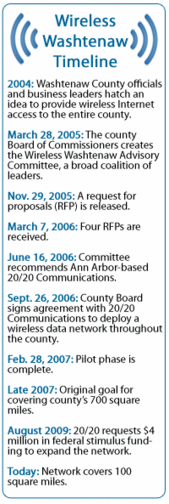
Wireless Washtenaw, an ambitious initiative conceived six years ago to provide high-speed Internet access to the entire county, is on life support.
Despite $2 million in private investment and another $70,000 in government spending, the project is stalled, attracting only 550 daily users in a county with more than 347,000 residents.
The project’s leaders attributed its shortcomings to an inability to attract investor funding.

James McFarlane, the county's Wireless Washtenaw project manager, is still optimistic that the program can be expanded.
Lon Horwedel | AnnArbor.com
But independent experts questioned whether it would ever succeed, in part because of the immense cost of extending wireless access to 720 square miles of land - at a cost that could reach tens of millions of dollars.
Now Wireless Washtenaw’s future may hinge on a last-ditch $4 million federal stimulus application, which hopes to tap $7.2 billion dedicated to spreading Internet access throughout the country.
Wireless experts, however, said the application is unlikely to land funding because the federal government is favoring broadband Internet projects that extend access to remote places with few ways to access the Internet.
Still, Wireless Washtenaw proponents are holding out hope.
|
Related story |
“We’re very excited and hopeful and encouraged that we’ll receive positive news back from the federal government that we’re going to receive money,” said James McFarlane, the county’s Wireless Washtenaw project manager.
The program’s original goal was to install equipment on government structures throughout the Ann Arbor region, creating a wireless cloud that would provide slow access for free and high-speed access for a monthly fee.
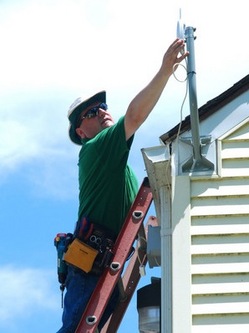
The company that landed the deal, Ann Arbor-based 20/20 Communications, spent more than $2 million to build the network.
But that was only enough to establish a network covering 100 square miles - about 1/7th of the county.
The service’s 550 users pay rates ranging from $45 per month to $99 per month. The rates are competitive with other Internet service providers but don’t generate enough profit for 20/20 to continue building the wireless network.

Bob Wolff, president of Ann Arbor-based 20/20 Communications, said his company has invested about $2 million in the Wireless Washtenaw project.
Lon Horwedel | AnnArbor.com
In the original plan, which proponents believe is still possible, county officials, business leaders and residents acknowledged that the project would eventually require outside investment.
But investors never came.
“The economy has hit us hard,” said Bob Wolff, co-owner and president of 20/20 Communications.
Meanwhile, the emergence of Wireless Ypsi, an unrelated local company that is promoting a different model for community wireless networks, has caused some observers to question the value of continuing to pursue Wireless Washtenaw.
J. Downs Herold, an Ann Arbor resident and retired University of Michigan administrator, said he’s been disappointed by Wireless Washtenaw’s lack of success.
“The thought of, ‘Boy, I could pick up wireless and not have to deal with Comcast’ was what really had me going,” Herold said. “But as I started to read more about it, it was kind of like, ‘How the hell are they going to put it up in the whole county?’”
With uncertainty clouding the project’s future, experts now say the original plan was flawed.

David Behen, former information technology director and deputy county administrator, helped devise the original plan for Wireless Washtenaw.
Lon Horwedel | AnnArbor.com
Esme Vos, an attorney and founder of MuniWireless.com,
said the project might have been doomed from the beginning because the
county didn’t offer to pay for the service for its own use.
“In the cases where it works, you need some municipal use for it to justify this gigantic investment,” she said. “It’s got to be sustainable.”
Wireless conception
Wireless Washtenaw was conceived in 2004 as many municipalities throughout the U.S. mobilized to provide community networks to residents and businesses. In Michigan, other counties that pursued wireless networks at some point included Oakland, Macomb, Kent, Genesee and Ottawa.
In Washtenaw, officials assembled a leadership team led by then-county information technology director David Behen, who later became deputy county administrator and is now a vice president of Ann Arbor-based GDI Infotech.
The coalition designed Wireless Washtenaw, and law firm Bodman LLP donated some legal services at the beginning to assist the project.
The county Board of Commissioners in late 2005 officially approved a plan to solicit proposals from private Internet service providers. The county got 4 proposals. Bidders included a joint application from AT&T and IBM; MichTel Communications; and 20/20, which won the deal in summer 2006.
By February 2007, 20/20 had already established a pilot project designed to create small wireless bubbles in downtown Ann Arbor, downtown Saline and parts of Manchester.
Soon after that, however, the project, which was supposed to be finished by late 2007, ran into trouble.
Municipal wireless initiatives throughout the country increasingly lost momentum as investors questioned the business model.
Behen said the county was confident that the project was doable, although he recalls an early meeting where some people expressed skepticism.
“We had people in the room telling us it can’t be done, it can’t be done,” he said.
Critics believe the county should abandon the project.
Steve Pierce, co-founder of Wireless Ypsi, which has created a free wireless Internet cloud throughout downtown Ypsilanti, said Wireless Washtenaw was flawed from the beginning.
His startup company focuses on creating community wireless networks in crowded places like apartment complexes instead of rural areas.
“If the plan was to cover the entire county, there were a heck of a lot of sheep and cows out there that don’t need wireless Internet access,” said Pierce, who said his service has attracted 40,000 users, including 800 daily in downtown Ypsilanti. About 2,000 people use the service in a given week.
Pierce argued that Wireless Washtenaw’s original objective was not plausible.
“The idea to blanket the entire county with wireless access is not cost effective. You put it where people are living and working, not in a corn field,” he said.
Funding obstacles
Wireless Washtenaw was designed to place all of the risk on the shoulders of the private sector.
“This had to be a partnership between the private sector and the public sector,” Behen said. “The public sector would not be paying for it. This was going to be funded through the private sector, a win-win for everybody.”
20/20 Communications has since spent more than $3,600 per active user to establish the network, with minimal revenue to show for it.
The county altogether spent about $70,000 with Bodman and consulting firm Plante & Moran to finalize contractual details and other specifics.
County officials such as Behen, McFarlane and others also spent innumerable hours working on the project.
“It was not correct to say the county was not spending any resources on it,” Behen said. Employees “spent a lot of time on it. That is taxpayer dollars. Some could argue that we could have spent our time focused on something else.”
To be sure, most experts didn’t expect venture capital funding opportunities to dry up - and the financial crisis made matters worse.
“It would have worked” with funding, Wolff said.
Rural Internet options still few
Most parties agree: The need to improve high-speed Internet penetration throughout Washtenaw County is still significant.
Thousands of users in western Washtenaw County are limited to Web access at dial-up speed.
Exact figures are unclear, which is partly why Michigan recently received a $1.8 million to study broadband Internet penetration. The Michigan Public Service Commission will work with Washington, D.C.-based Connected Nation to conduct the study.
“The need is growing at an exponential rate,” Wolff said.
Ray Berg, a Freedom Township resident who served on one of the original leadership teams for Wireless Washtenaw, has been using the network for 2 years at his 17-acre farm. He said the $49-a-month service has helped him conduct his custom homebuilding business more efficiently, since he doesn’t have access to DSL or cable Internet.
“It’s made a huge difference for me,” he said. “To be able to send drawings and large electronic files as part of my business is just critical. It’s been a huge boon to my business. And from a personal point of view, it’s just a tremendous difference.”
Home-based businesses, farmers and rural residents need high-speed Internet access, he said. Without high-speed access at home, students have a hard time completing Web-based research assigned by teachers.
“Certainly out here in the southwest part of the county, there’s huge demand for the service,” Berg said. “I’m still getting questions and comments from local residents here on when is this going to build out.”
Experts say that emerging wireless technologies may soon offer realistic, affordable options to rural residents who have been waiting years for high-speed Internet access.
Major cell phone service providers such as AT&T and Verizon, for example, are constantly expanding their 3G networks, which provide Web access to smart phones. Rural access to 3G networks can be spotty.
But “the technology continues to evolve,” said Marvin Sirbu, a professor of engineering and public policy at Carnegie Mellon University who has studied municipal wireless initiatives.
Stimulus hopes
Despite its failures, Wireless Washtenaw isn’t dead yet. In fact, this may mark the most hopeful moment in its recent history.
Wireless Ypsi co-founder Steve Pierce said the Wireless Washtenaw strategy was never plausible.
20/20 this summer filed an application seeking $4 million in federal grants and low-cost loans to expand the network. The U.S. is expected to distribute some $7.2 billion in grants and funds for various broadband Internet projects through the $787 billion economic stimulus program approved in early 2009.
Some $183 million has already been distributed, but the bulk of the awards should be announced within weeks.
“Broadband services allow individuals to access new career and educational opportunities,” the U.S. National Economic Council said in a December announcement. “They help businesses reach new markets and improve efficiency. They support struggling communities that seek to attract new industries. And they enhance the government’s capacity to deliver critical services.”
Wolff said he’s optimistic that Wireless Washtenaw’s application would find favor with the federal government.
“I’m being told by our field rep that we have a very viable application submitted,” he said.
Sirbu, however, questioned whether the government would distribute funds to Wireless Washtenaw in its first round of awards.
“The priority seems to be so-called unserved areas,” Sirbu said. “Ann Arbor has got lots of (options). There may be corners of the town that aren’t covered. But by and large most of the town has an option.”
For now, the county and 20/20 are waiting to see whether the government provides funding for Wireless Washtenaw.
“We’ve got a lot invested in this,” Wolff said. “In the event that
we did not get stimulus money, I think there would still be a plan to
move forward.
“It’s hard to define what that would be today.”
Contact AnnArbor.com’s Nathan Bomey at (734) 623-2587 or nathanbomey@annarbor.com. You can also follow him on Twitter.
Comments
tracyann
Tue, Jan 12, 2010 : 9:15 a.m.
@mw, you're right. I should've settled and went for a smaller house and no yard for my kids to play in JUST so I can get wireless internet. No matter that when I moved here I never thought that wireless internet from my home might be a necessity someday. I'm sorry, but it's comments like yours that make me glad I don't live in the city.
Technojunkie
Mon, Jan 11, 2010 : 7:04 p.m.
@Richard C: You could make a case to a rabid right winger (hi) for a dark FTTH network to be government owned, with competing private service providers leasing fibers which they then connect their electronics to. Once the fiber is in place there's little maintenance, less than roads. It would be more cost effective to have one shared fiber plant than Comcast, AT&T, etc building redundant networks, if they were inclined to build one at all. It would also be very easy for startups or any remaining independent ISPs to lease fibers. Or for businesses to lease point-to-point fiber links to connect their buildings across the county. It would make Washtenaw far more attractive to business in a way that actually makes economic and engineering sense. It would still be difficult to justify wiring up many rural sites, just as such sites aren't connected to city water. Fixed wireless probably makes more sense.
wlhneighbor
Mon, Jan 11, 2010 : 5:23 p.m.
I believe the rates are higher than cable internet, and it required an expensive gadget to be installed. Right?
Richard C
Mon, Jan 11, 2010 : 3:38 p.m.
The problem that dooms Wireless Washtenaw is the same one that doomed Merit Network Inc's dialup service - the urban people didn't need it and rural people couldn't afford it. The public Traverse City wireless network was used as a comparison to Wireless Washtenaw - but at the time, the Traverse City network was aimed at tourists (and some residents). Making your tourist-trap community more appealing to tourists does make a certain kind of sense - but the Traverse City network didn't try to be everything to everyone, which is what Wireless Washtenaw tried to do. If there is a need for internet access that isn't being satisfed commercially, and that need is sufficiently widespread, then a government funded solution seems reasonable. You CAN make a case that the entire Washtenaw community is NOT being well served by Verizon, AT&T, Comcast, etc. - the bandwidth offered is paltry compared to S. Korea, Germany, Japan, Sweeden, etc. A government owned network that ran fiber to the house would not be a free-market solution. It would be better. And anethma to the Rabid Right Wing. However, the overall social benefits of the government running a network infrastructure for the county isn't as clear as it is for roads. Anyone - on a lark - can use any of the government funded roads. Anyone, for whatever reason, can use a government funded road to travel somewhere within the county. However, a data network doesn't work that way. I don't see the county covered with RJ-45 ports, much less WiFi access.
Andy Brush
Mon, Jan 11, 2010 : 3:24 p.m.
@racerx James McFarlane and other county employees who have worked on the Wireless Washtenaw project have many responsibilities outside of Wireless Washtenaw - so he always has had another job. From reading the comments it appears that broadband internet is rural areas is still a challenge. Good dialog on how that might happen and what people are trying. Sounds like there is no clear solution yet.
Technojunkie
Mon, Jan 11, 2010 : 1:32 p.m.
The more I think about it, point-to-point wireless to customers who can't get cable or DSL is the only business model that makes sense. Forget cities, outside of volunteer efforts like Wireless Ypsi. Set up antenna towers on high ground as needed to get line-of-sight to customers, set up high-gain directional antennas and WiFi radios at customer sites and wire those into an otherwise standard home network. Plan on paying much more than AT&T and Comcast Internet but it'll work and perform well. Better than AT&T U-verse if they do it right. Once you have that in place you can plug femtocells (mini cell phone stations such as Sprint's Airave for routing cell photo traffic over the Internet) into the home network, use VoIP services instead of landlines, etc. A small number of high-paying customers is considerably easier to manage than trying to be all things to all people. For all I know 20/20 is already doing this. I'm wired for cable and don't need their service.
Craig Lounsbury
Mon, Jan 11, 2010 : 12:39 p.m.
@Tom Teague I don't think anybody who has posted here "from the city" thinks providing "cows and farmers" the Internet is a bad idea, its just a question of how to pay for it, given the private sector at the moment doesn't see a motive. Back when a millage for a new jail failed it failed in part by an overwhelming rejection from "cows and farmers" who didn't chipping in for more jail room as their problem. The reoccurring argument was that most of the crime was in the city and most of the criminals are from the city. In other words they were kind of watching out for themselves. Likewise there is an ongoing dilemma over the cost of supplying Sheriff Department deputies to cover outlying areas that don't pay for their own police department. As a city dweller I chip in for two police departments but only one of them ever comes through my neighborhood.
mw
Mon, Jan 11, 2010 : 11:54 a.m.
Careful - there may be a baby in the bathwater: It's not just a matter of faster internet service for farmers. The rural broadband initiative is seen as an equivalent to the Rural Electrification Administration. Except that rural electrification was intended for farmers, not sprawlers who preferred country living but otherwise had the same kinds of jobs as the nearby city folks. And the argument about 'not being able to afford to live in the city' doesn't wash. You might have to settle for a smaller house with a smaller yard to live in or close to town, but that's all. You get more house and yard for the money out in the sticks, but you get less internet for the money there. Nobody said that a longer commute was the only possible trade off for choosing to live out in the country.
Tom Teague
Mon, Jan 11, 2010 : 11:29 a.m.
Careful - there may be a baby in the bathwater: It's not just a matter of faster internet service for farmers. The rural broadband initiative is seen as an equivalent to the Rural Electrification Administration. Since most new jobs will require computer skills (some estimates as high as 90%), extending broadband capability to rural areas could ensure that workers and students there are able to train at home and have access to the same digital opportunities that we city folk take for granted. It came in response to the reluctance of the traditional internet providers to make high-speed internet available for rural customers. Whether the current business model is workable is another question, but we should give it some time to prove itself rather than discard the concept based on our citi-fied notions that cows don't need the internet. Without increases in the high tech skill base, Michigan will be unable to attract high-tech businesses that want to see the capability before they spend the money to locate here.
Craig Lounsbury
Mon, Jan 11, 2010 : 11:08 a.m.
Fred: good point with respect to them currently covering areas that already have coverage. I don't pretend to know much about the whole situation.But I assume the problem is the lack of a rather expensive infrastructure to deliver a signal to the outlying areas of the county for a limited number of paying customers. If thats the issue whats the solution? A tax payer subsidized building of the missing infrastructure?
Fred
Mon, Jan 11, 2010 : 9:56 a.m.
They are disappointed with the low number of current subscribers, but they ran the pilot (and the service is only available) in downtown Ann Arbor, downtown Saline, etc where there are other broadband choices. There are many of us in rural areas that can't get anything except dial-up and we'd love the opportunity to subscribe to Wireless Washtenaw.
tracyann
Mon, Jan 11, 2010 : 9:55 a.m.
I pay taxes, as well. Maybe my property taxes are lower than others but only because I can't afford a house in the city, therefore I moved to a more rural area. Only 7 miles outside of the city, mind you. Some of the comments made just seem very snooty to me. I don't expect someone to pay for me to have high-speed access but it would be nice to see Wireless Washtenaw work.
Craig Lounsbury
Mon, Jan 11, 2010 : 9:28 a.m.
@tracyann why should there be a trade off? Because at the moment it doesn't appear to be economically practical for the private sector to service sparsely populated areas. "Has it really come down to "city folk" against "country folk"?" Only if country folks refuse to accept their trade off for "cheap housing" (lower property taxes) and expect those paying higher taxes to subsides country folks high speed access. The thought there is that the Government steps in and does what the private sector won't do because there is no profit to be had.
Chase Ingersoll
Mon, Jan 11, 2010 : 9:25 a.m.
The technology and competition moved a lot faster than the Wireless Wasthenaw business plan. Comcast and DSL are doing a fine job of wiring the county, and where they are not the solution is for the home owners affected to make a small collective investment in a higher grade satellite connection, or a solar module repeating router network like the Wireless Ypsi technology to cover each other. I donated a 3 foot 15 decibel outdoor antenna to a group just north of Ann Arbor to get their area covered.
TripleVSix
Mon, Jan 11, 2010 : 9:19 a.m.
I have dealt with two of the early companies involved in this - IC.net and the company that was providing wireless on the south side of town - and their lack of success does not surprise me, based on my experiences with both of them. IC.net had terrible customer support and had problems answering even the basic questions about their own service when I would call them on behalf of my clients. The other company had problems with everything they did, from the technology to support. Even if Wireless Washtenaw had got going, their customer support probably would have just as bad. I think the time for this was six to eight years ago, not today when there are other options. How about tapping into the fiber that now runs along the Norfolk Southern railroad? They buried that fiber at least six years ago. It runs east to west through the center of the whole county.
tracyann
Mon, Jan 11, 2010 : 9:13 a.m.
Has it really come down to "city folk" against "country folk"? Why should there be a trade off because I don't want to pay out the rear for housing? The trade off is I have a longer drive to places. Anyway, I pay $70 dollars a month for a Verizon broadband card which works well, IF I have the external antenna hooked up, which of course is an additional cost. That's where they get ya.
mw
Mon, Jan 11, 2010 : 7:12 a.m.
First of all, public wifi systems have flopped in lots of places -- there's nothing unusual about Wireless Washtenaw: http://www.nytimes.com/2008/03/22/us/22wireless.html?_r=2&adxnnl=1&oref=slogin&ref=technology&pagewanted=1&adxnnlx=1206471978-gs55g+/KCIBQNf8CFSKIMA Second, the idea that rural dwellers who pay low property taxes and enjoy open spaces should have their internet access subsidized by the rest of us who pay much higher taxes for houses on smaller city lots is pretty dubious. In fact, density advocates should *really* oppose Wireless Washtenaw--because it seems that the need/desire for better internet access is a much more powerful motivator for people to chose to live in or closer to town than is the cost or hassle of commuting. Lastly, I believe that for virtually everybody in Washtenaw County a broadband card from Verizon or one of the other phone providers IS a viable option (though, as RB has done, you may need to do some work with an external antenna, amplifier, etc, and may have to forgo high bandwidth services like streaming video--but those are the tradeoffs).
InsideTheHall
Mon, Jan 11, 2010 : 6:24 a.m.
$4 million in tax money for a project that impacts how many people????? couple hundred perhaps a little over a thousand. This is folly! It is not a right (at least not yet) to have access to high speed internet. There are plenty of options available to those who do not have access and they have all been mentioned here. Daddy Obama will come to the rescue as DEMS want to secure rural Washtenaw as a DEM stronghold into the future.
racerx
Mon, Jan 11, 2010 : 1:17 a.m.
If the project is not working, or, still having trouble getting started after so many years, then does McFarlane have another job? Is this his only job duty? What is his salary and how is it being paid? What contracts are being draw up to pay several law firms large sums of money? This is a job for the private sector. Maybe the county can finally determine why Comcast still has a monopoly in our area. Seems as though opening competition could enable other vendors to provide this service and improve upon the existing cable service.
Lehigh
Sun, Jan 10, 2010 : 11:05 p.m.
Thank you, Mr. Bomney, for a lengthy, well-informed article on a worthwhile subject. I look forward to more of these from AnnArbor.com.
Rod in Chelsea
Sun, Jan 10, 2010 : 8:16 p.m.
Wireless Washtenaw is a joke. We have tried to get it on 4 different occasions and have either been completely ignored (3 times) then told that we could not have it as to many people already subscribe!! And we live in Sylvan Center VERY near the tower! We have AT&T wireless card for $59.95 and are very happy. Do not waste the money on a bottomless pit with no no benefits of any type.
RB
Sun, Jan 10, 2010 : 5:38 p.m.
@Barbara Ellis: I'm in the middle of Lodi township and use Verizon cellular broadband ($60/mo 5GB). In our house we get zero bars so I hooked up an outside antenna to an amplifier and the amp to a wireless router that accepts USB modems (Cradlepoint MBR1000). I now get 4 out of 4 bars for internet access! Sure bets dialup! I'm also in the middle of a woods. The might be ways so you can get a decent signal too. I got all my information from www.3gstore.com. I'm not associated with them in any way. Someone else passed their name along to me and they have all kinds of good info. The amp I have is a Wilson. Hope this helps! PS - We have 2 computers hooked up to the router and one of the users is a 13 year old and we never use more than 3GB/mo. No TV show downloads though!!!
Tom Joad
Sun, Jan 10, 2010 : 5:15 p.m.
It will require the deep pockets of a company like Google, who has already provided a stellar free wifi in their home town of Mountain View, CA. Alternately, there's a cooperative of users in San Francisco, called Free-the-Net, which is community based. Internet subscribers are eligible for a free wifi router if they provide their neighbors with free access. That program works very well in a densely populated city like SF. Ann Arbor residents should do the same. The problem with private companies' foray into this field is the intensely high cost of infrastructure, leading them to charge more than a DSL subscription. HENCE, 20/20 WILL FAIL.
Craig Lounsbury
Sun, Jan 10, 2010 : 3:33 p.m.
@Barbara Ellis: I don't think any of us "city slickers" are saying "you live in the sticks and you deserve it". We are merely pointing out the obvious, when you live in a low density area certain things are not economically practical to provide.
gemsbarb
Sun, Jan 10, 2010 : 2:58 p.m.
Verizon really isn't the answer out here in the rural areas. Yes, I can get a signal - one bar and only in certain areas of my house! It's hardly enough to keep a phone conversation going, it certainly isn't strong enough for internet (but it IS the only cell phone provider who give any coverage where I live - which is half way between Chelsea and Ann Arbor). Satellite? Oh yeah, we have it, and we pay a LOT for what is supposedly enough "bandwidth" for a small businesss... yet we can barely do email on it without it going in and out. Large files? Forget it. And yes, I run a good part of my business out of my home. I spend many hours using the Chelsea and Dexter library computers trying to do work I should be able to do from home. And as far as this attitude of "you live in the sticks and you deserve it" - come on people. Aren't we all a bit more mature than that? People choose to live where they live for a multitude of reasons, and for many of us, city living isn't an option we can afford. For others, it's just not something we would choose to do... it's a bit elitist to think that those who live in an area other than A2 somehow don't "deserve" the same services as those who do, don't you think? It wasn't all that long ago that the areas outside of A2 were quite rural - yet now there's subdivisions and big box stores. Come on... we're all in this together, as a community. Where's the supportive, loving, accepting mindset that A2 is known for? "Washtenaw" Wireless doesn't mean A2 exclusively... or have the rest of us been kicked out of the county?
shanedr
Sun, Jan 10, 2010 : 1:06 p.m.
With only 550 users the problem is obvious. They are charging too much. It doesn't matter what the competition is charging; the service quality is probably less then the competition, which means they are charging too much. Or the service is not where it is needed. If you advertise county wide service, you either better have it or you have to charge low pre-subscription prices until you have it. You can't expect people to pay full price for minimum service. You either cut the price until its completed or you build the full system on investor money and then open it up to subscribers. So to re-iterate: they're charging too much.
Bob W
Sun, Jan 10, 2010 : 12:35 p.m.
I agree with texorama. This would be a waste of stimulous funds. Getting it up is one thing, continuing as viable, ongoing venture in the future is entirely different and this won't challenge the competition already out there.
SDP
Sun, Jan 10, 2010 : 12:05 p.m.
I pay $59/month for my HughesNet satellite service to my rural Lodi township home. For this price, I have very limited bandwidth. My satellite provider has a "Fair Access Policy" that that limits my use in any 1-hour period to about 100MB. If I exceed this, they reduce my speed to dialup speeds for 24 hours. As a result, I can't use many internet services, like video, music, Skype and many others. It has gotten to the point where automatic downloads from Microsoft or installing a new software package results in me exceeding the limit. As the bandwidth requirements of today's applications increase, this option is becoming increasingly untenable. When previous generations of technology were rolled out (like electricity and telephones) governmental policy promoted the goal of universal access - urban users subsidized rural users because the societal benefit of having everyone have access to these technologies. I do beleive the nation will suffer if rural residents cannot connect to the net.
xmo
Sun, Jan 10, 2010 : 11:58 a.m.
Washtenaw County Wireless is what happens when you do not choose the right vendor. They were too small and/or not creative enough to make this work. I think they need to start over. Technology has changed since they first started this project. Thanks Washtenaw County!
Ken B
Sun, Jan 10, 2010 : 10:43 a.m.
IMHO Wireless Washtenaw is the best thing since sliced bread, for us rural users. DSL or cable doesn't reach us in the never lands between Dexter-Chelsea-Manchester. We had satellite for several years and hated it. Since the satellites are located 23,000 miles above the earth, in synchronous orbits, there is about a 1/2 second delay in signal travel times. Since the internet protocol for interactive (ie, browser use vs streaming downloads, etc) activities requires "handshaking" between send/receive points, every time a few hundred characters are sent the sender then asks the receiver if the message packet arrived OK, or not, before sending more. This almost 1 second turnaround delay between message chunks causes browsing to be only marginally better than over a phone line modem. Worse almost all interactive web-based applications, such as financial account management, etc, will fail to work under these sluggish conditions. Bottom line, we really benefit from and need Wireless Washtenaw until such time as viable alternatives are available. Here's hoping they continue to succeed!
Technojunkie
Sun, Jan 10, 2010 : 10:34 a.m.
Unfortunately, WiFi is just too short range for a business to blanket a city cost effectively with a wireless cloud. It's great for point-to-point long range wireless links with very directional antennas to areas where it's just too expensive to run fiber optic cable but even then $100/mo is much more realistic. As other commenters noted, it's a tradeoff for rural living. 3G wireless plans generally have 5GB/mo bandwidth caps. For light usage that's fine but monthly Windows updates alone can use up a big chunk of that. If you have multiple computers sharing the connection, look out. Satellite has very limited bandwidth and terrible latency. If you want to do VoIP or anything similar it'll drive you mad. It's better than dialup though. Wireless Ypsi's approach makes the most sense for a city. Spending gobs of taxpayer money to pretend that a few people get Internet access for cheap doesn't make sense. I think that 20/20's best bet is to focus on territory that can't get cable and to charge whatever it takes to make a profit. Even then, generating enough revenue to support full-time employees is going to be tough. It may not be possible to beat satellite on price but it'll have far superior performance.
Craig Lounsbury
Sun, Jan 10, 2010 : 10:21 a.m.
"Often they choose that area because it's less expensive you know." Which speaks to the "comes with the territory" draw backs. There are reasons its less expensive. Among them, in some cases, are water and sewer, trash pick up and Internet access. As I said in my first post, I sympathize and hope the private sector can find a cost effective way to deliver the service. But I would draw the line at tax payer's subsiding it. It gets back to "Often they choose that area because it's less expensive you know." Its less expensive because they pay less taxes.
Steve Hendel
Sun, Jan 10, 2010 : 10:08 a.m.
I like that last comment from a writer out in the country-essentially, he'd be glad to pay for high speed Internet if it was available. Plain and simple. Often, on this and similar issues, we hear from people in the "out-county" areas who want a service (paved streets, Internet service, police services, bus service, whatever) but have worked out an elaborate rationale for someone else to have to pay for it.
MichGirl
Sun, Jan 10, 2010 : 9:51 a.m.
Some very interesting comments. I just moved from the rural area of Western Washtenaw. One of the main reasons was lack of high speed internet which had been impacting my work needs over the last many years. I was particular struck by the "who cares" attitude of someone who said 'it comes with the territory'. Well, 30 years ago, no one had internet so who knew that we'd need it and it wouldn't be available for us rural folks? To me, having high speed internet should be available just like any other utility...everywhere in the state. There are many people who could earn a better income in a home based business if it was available. That could mean keeping jobs in Michigan as well as keeping more people employed. I have no clue how to pay for the infrastructure, but I would have gladly paid for DSL or wireless, if it were only available. Yes, I did use a satellite, including the highest package they had available for several years. It is not as good as DSL or wireless. The upload speed is better than dial up, but not by much. The satellite providers, like WildBlue, pack so many people on the satellite that it bogs down just like M-23 on the Friday before a summer holiday. Surely we can do better than that for folks who live outside the city. Often they choose that area because it's less expensive you know.
Liberty Soule
Sun, Jan 10, 2010 : 9:34 a.m.
People make choices to live in rural areas without connectivity. I live in town and I'd like a bigger yard, but that's not going to happen either. They're called tradeoffs, I pay $49/mo for Comcast. If the rural area have to pay $99, that's a tradeoff. Did we forget to mention we probably pay twice as much in property taxes. Wireless Washtenaw County already exists with Sprint, Verizon, and AT&T 3G, and 4G is just around the corner. The Wireless Washtenaw County plan was flawed partly because it wasn't a grassroot project with volunteers. Instead someone wanted to contract it out and then have people who could pay fund the other that couldn't. I guess they wanted socialized networking instead of social networking. Also, by the time the wireless equipment is installed it's obsolete. The cell towers will solve this dilema. Anyways, let's not "bailout" this project with our taxpayer funds.
KJMClark
Sun, Jan 10, 2010 : 9:15 a.m.
But $100/month for internet access is a fortune. I ditched my $40 a month cellphone service when I realized for the amount I used it I would pay about $10 a month with a pre-paid plan. Fewer and fewer people these days can afford $100 per month for a fast connection, when they can get the basic connection for $10 per month. At the same time, I only pay $30 per month for "pro" DSL service. If you're in a service area, you can get it for as low as $20/month. I think one point of the original Wireless Washtenaw proposal was to provide the low-cost / low-speed service to many people cheaply. That's why they put transceivers on the Saline and Manchester water towers. If you think things like Wireless Washtenaw have high startup costs, you should look at our roads. Maybe we should go back to private road funding - also known as toll roads. I always think it's funny seeing people's reaction when you propose privatizing the socialist roads. If basic internet service is a public need, which we're slowly moving toward, then there's a good argument for the public to provide a low-cost option.
The Picker
Sun, Jan 10, 2010 : 9:15 a.m.
Why does Comcast have a monopoly on the cable system? What ever happened to the fiber optics that were installed a few years ago?
Craig Lounsbury
Sun, Jan 10, 2010 : 9:11 a.m.
While I sympathize with folks in rural areas having limited or no options for high speed access I contend it comes with the territory. Many of those folks also have wells and septic fields. If you want to live in the "wide open spaces" of "farm country" it comes with some drawbacks. For those of us living in town, I'm not sure the ability to surf the net in the park under the shade of a big Oak tree is such a good thing. Maybe it would be better to just watch some birds and pick some patterns out of the clouds. By way of disclaimer I am submitting this on a desk top (one of those computers that plugs in to the wall) and my "stupid" (cell) phone doesn't even have a built in camera which admittedly makes me a bit of a dinosaur.
Rita
Sun, Jan 10, 2010 : 9:06 a.m.
Why would you spend 4 million dollars in stimulus money on this project? How will it create NEW jobs?
texorama
Sun, Jan 10, 2010 : 8:58 a.m.
Verizon Wireless coverage map for mobile broadband at http://www.verizonwireless.com/b2c/CoverageLocatorController shows almost no locations in Washtenaw County without coverage--just a few spots in the Sharon Short Hills. Price is $59.95 a month, for which you also get the ability to use the computer anywhere else. No money from any level of government should be spent on Wireless Washtenaw--is there a way citizens can express opinions on stimulus fund applications?
kirksupreme
Sun, Jan 10, 2010 : 8:45 a.m.
Yes $99.95 is less than $100 per month,which leads to me saying $45 a month is a better deal so I hope this wireless idea will work if you need advice on how to make this work I have a solution contact me and lets talk
Duncan
Sun, Jan 10, 2010 : 8:42 a.m.
Satellite service costs twice as much as Wireless Washtenaw. Satellite service also does not work well in the rural part of the county because trees block access to that part of the sky. Also, satellite service does not work well in storms. Wireless Washtenaw rarely has interruptions.
Steven Tutino
Sun, Jan 10, 2010 : 7:57 a.m.
Haven't the builders of this network ever heard of satellite? Anyone in Washtenaw County can spend less than $100 per month and get broadband satellite Internet. This reminds me of a few years ago when the someone proposed rewiring the farmers market so that the merchants could process credit cards (when the rest of the world already was using cellular credit card processing terminals!). I hope our federal government is not inclined to suppport this venture further as it is redudant with existing private sector technology solutions and a waste of our tax money.