

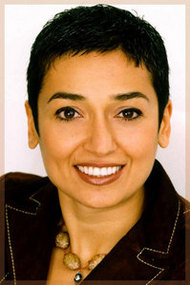
Zainab Salbi of Women For Women International Honored With Ross School of Business Women in Leadership Award
www.WomenForWomen.org
Ms. Salbi has been honored by President Clinton for her work in Bosnia and Herzegovina, named Time Magazine's “Innovator of the Month” and received Forbes’ Trailblazer Award. She is also the national best selling author (with Laurie Becklund) of the book "Between Two Worlds: Escape from Tyranny: Growing Up in the Shadow of Saddam," an account of her life in Iraq as the daughter of Saddam Hussein's personal pilot.
We had a chance to catch up with Ms. Salbi during her visit to learn about her successful approach to poverty alleviation and the challenges she faces as the leader of a multinational non-profit organization.
How did you decide to start Women for Women International?
Zainab Salbi: I was at George Mason University and it was the same month I learned about the Holocaust - because they did not teach us that in Iraq - that I learned about the concentration camps taking place in Bosnia. Well, people said never again then and it's happening again now and how come we're not acting? Where is the outrage?
One night I was sitting with my former husband in Denny's - which I don't think I've been there since - and I said, 'Well, how about we sponsor women?' I called other organizations the next day and the Unitarian Church said, 'Absolutely, we'll support you for a year and then you're on your own.' It literally started from nothing with my former husband and I using our savings for our honeymoon and raising money to go to Croatia and explore how we're going to start the program.
What is innovative about your approach to poverty alleviation?
ZS: You know, I don't think it was innovative as it was much more listening to what the women have to say. I think this is what's missing in the whole discussing of poverty of alleviation. Every aspect of the program was designed because a few women said something. Women said, 'I need a job. I don't want to be dependent on aid' and that's when we developed the vocational and business skills and added the micro credit components to our program. So the innovative part was listening.
How do you choose the communities and women that you work with?
ZS: We do community assessments in which we try to understand poverty as defined by that community. The assesments help us get away from our own preconceived notions, using poverty measurements and defining the most socially excluded people. That's how we really get a sense of the target population. We then do a community meeting where we announce to the whole community what we're doing, and that's when we start recruiting the women in our program.
We often see many non-profits working toward the same cause, but competing for resources. How do partnerships with other organizations fit into your strategy?
ZS: There are very little resources out there. Our fight right now is to increase resources, it's not to compete for them. We need to shift the dialog and say we have got to increase investment in women and girls.
One of our biggest partners is Heifer, International. We have a lot of complementary models. Right now we're trying to measure our collaboration including the impact on the target population, and how can we all exceed in accomplishing our goals. Donors creating incentive for collaboration has helped a lot.
Many people describe you as a 'social entrepreneur'. How do you define this term?
ZS: I would very much consider myself an entrepreneur, but my incentive is not to make profits, my incentive is to make social impact. I'm so not interested in the other side, even though I would argue the core skills are the same whether you are social or for profit. What keeps me going is not money at all, it's just how much impact one can make on the social reality of women.
There's a growing population that believes advanced degrees are no longer relevant. How do you feel your education has impacted your ability to be an effective leader?
ZS: It's not the degree or the lack of. You should neither brag that you dropped out of college and became an innovator of something nor brag that you have a PhD. Neither for me is relevant. What's relevant is, are you always growing? Is that something you're passionate about? Is it going to help you become more evolved in your thinking? And if that's what it does then you should absolutely pursue it.
With all of the responsibilities that come with running an organization, how do you stay connected to the actual work?
ZS: Last year I spent about three-and-a-half months in the field. I insist, insist, on going to the field and being with our international staff and the women we serve. There was a year I didn't do it and I felt horrible, disconnected. It's what keeps me going, it's what inspires me, it's what keeps me humble, it's what keeps me continuing to learn. It's constantly going to the very people you are serving and sitting with them and taking the time. That's what keeps you connected to the mission, and I think everyone should do that.
You have published a very personal memoir of your experiences as a survivor of war. How important is it for women in these situations to have a voice?
ZS: It's hugely important. I really think of it as a global women's issue. I think most women have stories and most women are stuck in our silence for a variety of reasons, and the core of the stories is the same. The discrimination, or harassment, or sexual abuse of women is the same, just different extremes. It's very extreme in Afghanistan, it's much less extreme in America.
We have to claim our voice. We have to break our silence because no one is going to save us. We must save ourselves and saving ourselves starts with saying 'I am not going to be silenced in the name of shame or embarrassment or being polite or family honor.' The beauty about Women for Women International is that it equalizes that dynamic.
Do you ever feel intimidated by the scope of what you're trying to accomplish?
ZS: Very much. I'm learning on the spot. I set up the organization with no experience. It takes the blood out of me to talk about budget and finance and operational efficiencies. It was a very painful experience to acknowledge that this was over my head, but I can't only focus on my weakness. I need to nurture my strengths as well. It's impossible to do the whole thing, so I have to have really strong people around me. That doesn't mean I'm a weak leader, but it helps you become a stronger organization.
In starting this organization, is there a moment you can point to where you asked yourself, 'Am I going to make it? Is this going to happen?'
ZS: Two moments. The first three years we distributed 100% of every dollar we raised. I was working full time and studying full time and there was a stage when I was like 'I don't know how to do it anymore. I'm just exhausted and I'm very poor and I can't survive like this.' At that time I had 400 women that we were supporting and was like I can't drop them, but I don't know how to do it. Two days later, out of the blue we got a check for $68,000. Someone had nominated Women for Women to Working Assets, and I really did not expect it. I did not know we were nominated. I looked at it and said, 'Okay, I'm supposed to stay.'
Two years ago the organization was about $26M and it felt like maybe this was too much. It was just swallowing me, like I can't breathe. And that time I stayed for the cause. I really believe in what I'm doing. I really really really believe, and the cause is too important to let it go.
What are you most proud of?
ZS: I'm going to answer in a very different way. When I grew up we had a maid in Iraq, and I was a kid so I don't remember the details. She was very much a part of my life. I did not know she was only two years older than me. Two days ago my staff in Iraq sent me a letter from her to the woman in America that is sponsoring her. So, she is a participant in our program. Because my staff were translating the letter they made the connection. I haven't seen her for 25 years, but I always think of her and what happened to her and there she comes through the program.
So, I'm proud of the connections that this organization has made. I'm proud of the many women who stood out there and said, 'This is what happened to me'. I'm really really proud of the women that we helped stand on their feet and start their own life back again. But I'm equally proud of Lisa Shannon, for example, who started a run for Congo and she was inspired by Women for Women. I'm very proud of that moment of click that the organization may have impacted in many women's lives.
Gina Valo is the Market Development Manager at AnnArbor.com and an occasional contributor to the site. You can reach her at ginavalo@annarbor.com. Read more from her blog, The Second Fiddle.