

Ann Arbor Symphony Orchestra looks inward to set 'Strings on Fire'
And now for something completely different.
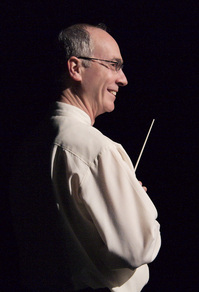
Arie Lipsky
When the Ann Arbor Symphony Orchestra returns to the Michigan Theater Saturday for “Strings on Fire,” it’s leaving behind what Music Director Arie Lipsky calls the “relentless energy” of its October all-Beethoven concert.
“We’re going to wash over the audience with gorgeous melodies and some genius counterpoint,” he said in a phone conversation about the upcoming concert, which includes Grieg’s “Holberg Suite, Op. 40,” Bach’s “Brandenburg Concerto No. 5 in D Major and Dvorak’s “Serenade for Strings” in E Major, Op. 22.
You can think of the Grieg, which draws on Baroque dances for its five movements — but in a lush, Romantic style — as a prelude to the real Baroque work on the bill, the Brandenburg No. 5.
The A2SO didn’t have to look far for a trio of soloists for the Bach concerto, a work in which Bach replaces a single instrumental soloist with three (violin, flute and harpsichord) who play together and, in the glorious second movement, all by themselves, without other accompaniment.
From within the orchestra come Associate Concertmaster Kathryn Votapek and Principal Flute Penelope Fischer; and from just up the block, also known as the University of Michigan, comes harpsichordist Edward Parmentier.
The three have played together before and are raring to do it again.
Lipsky is enthusiastic, too, about this foray into the Baroque. He’s intent on matching the orchestra string sound to the soloists’ sound — and particularly to the harpsichord. “It’s easy to balance the piano,” he said, “but with the harpsichord, we have to make sure every note comes out. It will take some rehearsing.”
In style, the orchestra and soloists will aim for a historically informed performance. Votapek will play her usual instrument, a mid-18th century violin. dates And Fischer said she’ll probably use her light silver Powell flute “that sometimes has a woody quality.”
“However,” she said, “I am also interested to try a wooden mouthpiece on my metal flute, which will make it sound more like the wooden Baroque flute. I’ll try them in rehearsals and see which works best with Kathryn, Ed and the orchestra.”
To hear Parmentier tell it, the harpsichord is just one of the guys. “The role of the harpsichord in the piece,” he wrote in an e-mail, “is one among three equals, the concertino section of flute, violin and harpsichord.”
But everyone, from Lipsky to Parmentier’s fellow soloists, is excited about what he’s playing and considers him primus inter pares. It’s the harpsichord that is granted an extended cadenza in the first movement (the longer of two Bach wrote for the work), and Parmentier acknowledges it in the most modest way: as “a tour de force — of composition.” Votapek calls it “one of the most amazing things ever written.”
“The title of the concert is ‘Strings on Fire,’ but it’s the harpsichord that’s really on fire,” she said.
PREVIEW
- Who: The Ann Arbor Symphony Orchestra.
- What: Music of Grieg, Bach and Dvorak.
- Where: The Michigan Theater, 603 East Liberty Street.
- When: Saturday, Nov. 13, 8 p.m.; pre-concert lecture for ticket holders at 7 p.m.
- How much: $10-$53, with senior, group and community-orchestra discounts available. Tickets available online at the A2SO website or by phone at 734-994-4801.
Pondering what makes this concerto special and popular, Votapek ventured that it is “very personal” and not just “pretty or beautiful.” “It’s just really sincere music that finds Bach as himself, pouring his most joyful attitude into the music. And the scoring is so immediately appealing.” Fischer added more reasons the work is beloved: “The sunniness of D Major and the pulsing rhythm of the two outer movements; the brilliant harpsichord cadenza at the end of the first movement; the intimacy of the middle movement. I hope that the audience also feels free to toe tap to the final movement.”
If they do, they’d better dance right back into the hall post-intermission for the Dvorak. This five-movement suite is a counterbalance, programmatically, to the five movements of the Grieg that opens the concert. And it is, as Lipsky noted, “one of the highlights of the string orchestra repertoire.”
With the orchestra’s strings playing splendidly these days, its gorgeous melodies should really sing.
Susan Isaacs Nisbett is a free-lance writer who covers classical music and dance for AnnArbor.com.