

Ann Arbor Symphony celebrates America in style
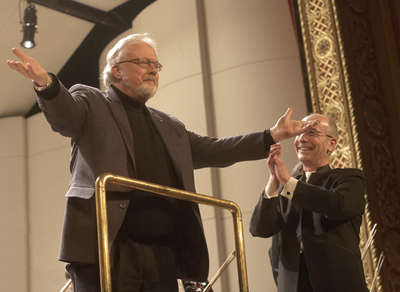
William Bolcom, left, and Arie Lipsky
Czarnecki/Dempsey
And in music of William Bolcom — in the audience to take a bow — Gershwin and Dvorak, the orchestra, under the baton of Maestro Arie Lipsky, played with fluency and ease to match.
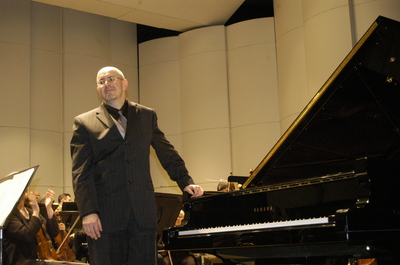
Arkadiy Figlin
courtesy of the Ann Arbor Symphony Orchestra
So was the evening’s opening work, the “Derby Dressage” section of Bolcom’s punningly titled “Seattle Slew: Three Dances in Forequarter Time.” In best Bolcom fashion, there’s a little bit of everything in this horsing around: the prancing carriage of the dressage steed, tango dancing, American popular dances and a tip of the old straw hat. It’s tremendous fun, with wonderful orchestration and delightful wind interludes bobbing up like tassels braided into a mane. The orchestra played it with verve and properly bridled wit.
Some of the evening’s most beautiful orchestral playing came in the Dvorak Symphony No. 9, “From the New World,” surely one of the most beloved pieces in the orchestral repertoire. Bohemian-American, Native American, African-American, the music evokes images of the great American frontier even as it embraces classical European form.
Perhaps the orchestra’s enthusiasm for the piece got the better of it in the opening movement, where volume said more than finesse with the musical line and the pacing was less than ideal. But from there on out, it was glorious, with the strings playing with mellow warmth and the winds and brass glinting and glowing. The Largo, with its haunting English horn solo, shaped so eloquently by Kristin Reynolds, was stunning.
Whatever pacing problems the opening movement had disappeared in a scherzo that swirled through its transformations, and the work drew to a triumphant, beautifully colored close that was equal parts abandon and precision.
Watch a "Backstage Pass" video with Arkadiy Figlin:
Susan Isaacs Nisbett is a free-lance writer who covers classical music and dance for AnnArbor.com.
Comments
uawisok
Mon, Mar 15, 2010 : 11:39 a.m.
My wife and I enjoyed this concert very much!
music man
Sun, Mar 14, 2010 : 11:53 a.m.
Kristin's playing was truly beautiful but equally beautiful was the trumpet solo in the second movement of the Gershwin. The Bolcolm was fun to listen to, as is par for the course for his music. An Ann Arbor treasure for sure. The only negative about the concert was the pitch in the woodwinds. Without calling any one person out, there is a major problem there that needs to be addressed.
music man
Sun, Mar 14, 2010 : 11:52 a.m.
Kristin's playing was truly beautiful but equally beautiful was the trumpet solo in the second movement of the Gershwin. The Bolcolm was fun to listen to as is par for the course for his music. An Ann Arbor treasure for sure. The only negative about the concert was the pitch in the woodwinds. Without calling any one person out, there is a major problem there that needs to be addressed.
music man
Sun, Mar 14, 2010 : 11:51 a.m.
Kristin's playing was truly beautiful but equally beautiful was the trumpet solo in the second movement of the Gershwin. The Bolcolm was fun to listen to as is par for the course for his music. An Ann Arbor treasure for sure. The only negative about the concert was the pitch in the woodwinds. Without calling any one person out, there is a major problem there that needs to be addressed.
AASO
Sun, Mar 14, 2010 : 9:57 a.m.
Kristen's playing was really first class.