

Angela Hewitt playing Bach, Brahms, Beethoven in much-anticipated Hill Auditorium concert
We’re catching up, here in Ann Arbor.
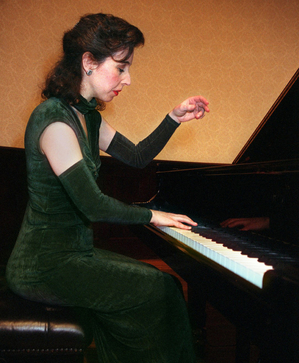
Angela Hewitt performs a program of Bach, Beethoven and Brahms on Wednesday, Feb. 10 at Hill Auditorium.
Karen Robinson
Twenty-five years ago, a young Canadian pianist named Angela Hewitt won the Toronto International Bach Piano Competition. She went on to make a brilliant career, not just in Bach — whose complete major keyboard works she recorded over 11 years for Hyperion, completing the task in 2005 — but in works by composers from Baroque to Modern, and in concert halls around the globe. She was Gramophone’s 2006 Artist of the Year, and Instrumentalist of the Year in MIDEM’s 2010 Classical Awards.
And she is finally coming to Ann Arbor, under University Musical Society auspices, for a long overdue debut recital here on Wednesday, Feb. 10 at Hill Auditorium.
It would be disappointing if her program did not include Bach, but it does: the much-loved “Italian Concerto” opens the bill. And it is followed by two other works — the Beethoven Sonata in D Major, Op. 10, No. 3, and the Brahms Sonata in f minor, Op. 5 — that, like the Bach, are “perfect works in their own right,” Hewitt said in a phone conversation from her home in London.
She spoke about her work and her program, taking time from rehearsing and playing before she crosses the Atlantic for a series of North American dates that include Ann Arbor and New York’s Carnegie Hall.
Q: I was reading your blog about your Italian tour, and how hard it is on your arms to be dragging suitcases around. It sounds like a professional hazard for a touring pianist. A: Now I’ve got 4 wheels, so I can push and not drag my suitcase. I still have to put as much stuff in them, though. I try to take my scores with me, but with the luggage restrictions, especially on some of the budget airlines, it’s getting harder. I had about 10 kilos worth of scores for Italy. You simply can’t keep it all with you as carry-on. With my “Goldberg Variations” and my “Well-Tempered Clavier,” I’d almost rather wear them than put them on the plane. When I did my 14-month Bach tour, I had a friend scan my complete WTC on PDF files. There was no way I was going to risk losing all my work on those, all the fingerings, etc.
PREVIEW |
Q: Have you had any thoughts about making a Bach edition? A: No, not at the moment; but maybe sometime, who knows? For the Bach, I don’t want to give away all my secrets, though I’ve done a DVD where I talk about my approach to Bach. Q: Could you talk a bit about the program you’ll be playing in Ann Arbor? How did it come about? A: This program has a very particular logic. It’s the 25th anniversary of the Roy Thomson Hall concert when I won the international Bach competition in 1985, so I wanted to choose works that won me my prize. That’s why I put this program together. Each piece is a masterpiece in its genre And the Brahms — I hadn’t played it in 5 years, and I really love it — fills the second half of a program wonderfully. It’s 5 movements, and it is very orchestral. In the first movement, I really imagine I’m the conductor of the Berlin Philharmonic. The piece has wonderful scope and tension and release. Brahms was only 20 years old when he wrote it, but it is such a mature work.
Q: It seems to me the question of playing Bach’s keyboard compositions on the piano has been laid to rest these days. Was it ever an issue for you? A: I never had any complexes about it at all. Of course, I knew it was played on a harpsichord, and I knew I had to pay careful attention to style. My father was an organist, and he made sure I did things very correctly. But you are not able to imitate the human voice on a harpsichord, which is a basic human gesture. Bach’s music cries out for a keyboard instrument that imitates the human voice. These days, you don’t hear so much discussion (about whether the Bach on the piano), and there are as many ways of Bach on the piano as there are pianists. What I try to do is not think of it so much as keyboard music but as music that imitates the voice or the orchestra. It’s not piano music in the way Brahms or Chopin is piano music. When I play the “Italian Concerto,” I think of a string orchestra, and in the slow movement, of a singer singing that beautiful line. I try to play in a way that would be acceptable to Bach.
Angela Hewitt talks about Bach and performs Prelude & Fugue No. 13 in F-Sharp Major BWV 882:
Q: What piano do you prefer? A: A Fazioli. I own two of them. I love the clarity and the action and all the colors you can get. I won’t have one in Ann Arbor, but I love it for the possibilities it gives my imagination. On other pianos you have to try a lot harder. Q: How has your Bach playing changed over the years, taking the “Italian Concerto” as an example? A: I’ve recorded the “Italian Concerto” twice, for Deutsche Gramophon 25 years ago and for Hyperion more recently, and they are quite a bit different. I’ve also played it since I was 15 years old. I’ve also re-recorded the “Well-Tempered Clavier.” It’s not so much the tempos, but the colors, the depths that I find, and the freedom in rubato, freedom in the pulse. Pulse is extremely important for accenting the harmony, for accenting the structure, and I do more now than I used to, with age and experience. You are so disciplined with yourself, especially when you are younger, that it is wonderful to have the spontaneity and freedom, and to not worry about reputation. So in a piece like the “Italian Concerto,” I think there is more license in it now, in a way. More joy and more expression. Q: Just before I called you, I was listening to the Beethoven sonata you are playing here, and I found myself hearing Bach in the music. Is that true for you at all? A: Absolutely. So many people don’t think of Bach when they play Beethoven. But look at the composers he grew up on. You hear it in the contrapuntal voices, the rhythms. I think early Beethoven is wonderful. I just recorded Op. 10, No. 2. Here was a composer so different from Mozart. He was playing the piano in a completely different way, a new way — the pedal effects, the new virtuosic style. He wanted to impress his Viennese public. Some performers forget to put themselves in his shoes, in that situation. They forget the impact this music would have had. Even though it’s 2010, you have to put yourself back in his shoes and also realize the piano that he had, the colors he would have had on the fortepiano. The highest notes he wrote were at extremity of the keyboard. I try to imagine that I’m him playing it.
Susan Isaacs Nisbett is a free-lance writer who covers classical music and dance for AnnArbor.com.