

Ann Arbor Art Center shows two artists 'Moving Ground'
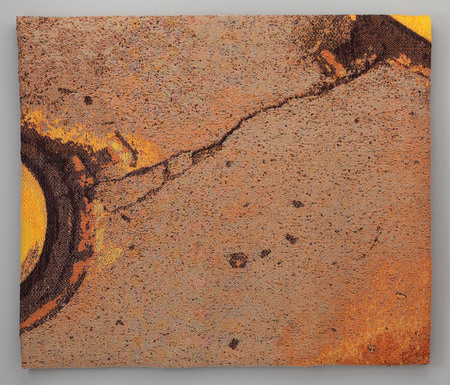
“Connection/Disconnection” from “The Ground Beneath My Feet” by Lois Bryant
Lois Bryant and John Cynar's exhibit "Moving Ground" at the Ann Arbor Art Center finds these two local artists moving along with their subject matter. Yet it’s only restless from execution to appearance.
Illustrating movement was a 20th century aesthetic concern focusing on technology. From motor vehicles and motion pictures to kinetic art and Jean Tinguely’s sculptural machines, technology inspired that century’s artists to depict motion. But artistic interests change with time — and like much clever post-modernist art, there’s a wry twist to Bryant’s and Cynar’s aesthetic — because motion is certainly their inspiration but it's an inferred conceptualization. Their personal interest in such change requires an audience to put it into play.
Lois Bryant has contributed two wide-ranging series of artworks — “The Ground Beneath my Feet” and “Landscape Studies” — that depict the ordinary as extraordinary. As she says in her artist’s statement, “I do not go to exotic places. Rather, I focus on ordinary aspects of the ground that most people overlook or write off as ugly, such as tire tracks and cracks on the pavement.
“I find beauty in unexpected and neglected places, such as parking lots and sidewalks,” says Bryant. “Aiming my camera straight down, I frame compositions of planned and accidental elements, clues to the histories of these small patches of earth and of our attempts to control and contain nature.”
These controlled patches are indeed embedded in her art. The larger number of the 27 mixed-medias and fiber works she’s contributed feature ground — as in the stuff beneath our feet. In fact, you can actually walk a considerable length of her “ground” in a work at the Art Center titled “On the Road.”
“The Ground beneath my Feet” series expands the concept of movement by concentrating on the elemental qualities of ordinary pavement. Bryant crafts works that on one level seem to be homage to asphalt; but are, ultimately, more observation on ground yet to be treaded.
By contrast, her multi-part “Landscape Studies — composed primarily of artificial grass, fibers, wire, and wood arranged to look like three-dimensional floral designs — are “The Ground beneath my Feet” by other imagery. These mixed-media studies of grass, flowers, and weeds feature a sense of expectant growth. They range from exceedingly large to exceedingly small, and each mixed-media composition approaches its subject like a first-time biological observation.
John Cynar’s 17 sculpture and photographic art works along the same lines as Bryant’s mixed-media and fiber art. For his art, too, features a sense of anticipation in various guises.
Cynar works in a diversity of media, from inkjet prints with photographic inserts to mixed-media sculpture, creating a superficial dissimilarity from one to another. Yet the works have an internal conceptual unity.
Some constructs (like the “Foreclosed,” “Sold,” and “Forgotten” triptych) blend a gestural post-painterly abstract base with small wooden houses affixed to the composition’s working surface. Others, like “Red/Black/White Fence,” are inkjet photos attached to wood planks — mysterious sculptural tableaus.
But perhaps the most intriguing of Cynar’s work in this exhibit are his inkjet photographic studies like “Pink Woods” where he mingles dimensions by inserting one photo image within a larger photograph.
“Pink Woods” features a cluster of trees flanking a hill with a pinkish skyline behind the stand. Shot in a panoramic setting, there is an inset stairwell placed in the right of the composition. The combination is a bit mysterious. But Cynar clarifies this ambiguity by saying in his artist’s statement, “I hope to pose this question, ‘What is the importance of man’s mark or role on (our) landscape?’
“For this journey, I use a photographic montage of landscapes to suggest one’s desire for control. The romantic notion attached to the classic natural landscape juxtaposed against images of man-made landscape including the mundane; such as a stairway or a light fixture. Does the work represent man vs. nature, or nature reclaiming what man has exhausted?” His photo-collage suggests both interpretations.
What “Pink Woods” cannot merely suggest is Cynar’s sense of artistic balance—it’s a strategic decision. This particular artistic touch creates a symmetrical balance that in turn makes the stairwell suggest potential motion. By seeking to move our eyes, Cynar cunningly moves his ground.
“Moving Ground: Lois Bryant Fiber, John Cynar Sculpture” continues through February 6 at the Ann Arbor Art Center, 117 West Liberty Street. Gallery hours are 10 a.m.-6 p.m. Monday-Saturday; and noon-5:30 p.m. Sunday. For information, call 734- 994-8004.