

Ann Arbor Art Fairs returning for four days of art, much more
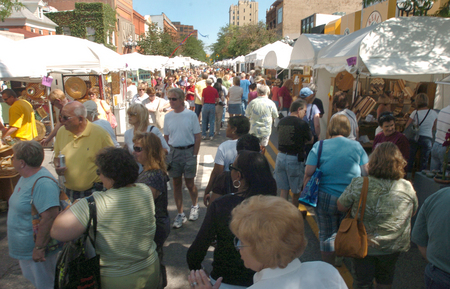
Crowds fill the streets during last year's Ann Arbor Art Fairs.
File photo
If you’re a local, the Ann Arbor Art Fairs are, in at least one sense, like Christmas.
Why? Because every year, the four-day event sneaks up on you, so that you can’t quite believe it’s that time of year again.
But it is, of course. And whether you’re cheering or groaning at the thought of a thousand artists and an estimated half-million visitors coming to Ann Arbor July 21-24, white tents packed with art, streets sales, live entertainment stages, and food vendors will soon take over numerous streets around the University of Michigan campus and downtown.
For a rundown on all the basic fair information, see our IF YOU GO: Art Fair facts Four fairs, one collaboration The four independent, simultaneous fairs that constitute the event are: The Ann Arbor Street Art Fair, located in the streets surrounding Burton Carillon Tower at North University; the State Street Area Art Fair; the Ann Arbor Summer Art Fair, located on both State St. and Main St.; and Ann Arbor’s South University Art Fair.
“We all have our own flavor because we’re in different sections of the city, but we have way more things in common than we have differences,” said Maggie Ladd, director of the South U Fair. “It’s a question that gets asked every year, and in a way, it’s a myth of the fair. … The State Street Fair is surrounded by businesses and the campus, so there’s more of a campus flavor. … At the Street Fair, there are no businesses around, and you’re in the middle of campus in a more park-like atmosphere. So the differences between the fairs are more about location than art.”
With this in mind, the directors of the four fairs have worked together more closely than usual this year, thanks in part to a new face on the scene: Maureen Riley, director of the Street Art Fair. (Previous director Shary Brown, after 11 years at the helm, retired following last year’s Street Art Fair, which marked that event’s 50th anniversary.)
“It’s been like having three big sisters guide me through the process,” Riley said, at a recent press event.
The directors — Ladd, Riley, Kathy Krick (State Street) and Debra “Max” Clayton (Summer Art Fair) — originally planned a one-time meeting in January to help Riley get up to speed, but then they “got along like a house on fire,” said Ladd. “Ideas that had been percolating for a while were laid out on the table, and we were able to move forward on them.”
New additions this year So what were some of those ideas? One was to replace the Link circulator shuttle bus with newly renovated, air-conditioned trolley cars that would transport visitors from one fair to another in a fun, appealing way. (Unlimited rides on the trolley for one day cost $1 per person.) In this video, Golden Limousine International CEO Sean Duval talks about the trolleys’ history:
See the trolley from the outside and inside in this short video.
Another new addition to the fairs this year is a free iPhone app that acts as a comprehensive guide for visitors. Paul Jacobs, of the Southfield-based company jacAPPS, which created the application (available on iTunes), discusses precisely what the app can do in this video.
Finally, a new ambassador program has been launched, wherein locals volunteer their time to answer visitors’ questions.
But the focal point of the fairs, of course, is always the art. Local potter Stanford Baker, whose work will be featured in the Summer Art Fair on Main Street, said, “The Ann Arbor Art Fair is the biggest show of the year I do. … I make about 25 percent of my income for the year (there), and I do about 25 shows a year.”
The Ann Arbor Street Art Fair The Street Art Fair, in addition to having a new director, will also return to its normal size this year. Due to construction in Ingalls Mall during last year’s fair, the event was forced to cut its artist list by 25; and that loss of booth rental revenue, combined with sponsorship declines, resulted in a $65,000 hole in the fair’s 2009 budget.
Now, however, construction in that part of campus has concluded, and the Street Fair’s fiscal outlook is far more sunny, according to Riley.
“I’m happy to say that things are back on track this year,” Riley said. “Sponsorship is up, we are back to our traditional number of participating artists, and we have been conservative with our spending. I’m anticipating that we will end up in the black.”
180 artists will offer up their work at this year’s Street Art Fair, which also hosts Art Activity Zones, with hands-on projects for adults and kids; street entertainers (including local favorite boogie-woogie pianist Mr. B); continuous artist demonstrations; and the Performance on the Lawn tent, which Riley describes as “a peaceful retreat for listening to a little music or enjoying a dance performance.”
State Street Area Art Fair One of the best fairs to attend for street sales, of course, is the State Street Area Art Fair, which truly marries town with gown.
“I think being in the heart of the fair, as well as close proximity to the university and the Diag green space, gives us a lively flavor with a lot going on,” said fair director Kathy Krick. “Because of such a large footprint, we are able to accommodate many more merchants on the street as well.”
The fair’s large footprint accommodates a whopping 316 artist booths; and Krick remarked that during her 20 year tenure as director, “I've seen the quality level go up tremendously.”
At one time, a live music stage was a part of the State Street Fair — hosted by Herb David Guitar Studio at one time, and more recently by an outside organization — yet “the costs have prohibited it lately," said Krick. "But its something we are working on for the near future. We are hoping to secure a sponsor for it, and bring some different kinds of music and performances.”
Even so, Krick notes that the State Street Area Fair is in very good shape: “Finances for the fair are very healthy this year, and interest among the artists seeking to participate has gone back up.”
Ann Arbor's South University Art Fair The edgier end of U-M’s central campus — the land of Middle Earth and onetime Pinball Pete’s — is highlighted by way of Ann Arbor’s South University Fair.
Emerging artists will be among the 175 featured in the South U Fair, in addition to 10 local ceramicists who work at the Yourist Studio Gallery Collective.
Yourist artist Rachel Jensen, while crafting nightlights that she will sell at the South U Fair, tried to explain the allure of working with clay. “There’s something about the malleability of it,” she said. “The ability to manipulate it and make whatever you want of it is really appealing. It’s just so nice and cold and mushy.”
Besides art, the South U Fair has the 107.1 Main Stage at Church and Willard, which will host local bands as well as nationally known acts (including Ann Arbor’s own Tally Hall); and an adjacent beer and margarita tent.
Last year, of course, tongues were wagging about how the recent recession might affect potential art-buyers, but South U Fair director Maggie Ladd said, “A 2008 survey showed that … 20 percent of the people that come to the fairs come from Ann Arbor; roughly 20 percent are from out of state; and 60 percent are from all over Michigan. So we’re pulling from areas that are not suffering financially to the same extent that Michigan is. We were of course all wondering how sales would go last year, but things went really well."
Ann Arbor Summer Art Fair Ann Arbor Summer Art Fair director Debra “Max” Clayton reinforced Ladd’s tidings of fiscal cheer. “Many people heard me say last year that what I was worried about was this year,” said Clayton. “There’s a lag that happens. … But a couple of things happened. 2009 sales were up, that was exciting to see — a harbinger of things to come. So although things are still a bit mixed up in art fair world, we’re on the upswing in a number of areas, and we’re expecting a great year.”
The Summer Art Fair, with 375 artists (making it the largest fair), features the work of members of The Guild of Artists and Artisans, a nonprofit organization founded in 1970 in Ann Arbor. With two locations, on State Street and Main Street, the fair offers, in addition to art, a popular entertainment stage on Liberty between Main and Ashley, and opportunities for art-seekers to also indulge in shopping and snacking.
“I think the best part of the fair for (the directors) is the same as for the fairgoers, which is, seeing all the artists and their work,” said Clayton.
Clayton first fell in love with the Art Fairs while a student at U-M. At that time, her then-boyfriend bought her the first piece of “serious art.” (“He’s long gone, but I still have the artwork,” Clayton said.)
And Clayton believes that what makes the event endure is the synergy that exists between the Fairs and the culturally vibrant city of Ann Arbor.
“This event would be totally different if it was located somewhere else,” said Clayton. “Something about Ann Arbor sets it apart from other places, which is why, I think, the fair has been successful for so many years. It’s not just that there are great artists, but they’re in a fun place, an interesting place. That’s the life and the spirit of this event. There’s an urban vibe here, but also small town friendliness and accessibility. … I think we have everything here that a fairgoer could want, … which acts as a kind of insurance for this event.”
Jenn McKee is the entertainment digital journalist for AnnArbor.com. Reach her at jennmckee@annarbor.com or 734-623-2546, and follow her on Twitter @jennmckee.
Comments
jernalyzt
Mon, Jul 19, 2010 : 8:04 a.m.
To the negatives I say, whatever. Go contemplate your navel under a tree or something. We've gone every year since we moved here five years ago and almost always find something...our house has several pieces of original art. Go as early in the week as you can, as early in the day as you can. The original art fair on North University is the best, albeit pricey, but you can find some good finds on the south end of State St...never found anything we cared to purchase west of State Street. Lotta junk as you get closer to Main. And ALWAYS take the bus shuttle from Pioneer HIgh School, it's a breeze. I see people desperately searching for parking downtown and shake my head; you're making life hard on yourself. If you find something you can go back and pick it up with your car; the artists make it easy for you to do that.
Guinea Pig in a Tophat
Mon, Jul 19, 2010 : 6:54 a.m.
I've found that the King's Courtyard (I believe that's the name) off of Liberty has lots of affordable booths. It's a little tucked away but worth checking out!
J. Sorensen
Mon, Jul 19, 2010 : 2:25 a.m.
I have to admit I go both ways on the fair, sometimes I just don't want to be lost in a sea of people, sometimes I like to people watch. As far as the art goes, I needed something new for my living room wall 2 years ago and found a nice piece on South U for $1,200. I wandered to State St. and found an even nicer piece for $300. The bigger the artists ego, the more inflated the price. Incidentally, the S.U. piece was "modern art" splashes of color haphazardly on canvas, while the inexpensive piece was beautiful bird/landscape batik by a Michigan lady as pleasant as could be.
15crown00
Mon, Jul 19, 2010 : 12:28 a.m.
here is what i need to know about the Art Fair---------NOTHING.haven't been to it in 15-20 years and that isn't going to change any time soon.
Soothslayer
Sun, Jul 18, 2010 : 9:49 p.m.
I've walked through the Art Fairs several times and not purchased any mid/high ticket items. It doesn't mean it wasn't a great experience and worthwhile nonetheless.
ypsicat
Sun, Jul 18, 2010 : 6:34 p.m.
My human likes the non-profit booths -- the bunny rescue, the nudist camp, the greyhound rescue (which is fine by me as long as she doesn't bring one home).
RobRoy
Sun, Jul 18, 2010 : 5:53 p.m.
The Art Fair would be enjoyable if it were affordable. Otherwise, its like going to a gallery knowing you cant buy anything. If I wanted that experience in July, Id go to an air-conditioned museum. Even though Ive tried to brave the crowds each year and give the artists the benefit of the doubt, perhaps this year, unlike last, they shouldn't have an $8000 painting at the entrance of the "affordable" art section.
Macabre Sunset
Sun, Jul 18, 2010 : 3:28 p.m.
It's the one time of the year when die-hard Ann Arborites embrace capitalism. Wouldn't miss it for the world.
Jay Thomas
Sun, Jul 18, 2010 : 2:58 p.m.
I usually go on vacation at this time. Just too crowded if you aren't in the mood every year. The art itself is great, the problem I find is that it is very often not for sale, despite still being prominently displayed (pre sold, etc).
bedrog
Sun, Jul 18, 2010 : 2:43 p.m.
granger is absolutely right re the hard ( and often excellent) work that exhibitors have to put in...and also the mean-spiritedness of the carpers/whiners. although ive never exhibited at the art fair ive done similar gigs elsewhere and appreciate those who come to show, those who come to buy and even to just admire... and the complainers can stay away,and won't be missed.
John Galt
Sun, Jul 18, 2010 : 12:59 p.m.
The Art Fair is one of the things I like about Ann Arbor. It is a chance for artists to make a living, shows the city off to thousands of folks from out of town, and supplies a needed boost to the local economy. Some locals seem to be annoyed by the traffic, etc. A small price to pay for such a good event.
Urban Sombrero
Sun, Jul 18, 2010 : 12:57 p.m.
I love the Art Fair! (And, for me this is pretty huge, since I tend to hate crowds.) Still, there's so much to see and do. Plus, my kids get a kick out of riding the bus and are always thrilled that we stop by the Parthenon's stand for gyros. I wouldn't miss it for the world.
Marshall Applewhite
Sun, Jul 18, 2010 : 12:27 p.m.
I only come to check out all the awesome fanny packs. Those things really get me excited!
eom
Sun, Jul 18, 2010 : 11:52 a.m.
For those of you who feel it necessary to comment negatively on EVERY SINGLE STORY WRITTEN...take a break during the Ann Arbor Art Fair. Pack up and move on to another destination that will, no doubt be better than A2. You heard me, leave. Who needs your kind of negativity? I have always been an Ann Arborite who loves the Art Fair. I love the people, the crowds, the amazing variety of amazing art and the ability to find something to do at any given moment for 4 wonderful days in July. I understand that not everyone feels this way - and that's okay. What I don't understand, is why the constant stream of negativity has to pour from your veins, out your fingers and onto this site. The Art Fairs are WORLD famous and bring people from all over the country to our town. They eat here, they stay here, they buy things here...contributing to exactly what we want and need. Is traffic a pain? Sure it is. Do you mosey on down to the downtown post office to mail a letter? Nah, you go to Stadium or Green Road...but life goes on, and you can manage for four days. Enjoy the Fairs, don't enjoy the Fairs...but can't you be positive about ANYTHING!? Sheesh.
Granger
Sun, Jul 18, 2010 : 11:44 a.m.
As a former exhibitor (retired) who traveled 800 miles from Arkansas to do this marvelous show I would like to share some thoughts. Since it was a stellar show for us, we turned it into an adventure. We arrived at least a day early and stayed at least a day late and shopped the city for a week before moving north to vacation in the UP. We purchased big ticket and small ticket items; we ate at many restaurants and stayed in the hotels. We did car repairs and oil changes; we had haircuts and massages. We enjoyed the atmosphere and the spirit of the city. As artists, we never raised our prices for this fair and showed all over the country. I do not think many, if any, artists do. This is a show we miss doing. We miss the sales, we miss seeing old friends and we miss the great sales the merchants have. We miss the people of Ann Arbor who for the most part are very gracious towards the artists. My recommendation to the whiners posting above is this. By all means, skip the fair and leave the city. The majority of the residents as well as the artists showing their work and the guests of the city that have traveled great distances would appreciate your absence. Some people are born to complain. They do not add much to the party; they suck the life from it. Better they do this out of town.
Brian Bundesen
Sun, Jul 18, 2010 : 11:18 a.m.
All the Cool Kids don't do Art Fair. We get it.
Soothslayer
Sun, Jul 18, 2010 : 10:37 a.m.
Wow, lots of nay sayers. Maybe we should just forgo the art fairs and do nothing so that we don't capture this problematic revenue and attention. I'm sure there are many other communities that would love to have the problems of tourists and revenue like we get. The Ann Arbor Art Fairs are successful for a good reason for both the visitors and the community. Everyone here enjoys the year round benefits the Art Fairs provide so get over it and move on to getting ready for Burning Man, playing the music of your people, sticking it to the man or whatever else you people do. Personally, I can't wait to see what this year's must have $20 "art on a stick" item will be...
Carolyn
Sun, Jul 18, 2010 : 10:07 a.m.
.........."it isn't art and it isn't fair"......? You get what you look for.
AA Lady
Sun, Jul 18, 2010 : 9:25 a.m.
I love the Ann Arbor Art fair! I haven't found the prices to be any higher than the numerous other art fairs that I frequent in the area and the merchants have great sales. Also the atmosphere is great! I plan on spending at least a couple of days at the fair this week.
Top Cat
Sun, Jul 18, 2010 : 9:22 a.m.
I go to the Art Fair every 10 years to remind myself of why I don't go more frequently.
MjC
Sun, Jul 18, 2010 : 9:08 a.m.
The Ann Arbor Art Fairs appear to be either loved or hated in our town, but I wouldn't miss it for the world. I take vacation time and volunteer just so I can get out of my office and be out in the midst of this event. So many artists coming from all over the country coming to share their work and amazing life stories. And the majority of visitors (and buyers) who come out are friendly, happy, and enthusiastic. It's an amazing transformation of our town.
Dr. I. Emsayin
Sun, Jul 18, 2010 : 9:07 a.m.
Ann Arbor's local artists depend on the art fair as well. Idelle Hammond-Sass, Margo West, Carol Furtado, I.B. Remsen, Helen Bunch: all friendly faces we should encourage because this show means a lot to their yearly sales.
YpsiLivin
Sun, Jul 18, 2010 : 8:34 a.m.
Ann Arbor Art Fairs returning for four days of art... It's not art and it's not fair....
Patriot
Sun, Jul 18, 2010 : 7:10 a.m.
The Insanity of the Ann Arbor Art Fair made the Plymouth "Art in the Park" a smashing success. Smaller, friendlier, less costly, and easy to get to - park - and walk into than the grand daddy A2 Art Fair. Like so other residents, we avoid A2 at all costs during the Art Fair.
SonnyDog09
Sun, Jul 18, 2010 : 6:42 a.m.
Ah yes, the Art Fair. Where the battle cry of the local merchants is: "Touristas! Touristas! Jack up the prices!!!!!" This is an annual event where merchants gouge out of towners by charging $5 for a bottle of water. I avoid the Art Fair like the plague that it is.
dading dont delete me bro
Sun, Jul 18, 2010 : 6:39 a.m.
i will be avoiding the area. overpriced whatevers.
Laiane
Sun, Jul 18, 2010 : 6:08 a.m.
The Art Fair IS like Christmas to me! This is when I take some vacation days (I work in a law firm on Main Street) in order to completely avoid the Art Fair insanity.