

Ann Arbor Film Festival, Day 5: debut feature from Daniel Cockburn; 'Waves and Particles'
Tian-Jun Gu and Greg Wachtenheim, both students in the University of Michigan's screenwriting program, are blogging for AnnArbor.com from the 49th Ann Arbor Film Festival. Here are their reports from two Day 5 programs on Saturday.
“You Are Here” by Greg Wachtenheim
Daniel Cockburn’s debut feature is about parallel worlds and their convergence in the life of an Archivist who collects artifacts from each of them.
At the film’s onset, the worlds it features seem entirely separate. The first segment centers on Dr. Eisenberg as he gives a lecture on awareness, questioning how the audience views waves in the ocean. Do they take in the image as a whole or do they focus on one particular wave?
The next segment mirrors the question Dr. Eisenberg raises by referring to a group of people as “Alan” and calling each member of the group “Alan” as well. The analysis of this eclectic group’s actions as a single unit is very intriguing.
Next we enter an office with the sole purpose of tracking people’s movement to ensure there will never be two people in the same place at the same time because that would create chaos.
The most significant character we are introduced to is the Archivist, who seems to be the lynchpin holding all the pieces of this film together. The Archivist is a woman who discovers an enigmatic artifact every day. She becomes convinced that if she can order the artifacts properly, she will understand what they mean.
The final world centers on a man with such exceptional vision that one of his eyes went blind because he didn’t need it, and he still saw better than everyone else. He created a robotic eye that enabled everyone to see as well as he could, but turned this blessing into a curse, forcing them to see not what was in front of them, but whatever he was looking at. As punishment, he was put in jail, which had the unfortunate repercussion of forcing everyone to spend their lives staring at the walls of his cell.
The film shuffles between these various worlds, its only hint that they will meet being the common image of a red circle that takes a different form in each world. These worlds intersect when the Archivist receives a call directing her to take a cab with Marcy, who insists that two people can in fact exist in the same place at the same time. Marcy helps the Archivist solve the mystery of two artifacts, but just as she does, the cab hits “Alan”, who is shown sprawled on the ground, his image constantly changing between each individual that constitutes the “Alan” group. “Alan” holds a red ball in its hand, which the Archivist takes and places in her archive, which she then locks up forever.
The concept of interweaving stories is nothing new in film, but “You Are Here” creates such individually compelling worlds that their interconnectedness is just icing on the cake. This is addressed within the film by the Archivist, who eventually chooses to give up on her obsession of finding the connection between artifacts but finds it impossible to escape the grasps of the other worlds.

Greg Wachtenheim
Throughout the film, the viewer is exposed to “thought experiments,” and watching “You Are Here” feels like taking part in such an experiment. It will challenge the way you see the world, and it will make you question how you process information. Do you analyze the world piece by piece, or do you study it as a whole? When responding to common questions, how aware are you of the words you’re disposing? According to the film’s message, the only sure thing is that “you are here.”
Greg Wachtenheim is a senior at the University of Michigan, majoring in Screen Arts and Cultures with a sub-concentration in screenwriting and a minor in Spanish. His love for creative writing and film has inspired him to pursue a career in screenwriting.
“Waves and Particles” By Tian-Jun Gu
With “Waves and Particles,” the films in this block either experiment with film form and/or center around the cosmos. These films explore our interest in the world around us and how we’ve come to capture such phenomena.

Nathaniel Dorsky’s “Compline” (2009) uses up the last of his Kodachrome, a film stock he has shot since he was 10. It’s a “fond farewell to this noble emulsion.” A meditative piece with no soundtrack, “Compline” places images of subdued beauty in front of us. From the dappled light of the moon through leaves to the undulating cables of a telephone pole, it’s a fitting goodbye to not just Dorsky’s favorite film stock but also a dear friend.
“… These Blazeing Stars” (2011), directed by Deborah Stratman, whose film “Ray’s Birds” opened the festival, contrasts the older methods of studying comets with modern ones to show their similarity. Its title is taken from a poem by Guillaume de Salluste Du Bartas. Images of a magnifying glass over 15th-18th century European broadsheets followed by NASA Jet Propulsion Laboratory footage are all attempts to read the stars. While the technology has changed, our fascination with space has not.
“Point Line Plane (for PP)” (Simon Payne 2010) displays intersecting perpendicular lines that continue to frame and reframe accompanied by a repeating tone. As these flickering patterns increase in frequency, so does the soundtrack until it fills the frame and the auditorium with its visual and audio intensity.
Philipp Fleischmann’s “Cinematographie” (2009) is a structuralist film experiment. Through pinhole photography techniques on light-sensitive 16mm film stock that’s horizontally arranged inside a custom-built camera obscura, images of a forest overlap to create an entrancing “scroll” rather than a series of frames.
“Cosmic Alchemy” (2010) by Lawrence Jordan uses the “Harmonia Macrocosmica,” an ancient star atlas, as the basis for his animation. It’s an amusing, lighthearted journey through three parts as an eclectic group of characters, ranging from mammals to machines, travel around a 19th century representation of space.
These films evoke a mood and atmosphere to comment not only on what the audience watches but how they watch as well. It is a fitting expression for these experimental films.
Our world, both knowable and unknowable, lies vast beyond our being. Even if these films feel alien, it is only because they are attempts to locate our existence within the universe, an existence that may either be a pinpoint or an expanse.
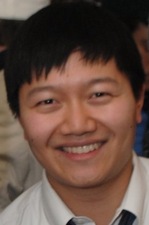
TIan-Jun Gu
Tian-Jun Gu is a senior in the Screen Arts and Cultures program with a sub-concentration in Screenwriting at the University of Michigan. Although born in Shanghai, China, he considers himself a Michigander. Film has been an integral part of his life but never a path he planned on taking. Originally enrolling in the University of Michigan as an engineer, he fell back in love with film through Hubert Cohen’s “Art of Film” class and cannot see himself doing anything else now.