

Jonathan Weiner questions immortality in his new book
On Wednesday evening Jonathan Weiner discussed his new book, "Long for this World: The Strange Science of Immortality." The discussion was part of the University of Michigan's Author's Forum. The College of Literature, Science and the Arts has selected "What makes life worth living?" as its theme for this Fall semester, and this book and the issues raised in it were discussed within that context.
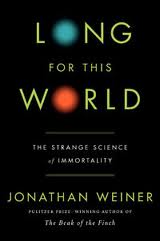
Jonathan Weiner is perhaps most popularly known for his 1994 Pulitzer Prize winning book, "The Beak of the Finch." "Long for this World" focuses on the work done in pursuit of immortality and the feasibility of being immortal regardless of what biology or nature has in store for people.
The author was interviewed by Elizabeth Barry, the managing director of the U-M Life Sciences Institute. The flow of discussion included his last book ("His Brother's Keeper"), hope for science writing in general and specifics of his most recent work.
A large portion of "Long for this World" includes interviewing Dr. Aubrey de Grey, a biomedical gerontologist and the Chief Science Officer of the SENS Foundation. Apparently a controversial figure in the science community, Weiner describes him as someone who is very "stage conscious," drinks a lot of beer and looks a bit like Father Time. Grey believes that the process of aging can be slowed dramatically and cured. Although as Weiner posited in the opening comments of the discussion, when focused on the question "What makes life worth living?" is more time the answer? Is it about more at all?
Weiner goes on to explain that Grey believes that science is moving at a fast pace, and the amount of knowledge learned increases exponentially. Consequently, if we can live long enough, we will live to see the cures necessary for longevity and, effectively, escape death.
After the interview that evening, I found myself mentally wandering in all sorts of directions. The audience was comprised of approximately thirty people, of all ages. What would it mean if everyone in the room were immortal? Or lived to be just over 100?
Elizabeth Barry opened the conversation with the startling statistic that the number of centenarians has doubled every decade since the 1960s. I am both wonderfully amazed and frightened by this information. If that were to be me, it means I am not even in mid-life yet. The lure of possibilities - the sense that time is on my side - is great. However my jellyroll belly has grown and the fight to trim it down seems harder as years pass.
In addition, we already live in a world of intense fighting for resources in order to maintain a good quality of life for everyone. The questions that plague us now would apply to even more people: Who would have access to those resources? How would that be determined? And these are, I know, just a few very basic questions.
At one point in the interview, they discussed how much of aging is associated with loss for people. Individuals connect aging with loss of physical abilities, loss of mental acuity, loss of friends and family as people pass away - is it even possible to visualize and comprehend a person of 100 years without such loss attached? As Weiner succinctly put it, "We cannot imagine it from here."
So, I am left with several questions, including the one I began with - What makes life worth living?
Information about the Author's Forum and upcoming presentations can be found here.
Julia Eussen received her B.A. in English from Kansas State University. She is currently a graduate student in Eastern Michigan University's Professional Writing Program. She is also an active member of the Ann Arbor Classics Book Group and has recently begun to re-acquaint herself with good poetry. She can be reached at jeussen at emich dot com.