

Michael Moore's work and image examined in U-M Press book, 'Michael Moore: Filmmaker, Newsmaker, Cultural Icon'
Note: this story has been updated with more information on the controversy over "Roger and Me."
Years ago, I interviewed an Ann Arbor man who’d known controversial filmmaker (and Michigan native) Michael Moore while growing up, and the interviewee said of Moore, “He’s a gadfly, but he’s our gadfly.”
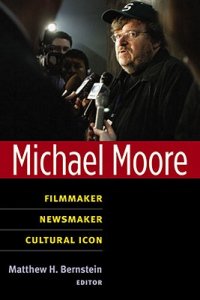
Because many locals feel the same way, a new book published by University of Michigan Press — “Michael Moore: Filmmaker, Newsmaker, Cultural Icon,” edited by Matthew H. Bernstein — may spark some interest.
The book is part of the publisher’s Class : Culture series; and because Bernstein, a film professor at Emory University, published a scholarly article in 1994 about “Roger and Me” (1989), he was approached by series editors Amy Schrager Lang and Bill Mullen about compiling a book of academic essays about Moore’s image/celebrity; his film work; and his place in the broader media landscape.
“I’d planned to do small book on Moore anyway,” said Bernstein. “ … I’d wanted to explore the question: why has (Moore) been able to come along and re-make documentary film as a genre, and suddenly make documentaries a theatrical phenomenon? Because we forget, but people weren’t generally watching documentaries in movie theaters before ‘Roger and Me.’”
Bernstein counted himself among Moore’s fans after seeing Moore’s first film, “Roger and Me” — about Moore’s attempts to confront GM’s then-CEO Roger Smith about the auto company’s economically devastating plant closings in Flint (Moore’s hometown). But later, when Bernstein became aware of accusations that Moore had the chance to meet with Smith, Bernstein felt he had to take the movie off the pedestal that he’d put it on.
“The whole premise of the film is that that didn’t happen,” said Bernstein. “So when you find out it happened, it undermines the whole film. … I agreed with (Moore) that the chronology (of events depicted in the film) doesn’t matter, … but meeting with Smith involves a whole other magnitude of dishonesty about what that film is.”
(Although Bernstein has accepted the often-repeated accusation that Moore did get the chance to interview Smith beyond the brief confrontation that happens at the end of the movie, Moore has vehemently denied that this ever happened.)
Still, Bernstein has admired Moore’s sense of humor and sheer nerve from the start.
“When I saw ‘Roger and Me,’ I was just so stunned that this guy was willing to make an idiot of himself,” said Bernstein. “That he’d walk into these corporate offices, not knowing anybody, and get turned away, and not be able to achieve his goals. But that’s part of the point he’s trying to make, too, of course. And you have to really admire that about him.”
This behavior also, in Bernstein’s estimation, sparks a sense of nostalgia among some filmgoers.
“(Moore) says things and does things that people think of, but won’t ever do,” said Bernstein. “And this pre-dates the George W. Bush era. ‘Roger and Me’ was very much, when it came out 20 years ago, about the Reagan Presidency and America’s pro-corporate culture. Not a lot of people were talking about that at the time.”
Indeed, Bernstein believes that Moore has an uncanny knack for focusing on issues before their time. “Sicko,” for instance, while it came after the Clintons’ failed attempt at health care reform in the ‘90s, nonetheless helped put the hot-button issue back on the map.
Yet Moore’s most recent theatrical release, “Capitalism: A Love Story,” in Bernstein’s estimation, fell short.
“What I worry about with ‘Capitalism’ is that he’s repeating himself,” said Bernstein. “Not just because he’s using clips from ‘Roger and Me,’ though that’s very telling, but because there’s always this issue with him: he’s really good at targeting individuals, … but with ‘Capitalism,’ he’s taking on a whole system, but using the same kind of methods. He’s extremely funny, and that’s another reason we like him. And he has a clear vision. … But when he places crime scene tape around the stock exchange, he says in voice-over, ‘I’m getting tired of doing this.’ And I thought, ‘I’m a little tired of you doing that, too. Do something else now.’ It was one of these impossible ironic gestures that is totally pointless. But he’s wedded to that. And in a way, the recent midterm elections may be a good thing for him, in that his voice might be needed again.”
Arguably, of course, a high point of Moore’s career came in 2003, when the filmmaker won an Academy Award for “Bowling for Columbine”. (Typically, he followed this with an acceptance speech that critiqued Bush and the Iraq War, thereby drawing both boos and a few cheers.)
“(‘Columbine’) was relatively open-minded, and it was definitely a movie of its moment,” said Bernstein. “It conveyed the horror of that time — when we were all trying to wrap our heads around the idea of children killing children — and it captured that very well. But at the same time, it also had this great sense of humor, too. … Moore has a great eye for the absurd. … And he was the one person brave enough to say, ‘This is crazy.’”
Plus, there’s no arguing that filmmakers like Morgan Spurlock (“Super Size Me”) have been heavily influenced by Moore, as has the entire documentary genre. And while Moore is now a wealthy, powerful, and famous figure, he still presents himself as an Everyman “shlub in a baseball cap” — a regular guy who’s bewildered by our government’s policies, and questions why America isn’t living up to its ideals.
“One of the things about Michael Moore is that he doesn’t really offer solutions,” said Bernstein. “He’s great at telling us what’s wrong with America, though. And he’s right, much of the time.”
Jenn McKee is the entertainment digital journalist for AnnArbor.com. Reach her at jennmckee@annarbor.com or 734-623-2546, and follow her on Twitter @jennmckee.
Comments
David Briegel
Tue, Dec 21, 2010 : 4:33 p.m.
Jerome, Thank you for agreeing with me (provocateur). When I briefly met Michael he was charming, gracious, witty, and insightful to many of us who where there to see the Gov of California, Jerry Brown. I was there to see Michael as much as the Gov! Michael even gave me his email address! Not an equal comparison with Rush. Michael doesn't tell nearly as many cynical, manipulative lies! Jenn, thank you for correcting things. I wonder how many naysayers will now apologize and admit to their errors?
Jerome Blue
Tue, Dec 21, 2010 : 2:35 p.m.
I have met Michael Moore, and what appears to be - neither icon nor journalist, but a rude, self-important buffoon. His films are merely the braying of a spoiled provocateur. Every side needs a buffoon, I guess - the right has Rush and the left has Michael Moore.
Jenn McKee
Tue, Dec 21, 2010 : 2:23 p.m.
This story has been updated, based on Moore's response.
Jenn McKee
Tue, Dec 21, 2010 : 2:19 p.m.
Moore responded to the Roger Smith interview issue, raised in this article, via e-mail: "Roger Smith did 'grant' me an interview - and it's at the end of the film! All attempts to get to the 14th floor of the GM bldg to interview Smith otherwise failed. The lie about how I left some big interview with Roger Smith out of the film, that one is just plain nuts. First off, why would I do that? If I had got on the 14th floor and got that interview, that would be the highlight of the movie!" Bernstein, meanwhile, cited the 2006 biography "Citizen Moore: The Life and Times of an American Iconoclast," and the 2007 documentary "Manufacturing Dissent: Uncovering Michael Moore," as two of his sources for this information, and wrote in an e-mail, "What occurs at the end of the film is, I suppose, 'an interview,' but it's on the fly, at the end of a corporate Christmas celebration."
Dog Guy
Mon, Dec 20, 2010 : 11:59 p.m.
Little of the comment is about Moore's work. As usual, Ann Arbor's herd of independent thinkers judges by liberal/conservative labels the worth and truth of anything. The modal Ann Arbor opinion is tribal, predictable, boring.
stunhsif
Mon, Dec 20, 2010 : 10:23 p.m.
Michael Moore, A bloviating buffoon you bet. A genius he is not!
jjc155
Mon, Dec 20, 2010 : 7:42 p.m.
I think that it is absolutely hilarious that the info that Cuba banned the showing of Sicko came from.............wait for it....... a memo that was "leaked" Assange and Wikileaks, LOL. Wonder if that is gonna change Moore's views on Assange?
julieswhimsies
Mon, Dec 20, 2010 : 7:08 p.m.
Michael Moore...like him or not is a newsmaker and a very talented filmmaker. With the regard to the rape charges against Assange in Sweden, it is my understanding that the charges have been dropped. In Sweden, if you have unprotected sex with a woman, it can be called rape, even if the sex was consensual. Here's a link I found, for those who are interested. http://www.msnbc.msn.com/id/40551118/ns/us_news-wikileaks_in_security/
jjc155
Mon, Dec 20, 2010 : 6:27 p.m.
@david-not to be a bummer or anything but you belive stats that are provided by a Communist Country? baby mortality is all great and all but why would Cuba ban instead of make manditory weekly viewing of Sicko if it portraied their system accurately? Dont forget the only thing that is better that communist propagande is american propaganda that make comminunist propaganda look better! LOL
David Briegel
Mon, Dec 20, 2010 : 5:53 p.m.
jjc, America is behind Cuba in infant mortality. More dead babies! Our value? Cuba trains doctors like we train nurses and they don't all earn a billion a year! All sacrificed on the altar of the American Mythology!
jjc155
Mon, Dec 20, 2010 : 4:17 p.m.
HEHEHE mike moore. I love the fact that in his "documentary" SICKO he trumpeted the triumphs of the Health System in Cuba and how it works and provides good care yadda yadda yadda. ANNNNND then Cuba turned around and immediately BANNED the movie in Cuba because they did not want a revolution on their hands as the health care system the Moore portrayed is NOTHING close to what the Cuban govt gives their people, LOLOLOOOLOOOOLLOLOL Soooo either he was 1) Hugely wrong about the Cuban health systen, didnt check his research etc OR 2) Blantanly lied about benefits of the Cuban model of Socialized Medicine......... Yeah he is a great jouralist and champion of the people......NOT (In Borat's voice, LOL)
Speechless
Mon, Dec 20, 2010 : 4:02 p.m.
Yes, it is sometimes true that Moore can play fast and loose with the superficial narrative in his films. I would agree that leaving out an actual meeting with Roger Smith would be inappropriate and potentially distract from the more meaningful, underlying social messages in that film. Yet Michael has very successfully made documentaries entertaining and easily accessible to the larger public by seamlessly blending a very serious social viewpoint with sharp satire and a good sense of humor. Compare him to Frederick Wiseman, an excellent documentarian whose typical, moment-to-moment, on-film realism is seen, unfortunately, by only a select few. One filmmaker who can, at times, approach what Moore does is Errol Morris. His otherwise sober portrait of Robert McNamara through the Vietnam years includes, as I best recall, a recurring droll humor and creative visuals. It's possible that early Morris films influenced Moore's Roger & Me. Moore's critics are notorious for having ultra-thin skins. This makes sense, since he targets society's top bullies. Most everyone knows from schoolyard experience that few are more hypersensitive to criticism than a bully. ------------ In regard to Moore's strong support for the accomplishments of WikiLeaks: First, Julian Assange may or may not be his own worst enemy. While we don't yet know the answer to that question, we do know that the WikiLeaks releases offer what easily comprises most important mass revelations of federal government behavior since the Pentagon Papers nearly 40 years ago. Hence, Michael Moore has excellent reason to champion WikiLeaks.... www.aolnews.com/2010/12/14/michael-moore-and-julian-assange-a-wikileaks-love-story/ www.michaelmoore.com/words/mike-friends-blog/why-im-posting-bail-money Should Assange eventually be extradited to the U.S. to face espionage charges, we'll then know the true purpose of the current Swedish charges against him. Thus, in order to support Assange's Swedish accusers and allow them to maintain credibility in world opinion, the U.S. government must completely refrain from any control-freak tendency it has to seek vengeance against someone who's facilitated truth-telling in the arena of foreign policy — something our domestic mass media has rigorously neglected to do.
David Briegel
Mon, Dec 20, 2010 : 12:26 p.m.
bugjuice, The haters here prove just how effective Michael is at shedding light on the deeper, darker secrets of the underlying mythology of America. Best health care in the world if 27th is best and 34th in infant mortality for the wanted babies. Did those wanted babies have a Right To Life? Provacateur is how I think of him. He provokes us to think and others to hate! And the last time I looked, Julian Assange has not been convicted. For those interested in rape, one needs look no further than how the good ole boy network in our military treats women as 2nd class citizens. But Rush and Sarah haven't told them what to think about that one!!
bugjuice
Mon, Dec 20, 2010 : 11:52 a.m.
I'll answer all of the loaded questions about Mike Moore if all the haters admit that he is a great filmmaker and a fine example of American free enterprise and entrepreneurship.
bugjuice
Mon, Dec 20, 2010 : 11:44 a.m.
I love Mythbusters. http://www.youtube.com/watch?v=W8qcccZy03s
bugjuice
Mon, Dec 20, 2010 : 11:40 a.m.
I call your links and raise. http://en.wikipedia.org/wiki/David_T._Hardy http://pajamasmedia.com/blog/obama-and-the-attempt-to-destroy-the-second-amendment/ Consider the source. Mr Hardy is a Waco wacko gun nut who made his living as a highly paid publicly employee. Something He probably consider heretical for anyone else. And don't forget that 50% of all attorneys graduated in the bottom half of their class. He has a wild hair for Mike Moore and anything that is liberal or progressive. A one trick pony who's afraid that he'll have to give up his AK. What else would you expect him to say? Maybe Mike could teach him how to be a world famous documentary filmmaker.
Joseph
Mon, Dec 20, 2010 : 11:37 a.m.
bugjuice, Moore would have been proud the way you spun my direct question into a condemnation of nefarious entities. Bravo. Bug, my question has nothing to do with 'trumped up charges'. Instead the manner that Moore deliberately lied about the circumstances of what defines rape in order to discount the charge itself. Following your sorta answer: why couldn't Moore simply say, "the charge was trumped up and everyone knows they are false"? Instead, Moore choose to minimize the rape charge to excuse Assante. Bugjuice, I am sure that you aware of the social implications of what happens when women see rape apologists in the media and the affect it could have on preventing other women from coming forward with allegations of their own, don't you? Can you set aside your defense and rhetoric and directly answer my original question: "When Moore downplayed and excused Julian Assange's rape charge was he 'telling it like it is' or was he portraying his version of reality to suit his political cause?"
Macabre Sunset
Mon, Dec 20, 2010 : 11:18 a.m.
To start with, here's a primer on the fiction from his most famous work: Bowling for Columbine... http://www.mooreexposed.com/bfc.html Apologies if links are not allowed. He's fundamentally dishonest. He should be dismissed as a charlatan. But the liberals champion him as exactly what he is not. That's what makes him annoying.
bugjuice
Mon, Dec 20, 2010 : 11:16 a.m.
As far as that link goes, everyone, both left and right know that powers that be trump up charges and try to destroy whistle blowers from Assange to Julia Roberts. Mike Moore reinforces the Lord Acton quote that power corrupts and absolute power corrupts absolutely. When he finds an example, he makes a movie about it.
Joseph
Mon, Dec 20, 2010 : 11:10 a.m.
bug or rusty, do you care to address Moore's latest lie (link above)?
bugjuice
Mon, Dec 20, 2010 : 11:05 a.m.
Mike Moore is a great example of a fat nerdy guy who became a self made rich fat nerdy entrepreneur. And I mean that most respectfully. He is a self taught and highly successful filmmaker. He knows how to provoke as much as promote. He does almost everything himself and does it with tiny budgets compared to may other filmmakers who desperately try to copy his style with little success. He is a great example of the American Dream. He is so hated is because he plays the game better than every other popular propagandist. He has a knack for pushing the buttons of those who admire him (like me) and those detractors whose skins are thin and can't stand it when he makes them look at themselves and those they admire. Mike Moore is a genius and he did it through his own hard work. The haters are jealous. Mike is fearless in his quest to expose the hypocrisy we see all around us. He knows that his attackers only increase the power and volume of his message. Crazy like a fox!
salineguy
Mon, Dec 20, 2010 : 10:48 a.m.
He takes facts, and then he puts a spin on them that some agree with and some don't. If what he was documenting was not fact based, he would have been sued by everyone repeatedly. He is a brilliant filmmaker. As mentioned in the article, he has turned documentaries into theatrical efforts. The genre has benefitted as a result. Like him or not, what he has brought to filmmaking will be influential for years to come.
Joseph
Mon, Dec 20, 2010 : 10:44 a.m.
Rusty, here is his latest gaffe and blatant lie. Even base liberal democrats are highly upset with Moore over this issue. Link: http://shakespearessister.blogspot.com/2010/12/michael-moore-doubles-down-on-rape.html
rusty shackelford
Mon, Dec 20, 2010 : 10:40 a.m.
Can anyone tell me what Moore's specific lies or misrepresentations are? It seems I hear a lot of grousing about it, but nobody can show me things he's willfully misrepresented. Anyone? Anyone? I'm talking an actual statement or argument Moore has made in one of his films, not just repeating "he's liberal" or "he lies."
Joseph
Mon, Dec 20, 2010 : 10:39 a.m.
Bugjuice: When Moore downplayed and excused Julian Assange's rape charge was he 'telling it like it is" or was he portraying his version of reality to suit his political cause? If you give my question enough thought, you may actually see Moore for whom he really is.
Macabre Sunset
Mon, Dec 20, 2010 : 10:23 a.m.
He doesn't tell it as it is, he tells it as he wants it to be. Unfortunately, he has a myriad of ditto-headed followers who also see the world through the same rose-biased spectacles.
Joseph
Mon, Dec 20, 2010 : 10:14 a.m.
If Mike Moore is genius than Keith Olbmerman is god-like.
bugjuice
Mon, Dec 20, 2010 : 10 a.m.
The reason Mike Moore get so much hate is because he's not afraid of telling it like it is. And some people just can't handle that.
bugjuice
Mon, Dec 20, 2010 : 9:58 a.m.
Mike Moore is a world class journalist.
JSA
Mon, Dec 20, 2010 : 9:38 a.m.
Cultural icon? Garbage! He's a cultural icon and Jack the Ripper was just a child gone wrong.
daytona084
Mon, Dec 20, 2010 : 9:20 a.m.
@bugjuice, anyone who does not agree with the hateful and hypocritical opinions of this multi-millionaire capitalist posing as a common man is, in your opinion, hateful and hypocritical?
Macabre Sunset
Mon, Dec 20, 2010 : 9:15 a.m.
Call him a lot of things, as long as you don't call what he does journalism.
Joseph
Mon, Dec 20, 2010 : 8:52 a.m.
Thanks bugjuice. Every now and then I need a reminder about how ultra-liberal the Ann Arbor-area Michigan is. Roger and Me was ground-breaking and fresh- subsequently his work too a sharp-turn to the left and never looked back. Enjoy his/your world. I guess in Moore's next project he can continue with his rape-apology for Julian Assange. Shame, shame.
bugjuice
Mon, Dec 20, 2010 : 8:37 a.m.
Mike Moore is a genius. He's a supremely talented filmmaker and propagandist. He's equally adept at making people laugh as he is making them angry. The reason he's so reviled is that he forces the people who do not share his views to look in their own mirror and face their hate and hypocrisy.