

The wordy transition: Crafting authentic dialogue
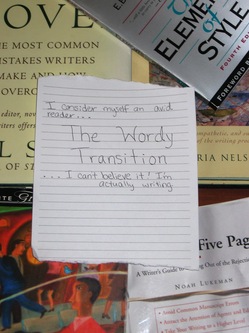
Crafting authentic dialogue comes easily for some writers, others have to work at it.
Last week, I discussed creating relatable characters in fiction. This week, I’d like to discuss another important element of writing — one that can be quite the challenge to master: crafting authentic dialogue.
Observe the following sample passage of dialogue. I’ve done my best to demonstrate several common mistakes that new writers make (although, admittedly, to an exaggerated degree). As you read, see if you can find the problems in this passage and think about how you might improve upon them.
“Hello, James, it is enjoyable to see you today. I am delighted that you are well,” said Jessica.
“Thank you, Jessica. It is also nice to see you. Yes, I am well. How are you?” said James.
“I am very well. Thank you, James,” said Jessica.
“That is marvelous, Jessica,” said James.
“James, did you hear about what transpired with Jordan? You know Jordan — he has been our coworker for the past ten years. He has sandy brown hair and is very tall,” said Jessica.
“Yes, Jessica, I know Jordan. What has happened to him? I did not hear,” said James.
Now let’s talk about the problems we have here:
1. Don't make your characters sound unnatural — How often do you tell your friend that it is “enjoyable” to see him, refer to something as “marvelous,” or ask if someone’s heard what has “transpired?” Probably never. It can be tempting to whip out the old thesaurus to spice things up, but use caution! Don’t put unnatural-sounding words in your character’s mouth — an exception, of course, being if your character is a stodgy know-it-all who would utilize obscure vocabulary words in speech. You must also remember that people use contractions and sentence fragments in speechl not everything is “I am” this and “you are” that.
2. Don’t information-dump — It’s true, dialogue can be more engaging for the reader than pages upon pages of exposition, but do not force your characters to explain everything to the reader. Why would Jessica have to remind James of who Jordan is when he is already well aware? Work this bit of background information into your exposition, convey the relationship through context. You could have Jordan reach his head up over the next cubicle having heard his name, or have James reflect on how Jordan isn’t the same person as he was when he first joined XYZ Corp.
3. Vary your dialogue tags — Did you notice that in this entire passage, James and Jessica only ever “said” what they wanted to say? Neither “yelled, whispered, asked, reasoned or growled.” Neither “said while tapping his foot impatiently” or “said, lowering her voice and sweeping her eyes across the room.” Well-placed dialogue tags add context to the conversation and remind us of who is speaking. If dialogue is done effectively, you won’t necessarily need a tag to indicate how a line of text has been delivered. A comment like “I don’t know what you’re talking about” could be interrupted as ignorance, denial, disbelief, or anger, but if you recraft the phrase to something like “Jeez! How many times do I have to tell you? I don’t know what you’re talking about,” there’s certainly less doubt. One word of caution: avoid the temptation of spicing up your tags by overzealously adding adverbs, especially when this involves inventing adverbs of your own by adding -ly to an adjective (she said concernedly, he said wondrously, they said annoyingly, we said celabratorily).
4. Don’t force your characters to say each other’s names over and over again — When having a conversation with your best friend, how many times do you say her name while speaking? How many times does she say yours? Probably not very often. Definitely not with every single line. Characters in films and television shows say each other’s names more often than is natural to remind the viewer of everyone’s names. In books, this is not necessary, since the characters’ names are present in dialogue tags, action, and exposition.
5. Don’t bore your reader with irrelevant dialogue — Truth be told, almost all of the above dialogue is utterly unnecessary. We don’t need to hear the characters greet each other, ask how the other is doing, say please and thank you and the like. If you include every single nicety in your dialogue, your story’s going to get very boring, very fast. And remember, sometimes the most authentic response is no response.
If we make changes according to the five suggestions above, our sample passage could be rewritten as such:
“Hey,” Jessica whispered, as she and James met at the water cooler. “Did you hear about what happened to Jordan?”
James glanced over at Jordan’s cubicle in the far corner of the office and then back up at Jessica, waiting to hear the latest gossip.
Notice that this is much shorter than the initial passage, and, if I’ve done my job, it should be a bit more interesting too.
Some writers have a natural gift for dialogue; others have to work at it. If you ever are in doubt about the authenticity of your dialogue, try reading it aloud to yourself or ask a friend to read and comment on it for you.
These are the basic mechanics of writing dialogue. I’ll cover more advanced topics such as using dialogue to reflect gender, education, financial status, dialect and other demographic traits some other time.
Melissa LR Handa is the founder and organizer for the Ann Arbor Classics Book Group and the Lead Books Contributor for AnnArbor.com. Her goal is to make classic literature more accessible to the everyday reader.
Comments
Melissa LR Handa
Tue, Dec 7, 2010 : 9:55 a.m.
That's right. I use "said" most of the time, but try to add in action movements for variety (he said with a shrug of the shoulders, she said fixing her gaze on the floor). For longer exchanges between two characters, I don't always include the tags--that would be tedious. I like to create unique enough voices for my characters that the manner in which something is said (word choice, slang, cadence, etc) should hopefully be enough to communicate who has said it. I hate it when authors feel the need to add an adverb after every dialogue tag. I also grit my teeth whenever a character "hisses" a statement with absolutely no S's in it--how can one hiss then?
Sarah Rigg
Tue, Dec 7, 2010 : 9:35 a.m.
Dialogue tags are tricky. I've read books by famous authors who never use anything other than "said" and sometimes don't use tags at all, assuming you'll figure out who's talking from context. And, I've read authors where the tags were really distracting. Sometimes you DO just "say" something rather than growling or exclaiming...