

This Week's Recommended Read: 'One Flew over the Cuckoo's Nest' by Ken Kesey
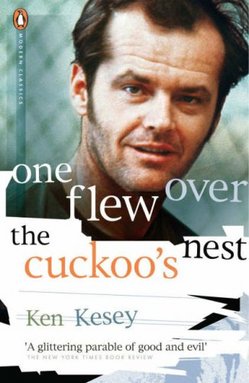
Jack Nicholson brought unlikely hero RP McMurphy to life in the 1975 film adaptation of Ken Kesey's powerful novel.
Preview…Reading fiction allows us to place ourselves right in the middle of a good book’s plot. Page by page, we can fall in love (without actually cheating on our spouses), pursue adventure (never at risk of any real danger) and overcome obstacles that may seem insurmountable (if we only keep reading). I’ve always found myself attracted to literature that reveals worlds that are nothing like the one I know, works that move the mind just as much as the soul. Ken Kesey’s “One Flew over the Cuckoo’s Nest” is one such novel.
Jack Nicholson brought the unlikely hero, RP McMurphy, to life in Cuckoo’s 1975 film adaptation. Although the movie depiction of the novel was entertaining, it swept over much of the story’s deeper meaning—the parts that make it so memorable and worthwhile.
In the novel, our narrator is Chief Broom, a paranoid schizophrenic, who pretends that he is a deaf-mute in order to be left alone by the staff of the 1960’s mental ward. The Chief has a routine that he performs day in and day out, that is until RP McMurphy arrives one day and stirs everything up. Quite arguably, McMurphy is not “crazy” when he enters the ward, but rather, has gotten himself hospitalized in order to avoid his other alternative, the tough labor of a work farm.
McMurphy entices and empowers the other patients, showing them that it is possible to stand up to the villainous, ball-buster Nurse Ratched. Realizing that he has become a leader to the others—and ironically an effective element in their treatment—McMurphy attempts to petition for change. He begins pushing the nurse toward the edge. She, in turn, pushes back.
What does it mean to be “mentally incompetent”? Can one ever really be “cured”? Does someone have to be pure and good in order to be deemed Christ-like? Kesey paints his characters beautifully. As a reader, you will find it impossible not to question the deeper meaning that lies just below the surface of this engaging story. If you haven’t read “One Flew over the Cuckoo’s Nest” already, I strongly urge you to do so.
You may like this book if…you enjoy a quick and riveting read; you like in-depth character studies; you enjoyed the film adaptation and want more of RP McMurphy and his buddies; you are intrigued by how the era may shape perceptions; you’d like to read the works of an author who will go to any extreme to get inside of his characters (even voluntarily submitting himself to electro-shock therapy); you like pondering the meaning of “crazy”; you find it interesting that the two primary female characters are the antagonistic nurse and a prostitute; and even if you don’t care for all of that deep symbolism business—you can still enjoy this novel! You may not like this book if…you have no interest in reading about the mentally ill or these types of issues hit too close to home for you; you like books with unequivocally happy endings; you just hate the idea of evil prevailing. Melissa LR Handa is the founder and organizer for the Ann Arbor Classics Book Group and the Lead Books Contributor for AnnArbor.com. Her goal is to make classic literature more accessible to the everyday reader.
Comments
Melissa LR Handa
Tue, Jul 20, 2010 : 7:59 a.m.
While I agree that the heart of this novel is the power struggle that ensues and that RP McMurphy is not "mentally ill", the cast of secondary characters more clearly suffer illnessess--beyond that, to reach the conclusion that McMurphy himself is "not crazy", we as readers must first examine what it means to be "crazy", both to ourselves and to society at large.
Harold A. Maio
Tue, Jul 20, 2010 : 7:26 a.m.
You may not like this book ifyou have no interest in reading about the mentally ill Ken Keseys One Flew over the Cuckoos Nest is not about "the" mentally ill. It is about abuse. The protagonist, McMurphy, has no illness, he is confronted with an adversary, Nurse Ratched, who has no conscience. What ensues is a battle of the wills, in which Ratched, having all power, has McMurphy lobotomized. Harold A. Maio, retired Mental Health Editor