

Comic Opera Guild presenting Balfe's 'The Rose of Castile' and Sousa's 'Chris and the Wonderful Lamp'
Want to feel as though you’ve stepped back in time? Like, way, way back?
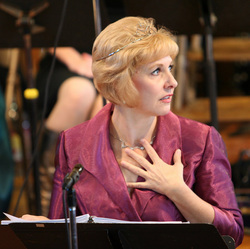
Karin White as Elvira in "The Rose of Castile"
The Comic Opera Guild kicks off its 38th season by way of concert performances (with original dialogue) of two more shows that previously seemed lost to time: William Michael Balfe’s “The Rose of Castile” and John Philip Sousa’s “Chris and the Wonderful Lamp.”
Both shows have languished for more than a century. Balfe wrote “Rose” in 1857, and Sousa wrote “Chris” — adapted from a novel by Albert Stearns — in 1899.
“The reason we chose these shows is, essentially, their scarcity,” said COG managing director Tom Petiet. “They’ve never been properly recorded. In the case of ‘Rose,’ one old recording was made of parts of it, but it’s not a very good recording. And the Sousa has never been recorded at all. So they both really seemed in need of being revived.”
For COG’s concert performances, pianists Patrick Johnson and Margaret Counihan will accompany 19 singers; and the concerts will be recorded so as to make available, for the first time, complete recordings of both shows. (Since COG began its Musicals in Concert series in 2003, it's revived 47 musicals and operettas, recordings of which are now sold internationally.)
PREVIEW
"The Rose of Castile" and "Chris and the Wonderful Lamp"
- Who: The Comic Opera Guild.
- What: Staged concerts of classic shows, with original dialogue.
- Where: Northside Community Church, 929 Barton Drive.
- When: “Rose” plays Wednesday, November 3 and Friday, November 5 at 8 p.m.; “Chris” plays Saturday, November 6 at 2 and 8 p.m.
- How much: $15 suggested donation. Information: 734-973-3COG (3264) or the Comic Opera Guild website.
COG’s presentation of “Rose,” in fact, might mark the first occasion the show’s been performed on these shores. (The one partial recording that exists was from an English production.)
“It may not have been ever in this country,” said Petiet. “… We’ve found no record of it, anyway.”
“Rose,” a ballad opera, tells the story of a princess who travels incognito to meet the prince she may marry. On the way, however, she’s intercepted by Don Pedro, her cousin, who seeks the throne for himself, and she’s saved by a muleteer who turns out to be the king.
In a strange coincidence, COG found “Rose”’s original score in the University of Michigan Music Library, after deciding to pursue a performance of the show. "Rose"'s dialogue, meanwhile, was more difficult to track down, and turned up in the National Library of Australia.
“It’s an English speaking country,” said Petiet. “ … It’s wholly possible that ‘Rose of Castile’ was performed there. And if not, … because the country was tied to the UK at one time, the published material may have came into their possession by way of a music lover coming to Australia.”
Balfe is largely unknown today, but in the mid 19th century, he was a prolific opera composer with a gift for melody, and his biggest hit was “The Bohemian Girl.” Though Irish, Balfe wrote in the Italian style - a seeming successor, according to Petiet, to George Frederick Handel in bel canto English opera.
“The term bel canto just means beautiful singing, so they were shows that were primarily showpieces for singers,” said Petiet. “They were not as dramatic as later operas — Verdi and Puccini changed things — but in this period, the emphasis was on the beautiful voice.” (Handling the highly difficult soprano part in COG’s “Rose” is Karin White.)
Petiet compares Balfe to Andrew Lloyd Webber, in that he created tunes that became popular beyond the context of the show.
“Today, you can’t think of a single tune from an opera that’s became popular,” said Petiet, who noted that Balfe was, for a time, artistically dismissed as a "populist." “Andrew Lloyd Webber doesn’t primarily appeal to aficionados. … And shows like “Phantom” aren’t opera, but they’re sort of operatic - popular operatic. Balfe sort of did the same thing. … He had a real talent for melody.”

Katy Kujala as Fanny in "Chris and the Wonderful Lamp"
“Chris,” meanwhile, was a holiday opera geared toward young people. The show, and the novel that was its basis, tells the story of a young man from Connecticut who buys Aladdin’s lamp at an auction. The lamp’s genie, who is more modern than expected, transports Chris to the boarding school of his sweetheart, Fanny, and then takes them both to Aladdin’s home. Aladdin tries to steal Fanny away, but she spurns him and returns home with Chris.
“It’s a little like (Frank L. Baum’s) ‘The Wizard of Oz’ being made in musical,” Petiet said of the show.
To dig up the show's dialogue, COG enlisted help from the New York team of William Martin and Jerrold Fischer, who are dedicated to restoring Sousa's stage works.
"We have connections now with a number of musical scholars around the country," said Petiet.
“Chris” has a Broadway run of 53 performances, and Chris was played by a petite actress, Edna Wallace Hopper, who had appeared with her equally famous husband (DeWolf Hopper) in Sousa’s earlier hit, “El Capitan.”
Sousa claimed that “Chris” was his favorite score. And while most of the music is light, there is a march.
“Since he was known for that, he had to throw one in,” said Petiet. “There’s little justification for it, other than that he just had to have a march.”
Jenn McKee is the entertainment digital journalist for AnnArbor.com. Reach her at jennmckee@annarbor.com or 734-623-2546, and follow her on Twitter @jennmckee.