

Bridge column, October 10: Do not be deaf to the bidding
Someone screams, "Don't go through that door!" So why, two seconds later, does a young woman do exactly the opposite? You think she would know better.
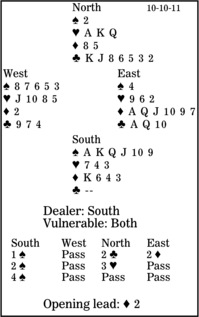
Occasionally a bridge player will act like that -- he is fully aware what will happen, but he cannot stop himself from making a fatal move. This deal provides an example. First, look at the auction. Then, how should South plan the play in four spades? West leads the diamond two. East wins with his ace and returns the diamond nine.
If the bidding were perfect, North-South would reach three no-trump. And perhaps South should have bid that over three hearts. But it is understandable to make six solid spades the trump suit. Note also that North was safe in bidding three hearts, to show his concentrated values in the suit. If South had held four hearts, he would have rebid two hearts, not two spades.
Declarer appears to have 10 winners: six spades, three hearts and the diamond king. But first, what must West's lead be?
Given that East made a two-diamond overcall, it must show a singleton. So if, at trick two, South puts up his diamond king, he knows West will ruff it. Then declarer will have only nine tricks.
It is akin to not taking a finesse that must lose -- do not play a winner that will be ruffed. Declarer must follow suit with a low diamond at trick two and at trick three. West may ruff the third round (to stop declarer from winning the trick by trumping on the board) and return a club, but South ruffs, draws trumps, and claims those 10 tricks.
Copyright 2011, United Feature Syndicate