

Bridge column, October 11: The bidding points to the points
Joe E. Lewis, a comedian and an actor who died in 1971, said, "I've been on such a losing streak that if I had been around, I would have taken Gen. Custer and given points."
If Lewis had been a bridge player who counted high-card points, his losing streak would have ended. Tracking points often turns apparent guesses into certainties. This deal offers a relatively simple example.
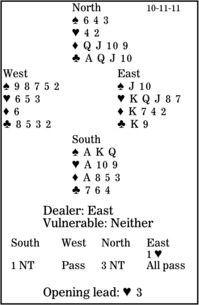
South is in three no-trump after East opened one heart. West leads the heart three (low from his worthless tripleton because he did not support his partner's suit). How should declarer plan the play?
South was about to open one no-trump. So, when East bid one heart in front of him, South was right to overcall one no-trump. And North should immediately raise to game. Be aggressive in these situations because declarer should -- will! -- know from the bidding where the missing high cards are located. He will play more accurately.
South starts with six top tricks: three spades, one heart, one diamond and one club. Three more tricks are available from either minor as long as the finesse is winning. But which finesse should declarer take?
South only needs to count the points. The dummy has 10 and he has 17. That leaves 13 for the opponents, yet East had sufficient to open. The club finesse must fail and the diamond finesse must win. Therefore, when declarer wins with his heart ace, he should play a club to dummy's ace and take the diamond finesse three times. No sweat!
Copyright 2011, United Feature Syndicate