

Bridge column, October 15: A pass may be as good as a peek
Mike Lamb, an infielder for the New York Yankees, said: "I took a peek. He looked like he was going back to third base."
It is said that a peek at an opponent's hand is worth two finesses. Sometimes, though, a call by an opponent supplies as much information as a peek.
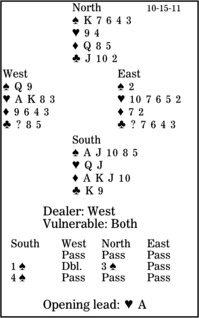
South is in four spades. West leads the heart ace, cashes the heart king and shifts to a diamond. How should declarer continue?
North has a borderline bid over West's takeout double. If he is a solid believer in the Law of Total Tricks, he will jump to four spades. But that is a big overbid with such a balanced hand. A pre-emptive three spades looks right to me. (Remember, with game-invitational values and four or more trumps, responder bids two no-trump, Truscott, in this situation.)
Declarer can afford to lose only one club trick. After winning trick three, he draws trumps, cashes the rest of the diamonds (discarding a club from the board), leads a trump to the dummy and calls for the club jack. When East plays low smoothly, what should South do?
West has already shown up with nine points: the heart ace-king and spade queen. If he had the club ace, too, he would have opened the bidding. Declarer should rise with his club king.
In conclusion, what do you think about looking into an opponent's hand? Some do it happily -- never give a careless person a break. Thankfully, though, most never peek. And, yes, it is silly not to keep your cards so far back that they cannot be seen by anyone else.
Copyright 2011, United Feature Syndicate