

Bridge column, October 7: Is the opening lead wet or dry?
Ruth Draper, an actress who died in 1956, said: "Wasn't the artist brave to go out and paint a sea as rough as that? I don't see how he kept his canvas dry."
Bridge can be like that in several instances. A bid can be brave or foolhardy; a play might work out well or badly; or, as in this case, an opening lead might beat the contract or let it make -- and sometimes, even then, it depends upon the skill level of the declarer.
For my next lesson on our cruise, I concentrated on declarer's reading the opening lead, working out what information it gives away, and deciding how to use that data with effect.
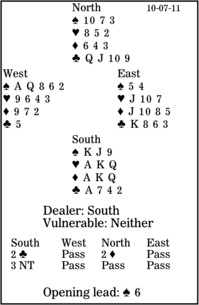
In this example, South is in three no-trump. West leads a fourth-highest spade six. What should declarer do?
South's sequence showed a balanced hand with 25-27 points. North had an easy pass.
When the lead is fourth-highest, apply the Rule of Eleven. Six from 11 is five. So there are five spades higher than the six in the North, East and South hands combined. And South can see all five: dummy's 10 and seven, and his own king, jack and nine. East cannot have a spade higher than the six. How does that help?
Declarer should call for dummy's 10, which will win the trick. Then he can run the club queen and get home even if the finesse loses, because his spade king will still be a stopper. Here, he collects two overtricks.
Note, though, that if South wins trick one in his hand, East gets in with the club king and pushes a spade through, giving West four tricks in that suit and killing the contract.
Copyright 2011, United Feature Syndicate