

Daily Bridge column, March 30
By Phillip Alder
Sherlock Holmes said, "I never guess. It is a capital mistake to theorize before one has data."
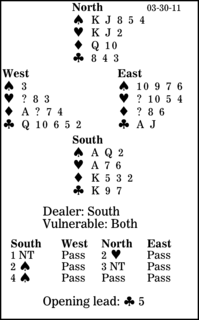
Bridge players try not to guess, but there are deals in which you just have to guess well to make your contract. This is one of them. How would you plan the play in three no-trump and in four spades? Against either contract, West leads the club five, East winning with his ace and returning the jack.
In the auction, North used a transfer bid, then jumped to three no-trump to indicate exactly five spades with game values. It was tempting for you to pass because both spades and no-trump might have won only nine tricks. But it was "normal" to correct to four spades.
In three no-trump, you should duck the second club. West will overtake with his queen and return a club to your king, East discarding a heart. With only eight top tricks (five spades, two hearts and one club), you have to guess whether to play a diamond, which works perfectly when East has the ace, but is a disaster here; or to take the heart finesse.
In four spades, you must win the second club and really guess well. If West has the diamond jack and East the heart queen, you can afford to draw one round of trumps, but then must play a diamond to dummy's 10. In contrast, if those red-suit honors are the other way around, you can draw trumps, take the winning heart finesse, and concede only one diamond and two clubs.
There really is no way to know which route to take. Even Sherlock Holmes would have had to guess.
Copyright 2011, United Feature Syndicate