

WCC's GalleryOne views the human form in "Considering the Figure"
“Considering the Figure: Four Points of View” at Washtenaw Community College’s GalleryOne highlights — as the exhibit’s gallery statement tells us — “artists who are using the human figure as inspiration or as a central theme in their work.”
This may seem self-evident, but the gallery statement also makes an additional observation that’s’ a bit more telling: “Until the 19th century, the human figure was central to Western art — everything was based on the figure. In the mid-1800s, the emphasis on the figure diminished.”
It’s this guiding thought that focuses the show.
For the mid-19th century indeed saw an aesthetic revolution in European art with its shift from natural observation to impression and expression. Granted, there were plenty of human subjects in the century’s later artworks. But figuration itself was largely subordinated to the farther-reaching goal of the artist.
The 20th century’s preoccupations with color, geometry, and psychology created a situation where the human form was typically even more diminished in a fundamental manner. So while it would be inaccurate to suggest that the human form wasn’t a topic of interest of artists and sculptors through the period of modernism, there was also a concerted preoccupation with other topics that vied for the artist’s attention.
It’s therefore of tremendous interest that the late Rudolf Arnheim once said in a late 1980s interview I conducted with him that there is no other subject in western art than the human figure. And Arnheim’s pointing to the resurgence of interest in the human form at mid-20th century has proven equally true nearly 2 decades later.
The 4 points of view in “Considering the Figure” confirm his insight. The 4 artists focus on the human body while also incorporating the lessons of 19th and 20th century art.
Each master in this exhibit — Margaret Davis, Nancy Diessner, Robert Hansen and Louis Marinaro — resolutely combines an interest in modernism with a re-examination of the human body.
Margaret Davis, an art professor at Eastern Michigan University, uses her figures to create complex paintings whose iconography informs the composition. Intermingling scientific symbols with mythic imagery, Davis creates a sort of art that’s hermetic yet transparent. “I am intrigued by how these various visual codes intertwine and overlap,” Davis says in her artist’s statement to the exhibit.
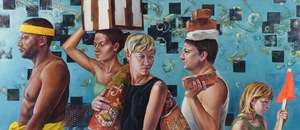
"Carriers" oil on canvas by Margaret Davis. On view in "Considering the Figure: Four Points of View" at Washtenaw Community College's GalleryOne through February 24, 2010.
Image courtesy WCC's GalleryOne.
And so it is that all 3 of Davis’ oversize oils on canvas in this exhibit (“Carriers,” “Column,” and “Dusk,”) hinge on this balance of the all-too-familiar referring to the vaguely unfamiliar. Yet Davis works in an exacting realism where her visual codes are subordinated to the human figure.
Davis’ “Carriers” is merely 1 of 3 equals in this display, but it also highlights the tension found in her art. The 5 figures of this composition are superb in their exacting detail — 4 carrying a physical object; with a crucial fifth carrying a seeming psychological burden — as she mingles race, gender, age, and a curiously shared blank emotional state in this inspired illustration of the human condition.
Nancy Diessner, chair of the Department of Interdisciplinary Studies at New Hampshire’s Chester College of New England, contributed 8 photo polymer intaglio prints whose expressive imagery portrays human and canine figures through varying parts and wholes.
Saying that her prints are “generally speaking, about longing,” Diessner explains in her artist’s statement that her investigation into form is meant to be “trapped or disguised.”
Diessner’s “Find the Sky No. 2” features 2 images: a hound lying on floral paper above a male model below wearing the mask of a dog. While “Finding the Sky,” by contrast, features 2 crouching figures with the higher of them bearing a faint furrow on the back of the model’s head while the bottom figure crouches on the ground with an etched line spiraling upon his head. And “Bodies of Longing No. 2” carries this motif even further with a churning twirl of etched line swirling about the head of her female model.
Robert Hanson, a professor of painting and drawing at the Pacific Northwest College of Art in Portland, favors what he calls an “openness, airiness, transparency” in his drawings.
Hanson’s sketches are taut affairs whose surface simplicity masks a keen complexity. Of the 4 artists in “Considering the Figure,” Hanson is the sole consistent proponent of portraiture, and his 7 inquiries into the human psyche via drawing and color pencil emerge like deft narratives whipped off by his draftsmanship.
As such, “Orange Bead” is a clever portrait whose flattening of figurative perspective is contrasted by his strategic use of color and line. Rather than load his portrait with detail, Hansen chooses to embroider the drawing with surrounding detail adding minutely to the carefully measured color in the portrait.
But leave it to Louis Marinaro of the University of Michigan School of Art and Design to decisively break the exhibit’s mold with his 4 bronze miniatures. One of this area’s most talented sculptors, Marinaro supplied what he calls “interwoven metaphor” between what he perceives and imagines.
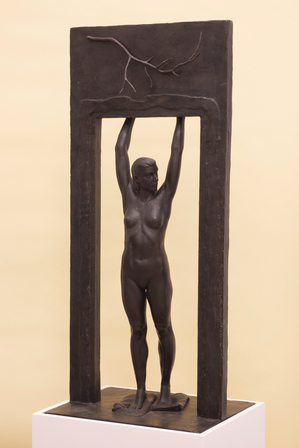
"Hanging Woman" bronze sculpture by Louis Marinaro. On view in "Considering the Figure: Four Points of View" at Washtenaw Community College's GalleryOne through February 24, 2010.
Image courtesy WCC's GalleryOne.
Marinaro’s works in this display are most certainly (as he puts it) a “knowing” kind of art. His ability to depict drama while yielding tension through the human form is quite remarkable.
His painted bronze, “Woman with Two Rocks,” echoes surrealism, being a miniature of a woman who bears a sack across her face. Marinaro credits the Mesopotamian myth of the “great deluge” and the subsequent repopulation of the earth with his inspiration, yet the insight is all his own.
And a reprise of his “Hanging Woman” (it’s been a number of years since this miniature has been exhibited locally) is a welcome reminder of his ability to craft figurative theater solely through sinew and stress. His model throws her arms up—body taut and erect—displacing air as she defies her stolidity. Magnificently hovering between defiant motion and frozen state, Marinaro’s “Hanging Woman” is a masterwork in unassuming human form.
“Considering the Figure: Four Points of View” will continue through February 24 at Washtenaw Community College GalleryOne, Student Center Building Room 108, 4800 E. Huron River Drive. Gallery hours are 10 a.m.-6 p.m. Monday-Tuesday; 10 a.m.-8 p.m. Wednesday-Thursday; and 10 a.m.-noon Friday. For information, call 734-477-8512.