

UMMA exhibit traces world-renowned artist Cory Arcangel's creative pursuits
For about a decade, Brooklyn-based digital media artist and programmer Cory Arcangel has built a world-renowned fine arts career around appropriating different types of popular media and technology, hacking into them and giving them new uses.
The artist is probably best known for hacking into video games — from classic systems like Nintendo and Atari, to popular contemporary games like Guitar Hero. However, throughout his career, Arcangel has explored and subverted the cultural meanings that people tend to attach to a lot of different kinds of gadgets, software and technologies.
Arcangel’s first solo exhibition at a North American museum, titled "Creative Pursuits," is on display in the Irwing Stenn Jr. Family Project Gallery at the University of Michigan Museum of Art through April 11.
The collection of Arcangel’s works featured in the show traces some of his long-lasting creative pursuits, and some of the works dabble in new creative directions. "Creative Pursuits" gives you a taste of what Arcangel has been about since the beginning, but the show also dips a toe into some of the artist's new approaches.
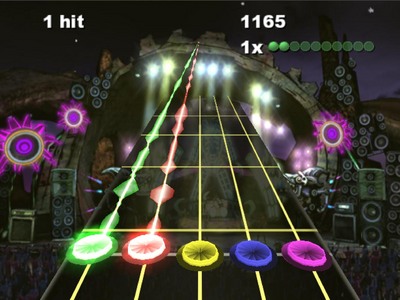
Cory Arcangel's "Composition #7," “Frets on Fire” video game
courtesy of the University of Michigan Museum of Art
One trend in Arcangel’s career has been manipulating different forms of technology in order to use them in ways that are different from their original intended uses, especially video games. In "Creative Pursuits," the artist cloned Guitar Hero into a new hacked version of the game, called "Frets on Fire." Players can sit down on the UMMA gallery floor and try to figure out the unusual logic behind his hacked gameplay and scoring system.
Spoiler alert: If you play the game, you will quickly find out that you are holding down the same two notes for a significant amount of time. In fact, the song you are playing is LaMonte Young’s "Composition 1960 #7," a minimalist number consisting of sustained B and F# notes, a perfect fifth. If you are patient, you will reach the end of the piece and receive a score of 32,903 points. When you wander down to the UMMA to play the game for yourself, please help me figure out, who’s Greg?
Arcangel also contributed a second video game hack to the exhibition, titled "Self-Playing Sony PlayStation1 Bowling." A projection of the auto-piloted bowling video game can be viewed through the gallery windows from the outside of the UMMA, after hours and into the night. The hitch here is that the game is programmed to constantly throw gutter balls.
The artist also appropriates popular technology into his work "Drei Klavierstucke, Op.11," which shows four spliced YouTube videos of cats playing piano. Arcangel composed the videos in a way that mimics Arnold Schoenberg’s 1909 composition — the first piece of atonal music. To create the work, the artist referenced a recording of the composition, which was performed by Glenn Gould, a pioneer in electronic recording and classical music.
The cat videos are particularly interesting in the context of Arcangel’s solo show because the artist has recently taken an interest in exploring the cultural meaning behind the intended uses of different media — not just creating new uses for these technologies. In my opinion, "Drei Klavierstucke, Op.11" toes the line between the artist’s usual tendency to hack and an exploration of how people actually use YouTube. YouTubers really do splice together other people’s videos in order to create their own, unique works. However, at the same time, this piece is also a clear example of how Arcangel appropriates media and technology in an unusual, subversive way.
The clearest example of Arcangel’s recent interest in how people use technology is his series of c-prints, collectively titled "PhotoShop Gradient Demonstrations." Each work’s title lists the simple actions he took in Adobe PhotoShop in order to create it. For example, one of the work's full title is "Photoshop CS: 40 by 30 inches, 300 DPI, RGB, square pixels, default gradient 'Russell’s Rainbow' (turn transparency off), mousedown y=9040 x= 2460, mouse up y=10040 x=1040." The resulting works resemble minimalist artworks that were popular in the mid-20th century.
The Photoshopped works are visually engaging; however, it actually took Arcangel very little effort to create them. In a statement the artist gave about similar artworks, which appeared in "Adult Contemporary," an exhibition held at the team (gallery, inc.) in New York in 2008, he states, “Imagine me buying some video equipment off of eBay, turning it on, pressing some random buttons, and then calling whatever comes out my ‘work.’ This mindset is the spirit of 'Adult Contemporary.' In contrast to some of my older work, which exercised a somewhat subversive use of modern digital tools, the pieces in this show are inspired by the idea of using technology exactly as it was designed, although in a manner best described as ‘non-expert.’ What if the possibility of using a system poorly in an uneducated manner were celebrated? What if I, as an artist, attached my name to the aesthetics of different eras of technology without really bothering to do my homework or even reading the manual (so to speak)?” he asks.
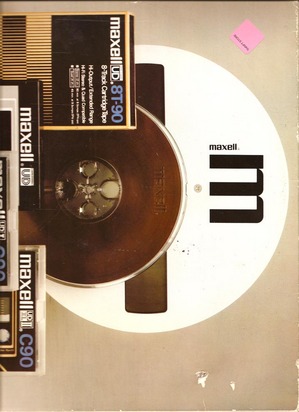
"Maxell 1" by Cory Arcangel
"Creative Pursuits" at the UMMA also explores the conflicts that happen when “technological incompatibility” occurs between new and old media formats, according to UMMA's associate of contemporary and modern art Jacob Proctor's statement about the exhibition. A series of 4 c-prints images the back cover of a late 1970’s Maxell “Rock Sampler.” When Arcangel set out to scan it into his computer, he found that the dimensions of his scanner were incompatible with the dimensions of the image he was trying to capture. The resulting 4 works show the cover, although the artist had to rotate it 4 times to capture the entire surface.
Finally, the exhibition features Arcangel’s first sculptural work, titled "Kinetic Sculpture #1," which the artist created in 2009. The work consists of 2 motorized retail display stands that the artist modified in order “to perform a composition based on the technique known as phasing,” according to Proctor’s exhibition statement. The two sculptures rotate in a repetitive motion; however, they don’t move at the same tempo. Sometimes they move in sync, but quickly they fall back out of sync.
In January, Arcangel also contributed improvised performance to the UMMA, in collaboration with Ann Arbor’s Digital Music Ensemble, called "Master Class in Reverse." The performance included improvised music using instruments that the ensemble provided especially for the event. Arcangel did not know what the instruments would be before the performance. The resulting event included Arcangel hurling a Conan the Barbarian sword at a metal cage strung with piano wire and projected through a guitar amplifier, as reported by the Michigan Daily.
Jennifer Eberbach is a free-lance writer who covers art for AnnArbor.com.
Cory Arcangel's solo exhibition, "Creative Pursuits," is on view in the Irwing Stenn Jr. Family Project Gallery through April 11 at the University of Michigan Museum of Art, 525 South State Street. Museum hours are 10 a.m. to 5 p.m. Tuesday, Wednesday and Saturday; 10 a.m. to 10 p.m. Thursday-Friday; and noon to 5 p.m. Sunday. For information, call 734-763-UMMA.
Comments
John Carlos Cant
Sun, Feb 21, 2010 : 11:40 a.m.
Good work... and good writing!