

Emerson String Quartet returning to Ann Arbor for classic Mozart works
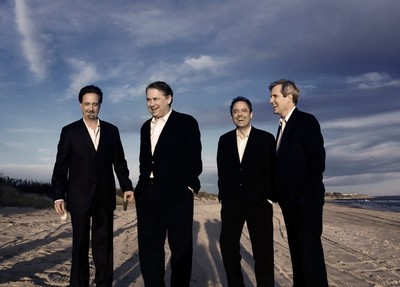
The Emerson String Quartet returns to Ann Arbor next Sunday.
Surprisingly, the Emersons—Eugene Drucker and Philip Setzer, violin; Lawrence Dutton, viola; and David Finckel, cello—have never recorded these quartets before.
PREVIEW
Emerson String Quartet
- Who: Highly esteemed chamber-music ensemble.
- What: The late Mozart quartets ("King of Prussia") and the Adagio and Fugue in C Minor.
- Where: Rackham Auditorium, 915 E. Washington St.
- When: Sunday, Sept. 18, 4 p.m.
- How much: $24-$52. Tickets available from the UMS Ticket Office in the Michigan League, 734-764-2538, and online at ums.org.
“There was no intention behind that,” Drucker added. And the three King of Prussia quartets coming up Sunday have been in their repertoire since just about the time they learned the “Dissonance,” so they are old friends. The question arises whether these three last quartets—Mozart envisioned a set of six, but completed only the three, under monetary and personal duress—are a summation of sorts, in the manner of the late Beethoven or Schubert quartets.
“That’s not the case here with Mozart,” Drucker said. “It’s hard to point to an arc of progress from the Haydn quartets of the early 1780s to these quartets of 1789-90. It’s hard to say that these are more advanced than the others.”
Two things are different, though, as he sees it.
One is the prominence of the cello part. “That has something to do with Frederick,” he said, “who was a great amateur cellist and had one of the greatest cellists of Europe, Jean-Pierre Duport, in his employ. I assume Mozart did it to please him.”
The other thing that distinguishes these last quartets is their minuets, Drucker said. “Two of them—K. 589 and K. 590—have striking minuets that are far more developed than in the earlier quartets.”
Still, he said, “you can’t talk about ‘late style’ in the quartets the way you can talk about it in the last three Mozart symphonies, a few of the viola quintets or the last Da Ponte operas.” On the other hand, listening to these last quartets is an immersion in music “so beautiful and crystalline,” Drucker said. “It’s a master at the height of his powers.”