

Encore Theatre's 'Fiddler on the Roof' isn't perfect, but it's enough
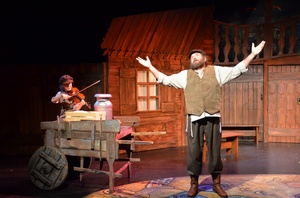
Emily Slomovitz and Stephen West in Encore's "Fiddler on the Roof."
Photo courtesy of Encore Theatre
For I’m part of a multicultural family, and the classic musical is, in large part, about the struggle to hold on to traditions, rituals and beliefs in a world that’s constantly changing.
Based on the stories of Sholem Aleichem, with a book by Joseph Stein, music by Jerry Bock, and lyrics by Sheldon Harnick, “Fiddler” focuses on Tevye (Stephen West), a poor milkman who lives with his wife and five daughters in the Russian shtetl of Anatevka at the turn of the 20th century. As his daughters approach marrying age, one resists the match made by her parents; another asks for her father’s blessing, not his permission, to marry the man she loves; and the third dares to marry a non-Jew - a crisis that forces Tevye to choose between his faith and his family.
There’s a good deal to recommend director Barbara F. Cullen’s three hour production of “Fiddler,” but one overarching problem is that the world created doesn’t feel wholly authentic. Sharon Larkey Urick’s costumes, while otherwise appropriate, look pristine and spotless, rather than the dusty, dirty, worn rags these people would likely have donned; when the Russians warn Tevye and his family that they’ll have to leave town, the “raid” looks and feels toothless (no matter how hard you throw a pillow, it’s still just a pillow); and the actors’ line delivery - in terms of cadence and inflection - didn’t convince me, either.
Even so, the production has great spirit and some solid vocal ammunition (guided by music director Cheryl Van Duzen). Encore co-founder Dan Cooney originally envisioned the theater as an intimate performance space that would allow theatergoers to focus on a show’s text and music and lyrics; so it’s hardly a surprise that “Fiddler”’s least-busy numbers - “Sunrise Sunset,” “Do You Love Me?” and “Chavela Sequence” - are its best and most moving.
Conversely, Cullen’s “To Life” bites off more than it can (and should) chew, as the Russians in particular struggle with portions of the labored choreography. Plus, during all-hands-on-deck dance numbers like “Tradition,” Encore’s small stage sometimes feels cramped and overburdened.
Yet a good Tevye goes a long way, and Encore has that in West, a voice professor at the University of Michigan. With bear-like physicality, West makes Tevye a larger-than-life, but nonetheless vulnerable and wry, man who’s struggling to reconcile his sense of identity and faith with the revolutionary actions of his daughters. Marlene Inman-Reilly, playing Tevye’s wife Golde, seems a perfect match, with outstanding vocals to boot. And among the supporting cast, the hands-down standout is the charismatic Sebastian Gerstner, whose Perchik - a poor student who tutors Tevye’s daughters and falls in love with Hodel (Clare Lauer) - is an earnest catalyst and advocate for change.
Toni Auletti’s Chagall-inspired set, expertly lit by Daniel Walker, provides flexibility for the musical’s many scene changes, and Cullen’s method for executing them is inspired - as is her vision for Tevye’s portentous dream, despite the scene's bumpiness on opening night.
The consequence of that highly theatrical dream scene, apparently, is an early close to act one; for Encore’s “Fiddler” breaks thereafter, rather than following the Russians’ raid, and it’s not the most natural stopping point.
But these are mostly small quibbles about what is a fairly solid production. So in Tevye-like fashion, I’ll simply shrug and say, “It’s not perfect. But it’s enough.”
Jenn McKee is the entertainment digital journalist for AnnArbor.com. Reach her at jennmckee@annarbor.com or 734-623-2546, and follow her on Twitter @jennmckee.
Comments
Jeffrey
Tue, Jul 17, 2012 : 9:24 p.m.
I am responding with literary criticism, not personal attacks: I appreciate Ms. McKee's work writing about theatre in the Michigan area. However, I encourage her to stray from blog-like wandering ("But theatre are mostly small quibbles" following bits and pieces of moments and production aspects that caught her eye, as if listing laundry notes she took during the production) and develop ideas in her writing inspired by an aspect of or theme within a production, good or bad. The New York Times review of Spider Man: Turn Off the Dark is a good example of a writer understanding a show on greater terms and in a context. In addition, her personal narrative, introducing the review, feels very out of place given the lack of through line (bringing the writer's story into a review is, in itself, always questionable and tricky). If a review is going to be luke warm or negative, it should at least be able to stand alone on its own merits, reflecting the craft of review writing. Along the same lines, someone could ask me why I abused the parenthesis in this comment. My answer? I'm not a professional writer for a newspaper. For what it is worth, I am not, in any way, associated with this production.
A2lover
Mon, Jul 16, 2012 : 4:25 p.m.
"I's not perfect. But it's enough." Pretty much sums up theatre in Michigan. But is enough, good enough? According to theatre reviewers it seems to be.
Halter
Sun, Jul 15, 2012 : 6:59 p.m.
Yes, Will... And that's the highlight of this production too....
Will Warner
Sun, Jul 15, 2012 : 4:13 p.m.
IMO "Fiddler on the Roof" is the best Broadway musical, because its book is as compelling as its score, and because of dialogue/lyrics like this: (Tevye) Golde, I have decided to give Perchik permission to become engaged to our daughter, Hodel. (Golde) What??? He's poor! He has nothing, absolutely nothing! (Tevye) He's a good man, Golde. I like him. And what's more important, Hodel likes him. Hodel loves him. So what can we do? It's a new world... A new world. Love. Golde... Do you love me? (Golde) Do I what? (Tevye) Do you love me? (Golde) Do I love you? With our daughters getting married And this trouble in the town You're upset, you're worn out Go inside, go lie down! Maybe it's indigestion (Tevye) Golde I'm asking you a question... Do you love me? (Golde) You're a fool (Tevye) I know... But do you love me? (Golde) Do I love you? For twenty-five years I've washed your clothes Cooked your meals, cleaned your house Given you children, milked the cow After twenty-five years, why talk about love right now? (Tevye) Golde, The first time I met you Was on our wedding day I was scared (Golde) I was shy (Tevye) I was nervous (Golde) So was I (Tevye) But my father and my mother Said we'd learn to love each other And now I'm asking, Golde Do you love me? (Golde) I'm your wife (Tevye) I know... But do you love me? (Golde) Do I love him? For twenty-five years I've lived with him Fought him, starved with him Twenty-five years my bed is his If that's not love, what is? (Tevye) Then you love me? (Golde) I suppose I do (Tevye) And I suppose I love you too (Both) It doesn't change a thing But even so After twenty-five years It's nice to know