

Ann Arbor/Ypsilanti Reads author explores Great Lakes lore
For anyone who’s ever wanted to sit by a fire on a winter night with a sailor spinning yarns from the sea, the Ann Arbor and Ypsilanti District Libraries have found your guy. And if you haven’t, pull up a chair anyway. You’re going to love it.
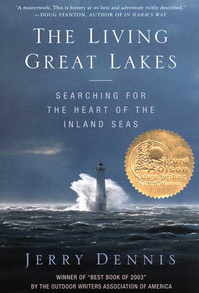
It’s a thoroughly satisfying tour of the almost unimaginable wealth of fresh water that surrounds us, led by a guide whose kinetic natural curiosity makes it his business to know or find out about glacial moraines, aquatic biology, shipwreck history, migration and trading patterns of past civilizations, and the edibility of lichen, among other things. (Even the endnotes are interesting. Really.) But Dennis tells us by the end of the first short chapter that this fortune of facts alone wasn’t painting the picture he wanted to paint. They were nuggets of rocks and debris drifting along the shore when what he wanted was to be inside a cresting wave. What he really needed, it turned out, was a good story.
So when a newspaper article reported that a local schooner had been bought by an investor to be put to work in Maine, he found the docked boat and asked the captain, who had been hired to sail the Malabar to its new home, if he could be a deckhand on the journey. This maybe wouldn’t be the first research method many of us would think of, but Dennis is the kind of guy who writes of being awakened at his home on the Old Mission Peninsula by a howling wind “like a herd of animals in a panic” — then grabs his sleeping bag and camera and crawls across the Mackinac Bridge at 15 miles an hour to enjoy the raging, crashing storm from the tip of Whitefish Point.
He’s also the kind of guy for whom this sort of adventure ends in happening upon a yearly reunion held by the relatives of the crewmembers on the long-sunk Edmund Fitzgerald, where he hears a tale of tiny miracles and uncomfortable heroism that add up to a huge moment of wonder at just how the universe disperses its mercy.
And that is just how it goes as the five-member crew of the Malabar sails most or all the length of Lakes Huron, Erie and Ontario. Headed steadily toward the east at 6 knots an hour, there are detours through history and meanderings on passing shores and cautionary tales of looming dangers. The Malabar sees only the northern edge of Lake Michigan, but no matter — passing the treacherous Gray’s Reef launches Dennis into a merry recollection of hitching a ride in a Chicago-to-Mackinac yacht race. Much to the captain’s dismay, Lake Superior isn’t on their route either, but Dennis has loved it long enough to tell him stories about camping alone in its cold spray and canoeing along its barely-inhabited north shore.
We learn the lakes’ connective tissues, the locks and rivers and canals that course together to make one organism out of five bodies of water, and when Dennis can’t stand to abandon ship at the end of the Great Lakes portion of the journey, we sail into the Atlantic to see how that water is different from ours. (Late in Lake Erie, Dennis asks the captain, a life-long sailor of the open seas, what he thinks of the Great Lakes. “I’m surprised at how much seamanship is required to sail them,” he replied. “I always thought they were for wussies, that only the oceans were worthy of tough guys like me. But…these lakes can kick your ass.”)
Now a longtime chronicler of the natural world, Dennis credits his restless, voracious natural curiosity with leading him to writing in the first place. “(That curiosity) comes with being a human being,” he said by phone from his beloved Traverse City, “but I think it gets squashed when we’re young. I think I spent a few years after high school relearning it, by immersing myself in books and experiences and releasing myself from all those chains.”
There was moment in college at Northern Michigan University, he said, when he realized he had to get out of the hallowed halls of education to find out what was holding him back from throwing himself into his studies.
”I knew I should be immensely curious, and I had this great opportunity to study great books and I just wasn’t liking it. So I spent a winter near a lake, living alone in a house with two large stereo boxes of paperback books. And I would sit out on the lake ice fishing for walleye and pike and I spent every day looking at the lake and reading. Then something clicked and I started writing. … I can almost remember the moment when I started shaking free of it, and I don’t have any doubt that that’s why I became a writer — when you learn these great things and make discoveries, you want to share it.”
When I comment on what a nice story that is, though, he gives the kind of half-rueful laugh that comes with the recollection of excruciating life lessons that have long since yielded their fruit and smoothed into history. “Well it is,” he said, “but I was driven there by despair.”
He tackles another despair-inducing topic, a half-century of deleterious industrial practices on the lakes, with a line that seems to run directly contrary to conventional environmental wisdom: “Those of us who dream of 5 pristine lakes protected from commercial abuse,” he writes, “will be wise to remember that local economies dependent upon the lakes are the final line of defense.” What does he mean by that? “I’m always reaching for solutions that work, and … it does seem pretty obvious that economy is one way to get folks who wouldn’t give a damn about the environment to care about it. We know who the problem is in many of these cases. But in just the 20-30 years that I’ve been writing about the natural world, I’ve seen these oil and chemical companies open up — there was once no way you could get them to admit that a good environment was good for business. Now they at least pay it lip service.”
He got a front-row seat on this win-win dynamic in 2003, when he protested a proposed bridge over the Boardman River. He and his friends and family had been fishing in the river all his adult life, and his affidavit reads as much like a love letter as such a dry document is capable of. In the end, he said, “we won. And it was a bloody battle that cost a lot of money and a lot of effort, it cost a prominent person on the other side of the table his job. But you know what one of the amazing things about it is? The two sides that were battling over this story — you don’t even need to know the details because it’s the same story you can find anywhere — one side wanted progress and thought, ‘Let’s build a bridge,’ and the other side said, ‘Look, you don’t even need the bridge, and it’s in the middle of what’s becoming this beautiful park.’ There were a lot of hard feelings and a lot of people who were counting on it for a source of income. But in the end, the two sides got together and studied it and said, ‘OK, let’s plan for the long-term future for this community. What kind of construction do we want? What kind of roads?’ And now the people who are involved have become good friends.”
Advocacy isn’t really his thing, though. “That one was just too close to home to ignore,” he said, “but I have enough work to do.” No kidding — just now he’s working on 2 to 3 new books (“I didn’t really plan it…I thought it was one book, and then 2 halves started diverging”) as well as helping PBS develop “The Living Great Lakes” into a 4-part miniseries slated to air in fall of 2011. “It’s quite an adventure,” he said of the movie-making process. “We’re really having a lot of fun with it. These people who are working on it are amazingly talented and dedicated to it, and they’ve brought me along as an advisor and to help write the script. Especially for a writer who’s accustomed to working alone and laboring in solitude, to work with a team of really talented people is a great experience.”
Toward the end of the interview, I ask Dennis what turns out to be a silly question: Landlocked down here in Ann Arbor, it feels like the Lakes are a vast part of our culture and heritage, but not so much a feature in our everyday lives. What could we do to feel closer to them? He says it’s a good question — the universal stall for time — and then tells me that when he counsels students who express a similar sentiment, he starts with the nearest body of water and walks them through its source, the groundwater that feeds it, the aquifers below the earth and the precipitation recycled from the sky. “The idea is to get them to realize that the whole state is a Great Lakes area. I would not presume to give this lecture to adults, though, because when you think about it it’s pretty obvious. So please don’t put me in the position of doing that,” he concluded with a laugh. Eh, there’s no need for that. The answer to my question had become obvious to me almost before it finished leaving my mouth: if you want to feel closer to our lakes, more firmly born of them and entrenched between them and blessed by them, reading this book is a darn good start.
Jerry Dennis will read from "The Living Great Lakes: Searching for the Heart of the Inland Seas" at 7:30 p.m. on Thursday, Jan. 28 at Morris Lawrence Auditorium on the campus of Washtenaw Community College. Admission is free.
Leah DuMouchel is a free-lance writer who covers books for AnnArbor.com.
Comments
B82Colwell
Thu, Jan 21, 2010 : 1:29 p.m.
was given this book by a friend a week ago, I can't wait to read it, once I finsh "White Hurricane" about the 1913 November snowstorm. I may have to catch Mr Dennis on the 28th....
81wolverine
Wed, Jan 20, 2010 : 3:49 p.m.
It's a great book. It actually came out in 2003, so it's been out a little while. I actually bought a copy 5 years ago or so, but just recently read it with all the local attention from Ann Arbor/Ypsi Reads. Mr. Dennis does a great job weaving in Great Lakes facts and history between his telling of the story about being a crew member on several boats. If he didn't tell the story, the book would probably have been like a textbook - a little dry and hard to read. But, there are some great anecdotes and personal stories in the book to make it even more interesting. Fortunately, Jerry doesn't go into too much detail on the science stuff, as that would also make it less interesting for many people. Anyone who reads this will learn a lot about the Great Lakes and why things are like they are today. For instance, being a fisherman, I always wondered why Lake Erie seems so much rougher much of the time compared to Lakes Michigan or Huron. He explains why in the book. I highly recommend reading it.
Theresa Taylor
Wed, Jan 20, 2010 : 1:42 p.m.
Wow - I had no idea that this book was available! As a Michigan scuba diver, I am passionate about the Great Lakes and all that they have to offer.
ChildeJake
Wed, Jan 20, 2010 : 11:17 a.m.
Thanks for the recommend. It sounds like it's worth picking up a copy.