

A Lesson in Beer: Why glassware matters
Glassware is not the most exciting component of the beer drinking experience. For many beer drinkers, the appropriate glass is whatever is clear, clean and close at hand. For others, it is even simpler: Skip the glass and consume straight from the bottle. While I cannot promise to make glassware exciting, I can promise to explain why selecting the appropriate glass is important. I can also promise to give you the run-down on the essential beer glassware you should keep in your bar at home.
Appearance, aroma and mouthfeel
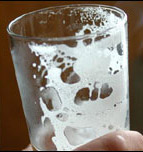
The primary function of the glass is to display your beer. If you did not pour your beer into a glass, you would never see the beer, the head of foam resting on the top of your beer, the bubbles rising from the bottom of the glass or the lacing (rings of foam) left by the retreating level of liquid. This sounds trivial, but the appearance of beer has become significantly more important since glassware became a readily available home good (beer was previously consumed from opaque porcelain or stoneware vessels).
The second function of your glass is to aid in the full expression of aroma. If you did not pour your beer into a glass, the narrow opening in the bottle would offer you only a peak at the wide range of aromas waiting to burst from your beverage. This is primarily because you cannot stick your nose into the neck of the bottle, whereas you can easily situate your nose close to the surface level of the beer in your glass. This is also because the shape of beer glassware encourages the channeling of aromatics and allows the carbonation in your beer to fully realize its aromatic-carrying capacity.
The final function of your glass is to alter the way the beer feels when you take a sip. If you did nor pour your beer into a glass, you would not get to experience sipping the foam head on top of your beer. You would also experience the carbonation of your beer, channeled through a narrow opening. Pouring your beer into a glass allows for the beer to develop the mouthfeel intended by the brewer, releasing not only a foam-head but also appropriately distributing carbonation.
The basics
The following is a list of the basic glassware you should have in your home. These three glasses will allow you to fully enjoy nearly any style of beer you should bring home.
The pint glass:
The pint glass is the most basic of beer vessels. It is seen and used in nearly every bar, and for good reason. It allows for pouring a beer with a one-inch head and gently encourages the expression of aromatics. The majority of beer styles are intended to be poured with a one-inch foam head and do not require any specific aromatic enhancement. For beers of this nature (most English and American ales, American lagers, many German lagers), the pint glass is the way to go. I personally own thicker-rimmed glass mugs, solely for the added benefit of increased durability.
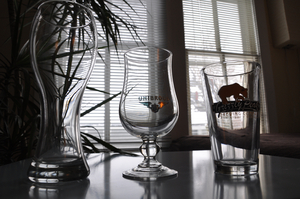
The tulip glass:
The tulip glass consists of a bowl that narrows as it ascends before widening again to the full rim circumference. The shape of the tulip glass encourages the formation of a two- to three-inch foam head and enhances the expression of yeast-driven aromatics (esters and phenols). It is the ideal glass out of which to consume Belgian (or Belgian-style) ales, as these beers are intended to be experienced with a large, foamy head and enhanced aromatics.
The Weizen glass:
The Weizen glass is a tall glass that bows out from the bass and gently curves upwards toward the rim. The shape of the glass is designed for one essential purpose, and that is to capture the massive foamy head caused by pouring a Bavarian-style wheat beer. If you were to pour these beers into a normal pint glass, a foamy mess would ensue. While this is a rather style specific glass, so much of the wheat-beer experience is wrapped up in the giant foamy head and banana and clove yeast aromatics, to pour your wheat beer into any other glass would be missing the majority of the experience.
Advanced glassware
The Pilsner Glass:
Found in many bars and homes around the country, mainly as a result of its aesthetic appeal, this tall slender glass should only be used for one purpose: the pouring of pilsners or other pale lagers. The tall, slender shape allows for display of the pale, clear appearance and white foamy head of these beers. It is, unfortunately in my opinion, a poor choice for most other styles of beer.
The Snifter:
The snifter performs the same aromatic function as the tulip glass without encouraging larger than average head formation. This glass is nice for styles of beer that require specific aromatic consideration but are not intended to be consumed with a larger than average head. Most significantly, this applies to strong darker ales like Russian Imperial Stout or American Strong Ale.
I would like to thank my co-worker Fran Trott for providing the inspiration for this post.
Ryan Sloan is an employee at Morgan and York, musician and beer-writer. He maintains a personal blog and can be reached at rysloan4@gmail.
Comments
David
Wed, Oct 6, 2010 : 12:28 a.m.
I always like to drink beer in the glass mug i really enjoy it but usually I drink beer in bottles and cans because i am just interested in drinking beer it doesn't matter too see the foam but in Party surely the glass matters. Cheers! its David from wholesalepages.co.uk
MrCicerone
Mon, Mar 8, 2010 : 11:01 a.m.
I like my dry draft lite in an unrinsed jelly jar! With a cocktail onion if I'm feeling fancy!
treetowncartel
Fri, Feb 26, 2010 : 8:37 p.m.
I like a short glass too, those small juice type glasses, about 6 oz.They are good for the standard american lager, ale or pilsner, light or regular. These are especially good for can beer, maybe even add a little ice now and then, especially on a hot summer evening.