

The practicalities of having chickens in your backyard
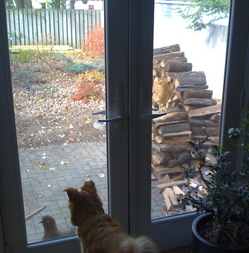
Dog watches chicken watching dog.
Corinna Borden | Contributor
There are plenty of chicken books to choose from. My favorite one was a book I “borrowed” from my grandparents, now defaulted to a permanent loan, called Encyclopedia of Organic Gardening: A complete guide to gardening without DDT or other poisons or chemicals edited by J.I. Rodale, a pioneer in the organic movement. I wanted to write out the full title just to show how far we have come since the book was published in 1959. DDT was banned in 1973. The book was republished in the 90s with a different title.
What first piqued my interest in chickens was the assumption in that book that every gardener would have chickens to help with fertilization, aeration, and insect control.
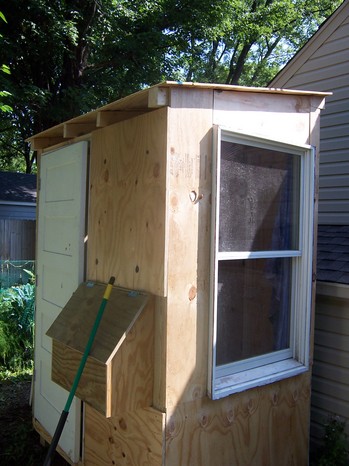
We designed the coop to have a large window facing south for sun exposure and nesting boxes one can access from the outside.
Corinna Borden | Contributor
With borrowed saws and air guns we were able to cobble together a very serviceable structure. Most people tell you to have about 3 square feet per chicken, and I will be good and not mention that is a lot more space than what chickens have in factory farms (I am being so good, not mentioning that.) I had visions of raccoons creeping into the structure at night and dismembering our girls, so we have hooks that latch, a door with a key that locks it (those raccoons can be crafty), and a double layer of chicken wire at the top protecting our ventilation gaps.
Once the girls got big enough to dig in the earth, we built a small run for them to be outside. By this time, I had heard horror stories of a raccoon eating a chicken through chicken wire, so I completely enclosed (top, sides, bottom) a small area with a double layer of chicken wire and plastic garden netting. After the girls became large enough to scare away our cat (and I had stopped worrying so much about raccoons during the day) we opened their door and let them roam in the garden that we had cordoned off with deer fencing. Now every morning, I open their door, they run outside squacking and flying directly to a row of conifers. Once it is clear there are no hawks about, they start aerating and fertilizing our fallow garden, just like J.I. Rondale said they would.
The coop discussion can take a few months so it is a good thing you are starting it now. Depending on your time, finances, and building expertise you can purchase a coop instead of building one. There are pictures of coops available online, but most want you to purchase a book for detailed plans. One can find options of ready coops on Craig’s List. A New Yorker article in September introduced me to the Eglu ~ the latest in chic homes for your girls out of the UK.
The cost of the Eglu aside, I do think their model works well in that they will send you four chickens to go with your purchase of a home. Poultry hatcheries require you purchase 25 chicks at a time, which doesn't work if you live in Ann Arbor. I was able to work around this by piggybacking my order with a friend who lives outside of town. That being said, there are classified ads of people selling their girls for one reason or another, a2citychickens.com is a good place to start. Also, since you are discussing this in front of the fire with six of your friends, perhaps you can share an order.
With the deep litter method, large containers of water and feed that only need to be filled every 4-5 days, and a well built coop, the chickens are a lot easier than our dog and cat. We left them alone for two days for the Thanksgiving holiday. The only noticeable difference when we returned was the duration of the first flight as they emerged squawking and trumpeting from the coop to welcome us home. It was nearly 15 feet long!
Drop me a line! Check out my website! Post a comment and start the conversation rolling!
Comments
Corinna Borden
Sat, Dec 19, 2009 : 3:52 p.m.
hi amsims, I hear you about shielding your compost from being an eyesore for your neighbors. I have mine tucked away behind garages and I am lucky to have tolerant neighbors and lots of shrubbery. If space does not allow you to plant some conifers or boxwood to hide it, my neighbor has a standalone one that looks like a modified garbage bin. Here is the link for what they have at gardeners supply and I am sure there are more options out there. http://www.gardeners.com/on/demandware.store/Sites-Gardeners-Site/default/Search-ShowCategory?cgid=20706&PageSize=2000 So far all of our chicken waste is hidden under the fall leaves in the compost bin. We are adding pine shavings to the waste in their coop and turning it, I plan to clean all of it out in late spring or summer. Thanks for asking!
amsims
Thu, Dec 17, 2009 : 11:29 a.m.
I'm enjoying your posts on chickens - would be interested in suggestions on how to camoflage the urban/suburban compost pile in a way that *looks* neat (or at least unobtrusive) - I know *how* to compost (greens & browns & so on) but live in a subdivision and want my compost heap to be less of an eyesore. I imagine this is an issue you address with composting your chicken litter?
classroomlessteacher
Wed, Dec 2, 2009 : 8:03 a.m.
re: University Brat, it's nice to see someone share that selfless attitude I've come to expect from A2 residents. I don't see a problem with a coop as long as the owners maintain it. To deny someone something on the assumption that they will not maintain it or do the necessary upkeep is.....unneighborly.
university brat
Tue, Dec 1, 2009 : 4:46 p.m.
I was astounded when A2 city council OK'd chickens within the city limits, changing previous law. The reason why are forebears OUTLAWED the practice is very common sense. Ever been downwind of a chicken coup in the July sun? THEY STINK! Now, imagine your neighborhood with chicken coops all around. Say goodbye to those wonderful summer time breezes.
strunny
Tue, Dec 1, 2009 : 11:03 a.m.
Your article reminded me of Peter Thomason in Ypsi, who has chickens (amongst other animals) too. His is an interesting story too, he had to go to court to be able to raise them in the city. His post is http://thomasonfamilyfarm.blogspot.com/ (scroll down): POULTRY IN MOTION - WHY ARE THERE CHICKENS IN THE CITY?
texorama
Mon, Nov 30, 2009 : 12:41 p.m.
That's "piqued" my interest.
suem
Mon, Nov 30, 2009 : 9:38 a.m.
You can buy chicks at Tractor Supply in the spring, lots of other good things too.