

Food hubs are coming to Michigan
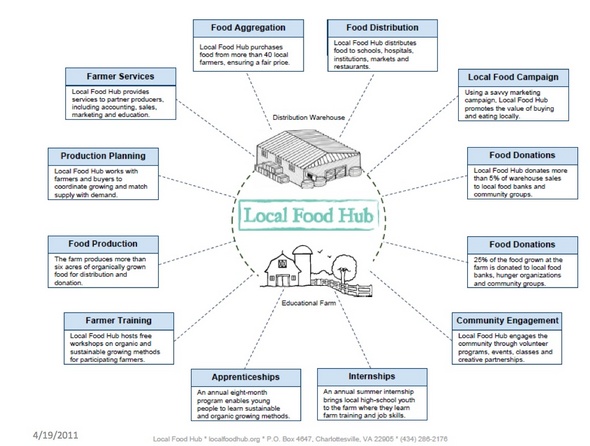
This image outlines many of the components of food hubs being developed around the country.
From the USDA and localfoodhub.org
Has "food hub" entered your personal lexicon yet? If not, I'm guessing that it may in the next year or so.
The USDA defines a food hub as "a centrally located facility with a business management structure facilitating the aggregation, storage, processing distribution, and/or marketing of locally/regionally produced food product," and it's a concept that is taking hold in almost every state.
The USDA says it is "committed to food hubs because we believe that food hubs offer strong and sound infrastructure support to producers across the country which will also help build a stronger regional food system."
On Nov. 28, Keith Creagh, the director of the Michigan Department of Agriculture and Rural Development, called a meeting in Lansing to bring together key players in Michigan interested in the emerging concept of food hubs.
Representing a brand-new Washtenaw food hub, I was able to participate in the meeting of approximately 30 attendees. About half of the participants represented communities around the state, from Marquette to Grand Rapids to Detroit, and about half the participants were state employees.
Creagh opened the meeting by remarking that the staff was on hand because he wanted to see inter-agency collaboration that could help local economies, build capacity and contribute to health and wellness in Michigan.
More specifically, Creagh said he saw the development of food hubs as part of Michigan's "reincarnation." Food hubs can be aspects of a healthy economy and jobs, contributors to state goals for health and wellness, and key to the Michigan Good Food Charter's goal to "enable 20 percent of food purchased in Michigan to come from Michigan."
In Southeast Michigan, Detroit's Eastern Market has undergone extensive renovation and re-envisioning as it has expanded into a 'Healthy Metropolitan Food Hub.' It is becoming a model for large-scale community re-development based on values of "connectivity, density, mixed-use and authenticity.
In our part of Michigan, there are other food hubs also in the works. There is a group in Flint working on a food hub, and, in Ann Arbor, the Washtenaw Food Hub is just getting started.
For the past several months, a small group of people has been working to organize the Washtenaw Food Hub, initially envisioned as "a bustling network of local, food-based businesses as well as a demonstration site and destination for anyone interested in sustainable food systems."
Some of the main goals of the Washtenaw Food Hub are "to increase the available supply of staple foods grown in Michigan by coordinating infrastructure, resources and market outlets for producers" and "to provide a 'one-stop' experience for individual and institutional buyers who prioritize support for local farmers and Michigan-grown food."
Recently, Richard Andres and Deb Lentz, owners of the Chelsea-based certified organic Tantre Farm, purchased the 16-acre Washtenaw Food Hub property on Whitmore Lake Road, with the intention that ownership would eventually shift to a group of investors.
At the initial Food Hub open house on Dec. 11, Andres explained, "Ann Arbor Township has made an unprecedented effort to raise a bond to preserve open space and farmland. This site has a lot of big buildings that could be used for making, storing and supplying food. Ann Arbor supports fresh, local food and this is the only really rural corridor that touches Ann Arbor, and it is very bike-able. We would like to use this site to support any local food production that serves the local community…We have an opportunity to work on something positive in our region and are hopeful that there is support."
Hoping to begin a process that will gain community input and support, the Washtenaw Food Hub organizers held their first two open houses within the past two weeks. At these potluck open house events, people brought food ranging from huge kale salads from Tantre, to homemade Christmas cookies, to pizza from Silvio's and Roos Roast coffee.
Other local restaurants and businesses who want to encourage support for local food (and may join in the Food Hub effort) also contributed, including the Ravens Club and the Brinery (whose tagline for their naturally fermented foods "stimulating your inner economy" always makes me laugh).
As part of the event, participants were able to tour the site. The property includes a large 1870s era house, several agricultural outbuildings and loading docs, silos, and a pond.
More community potlucks and open houses are planned after the beginning of the year. For more information, email: washtenawfoodhub@gmail.com.
Kim Bayer is a freelance writer and culinary researcher. She would love any news about interesting local food and agriculture efforts. Email her at kimbayer at gmail dot com.
Comments
Diana Dyer
Thu, Dec 22, 2011 : 9:02 p.m.
Thanks for the well-written article, Kim. Food Hubs are the future for all communities. A Food Hub is about food, but so much more, including community-wide economic growth. I hope future articles that keep the community informed about this important venture are considered 'front page, above the fold' stories.
toothless wonder
Wed, Dec 21, 2011 : 12:41 a.m.
Whitmore Lake Rd is very bike-able ?? If you can hack going up a constant grade for like 3 miles. You can hit 50 mph coming back though!
Patti Smith
Wed, Dec 21, 2011 : 12:19 a.m.
Wonderful! Thanks for the article! :)
Julianne Smith
Tue, Dec 20, 2011 : 11:58 p.m.
This is an exciting and worthy development and I am anxious to see the progress. Many thanks to all who are working toward its realization.
justcurious
Tue, Dec 20, 2011 : 8:19 p.m.
I like this whole "retrograde" (as I call it) movement. We used to consume foods that were grown locally, then things changed and we started getting our food flown in from all over the world. This allows us to have more control over how our food is produced as well as it's quality. It doesn't require extraordinary and unhealthy means to make it look fresh - because it is. It also takes some of the money away from the corporate farms. Makes sense to me.
smokeblwr
Tue, Dec 20, 2011 : 6:35 p.m.
I was picturing a feed lot instead of a food hub.
Usual Suspect
Tue, Dec 20, 2011 : 5:37 p.m.
Would it be possible to provide an image that can actually be read?
justcurious
Tue, Dec 20, 2011 : 8:23 p.m.
With Safari I was able to enlarge it using the view tab and zoom. I also right clicked and sent it to my iPhoto.
DBH
Tue, Dec 20, 2011 : 6:17 p.m.
One option is to view the page using Internet Explorer. When doing so, you can increase the magnification by using the magnifying glass icon, usually in the lower right corner of the page. You can increase the size of what is displayed by 400%. Such an increase in magnification might be available in other browsers also.
Nathan Ayers
Tue, Dec 20, 2011 : 4:13 p.m.
Amazing work. We are extremely fortunate to have people like Kim working in our community. Local food means business.
lisa gottlieb
Tue, Dec 20, 2011 : 2:34 p.m.
Great article by Kim Bayer, sharing this exciting project. There is so much potential in our region to continue to build a robust and sustainable food-shed.
Jennifer Shikes Haines
Mon, Dec 19, 2011 : 10:58 p.m.
This is fascinating and sounds like a wonderful plan for Washtenaw County and many other parts of Michigan! Lovely article - I'm delighted to know about this.