

Outstanding in the Field features Grange Kitchen and Bar for farm-to-table meal
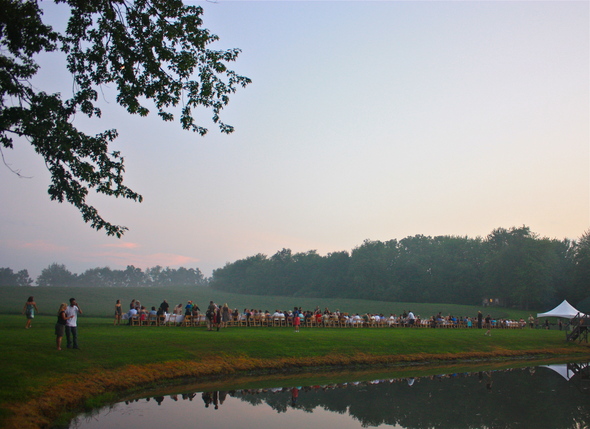
Outstanding in the Field Dinner at Back Forty Acres in Chelsea, Michigan
Photo | Bob Kuehne
At the Wednesday morning farmers market a couple of weeks ago, I spied Chef Brandon Johns, owner of Grange Kitchen and Bar, considering menu options as he scoped out the gorgeous fruits and vegetables of high summer in Ann Arbor. Johns was shopping for ingredients for an outdoor dinner he had been invited to prepare the next Saturday for Outstanding in the Field, a company that hosts nearly 90 farm dinners a year as it tours the country in a 1953 bus.
The OITF mission: "to re-connect diners to the land and the origins of their food, and to honor the local farmers and food artisans who cultivate it." Since OITF started in 1999, this would be only their second trip to Michigan.
Chef Johns was walking the market in his Back Forty Acres T-shirt, carrying two boxes of the last apricots of the season scored from Wolfe Orchard of Tipton.
Stopping at a colorful display of potatoes, herbs and eggplants, he listened thoughtfully to Tantre Farm owner Richard Andres quietly describing recent rains that had brought a large flush of shiitake mushrooms. The savory mushrooms would pair well with the crispy skin chicken Johns would be pan-frying "en plein air" for 152 people — all of them seated at one long linen-covered table with grass underfoot. The backdrop: a pond and the woods at Back Forty Acres farm in Chelsea.
As a chef, it's an honor to be invited to participate in the high end (and mostly sold out) Outstanding in the Field events that draw people from near and far to tour the host farm, meet the farmers, and learn a bit about what went in to making the meal. Many of the country's best chefs have participated in OITF, including Paul Kahan of Blackbird Restaurant in Chicago, Dan Barber of Blue Hill Restaurant in New York and Susan Spicer of Bayona in New Orleans.
Known for his farm-to-table food at Grange Kitchen and Bar in Ann Arbor, Johns was tapped by Outstanding in the Field to create a meal that would highlight the local growers and artisans with whom he works most closely here in Michigan: Back Forty Acres, Tantre Farm and Mill Pond Bread.
The tousle-haired Johns was nearly vibrating with excitement when I talked to him that Wednesday at the market. He was planning to poach the rosy-skinned apricots with chamomile to serve with a cornmeal cake. And he had already butchered one of Back Forty Acres' red Tamworth hogs for a charcuterie plate of salami, chorizo, rillettes and lonzino — a salt and sugar cured "quick prosciutto."
Johns has a thing for the pig — just check the tattoo on his right forearm. The nose-to-tail deliciousness (and nothing going to waste) of the heritage-breed Tamworth "bacon hogs" is one reason Johns likes working with Larry and Stephanie Doll, partners at Back Forty Acres.
The Dolls are the purveyors of much of the meat (including chickens and duck) at Grange Kitchen and Bar. The Grange menu, according to Johns, sources 95 percent of its ingredients from Michigan.
Focusing on the satisfaction of connecting with people he knows and respects, Chef Johns says "John Savanna at Mill Pond Bread is making the best and most interesting bread in our area," while "The Dolls at Back Forty Acres and Richard at Tantre are the two places that I have the largest relationships with. Back Forty Acres has been my biggest purveyor for meat, and Tantre has such a wealth of things. Both those places are beautiful in their own different ways."
He continues, "I like the people, I buy a lot of their stuff, and they're both wonderful… Part of it, for me, is the enjoyment of talking to these people twice a week, face-to-face at the market, not just over the phone."
Stephanie Doll of Back Forty Acres says, "Brandon is the epitome of a chef who understands farmers' schedules." And Johns laughs when I ask him what that means.
He says, "It means you've gotta be flexible no matter what. If you can't get raspberries, then you use apricots. The chickens are ready when they're ready. It's the complete opposite of the other way, where you write something on a piece of paper and get your delivery at 2 p.m. on Friday. You have to be way more zen with the world to do it this way."
Tantre Farm
If you want to meet someone who is zen with the world, talk to Richard Andres, farmer and owner of Tantre Farm. Down country roads south of Chelsea, and just a few miles from Back Forty Acres, Andres and his wife, Deb Lentz, cultivate 30 acres of their certified organic CSA farm that now, after 11 years, feeds over 500 families with more than 100 different crops.
Richard Andres describes Brandon Johns, a frequent visitor to Tantre, "as the type of person who is willing to come to the (Ann Arbor Farmers') Market, even with a very busy schedule…Even going to pick up meat from the butcher himself, and Back Forty, and butchering the whole hog, cutting it up himself. (Brandon has) that kind of authenticity and getting back to the old ways." It's a level of participation in creating a new food system that Andres knows well.
Andres describes the difference between his own ethos and that of the conventional food system: "My dream is part of the larger collective dream that is driving our history and everything here. There's just an aspiration to create something beautiful, tangible and wonderful in this great land of ours… We're all sort of dreaming this dream of doing something local because the (other) dream that we've been working on is kind of shadowy… Within the huge extractive industrial economy there's this network of food that's surging down the highway every day."
"When I was first introduced to trying to sell food, a lot of people were talking about it as 'product.' But (at Tantre) we're out there digging this stuff out of the ground with our hands. And washing it under a tree. And I guess it's a product, but it's not what's going through that (commodity) network… (At most restaurants) if they can dump something out of the bag from Sysco, what will the customer care?" he says.
"The potential for getting dirt or bugs coming from my farm is probably exponentially greater… When you get a worm in there, it means the ecosystem is intact; it wasn't eviscerated by petrochemicals…You can freak out about it, or you can think 'they didn't use poison on it.'
"It is work, and it's not just an aesthetic. It's a balance between grit and grace. You have the grace of the beauty, but you have the grit behind it — it gets cold and wet out in the fields. I look at the people who are working out here and living out here — young people, strong people that want to test themselves, perhaps, and develop different strengths and skills in their lives. And in some way they've sort of been set up culturally and socially. They really do want to embody the grit that it takes to see the grace. We do have a lot of really excellent meals, but nobody that works here will avoid coming away exhausted and tired. But this farm seems to build a lot of social and environmental capital…. it's created a different paradigm in a way and it's kind of cool. It allows us to be more direct in solving our problems.
"As a culture we've been separated and broken up and divided from each other by the consumer culture, and you see the effects because there's big business in helping all these people who got sick from eating this (low quality) food and passive consumption. Unless we say we need to carve that out, we're just going to be tethered to that — gas station food, Doritos and pop cans… People don't understand the insidious nature of these comforts. So I'm going to encourage people to eat vegetables and do manual work."
Mill Pond Bread
A few miles away, John Savanna's bakery, Mill Pond Bread, overlooks Sugar Loaf Lake near tiny Waterloo, Mich. Filled with natural light, the bakery is more like an artist studio than a bread manufactory.
Knowing that his house is connected to the bakery, I asked Savanna what time he gets here to start baking and he jokes, "I don't leave — I live here." Then smiling, "I got up at 4 a.m."
Savanna's easy grace in handling the heavy dough speaks of long familiarity, as do his choreographed movements, wielding a worn six-foot wooden peel to airlift crusty loaves from a fire-breathing 500-degree oven to wire cooling racks.
Savanna stores the wooden peels in a rack overhead within his easy reach. Both rack and peels were custom made for him by a friend. His tile floor was laid by a friend. And some of his refrigeration units were given to him by friends. There is heavy trade among friends in the farm and artisan world, and you are lucky if you have a skill that can make you a part of it. As a master of his art, Savanna is a major player in the network.
Savanna roasts whole cloves of garlic from Frog Holler Organic Farm and grinds sea salt in a heavy molcajete for the vegetable-filled focaccia he makes twice a week. Watching him, I observe at least 10 different steps that go into making the flower-shaped loaves — and the focaccia is only one of the dozens of hand-made breads and pastries he brings to market twice a week and that he will bring to the Outstanding in the Field dinner on Saturday.
Using organic flour and local ingredients for his artisan breads, Savanna tells me that he also has learned flexibility.
"If you run out of something, I realized, just use what you've got. You look around to see what you have, and you use what's current. If you don't have peppers, use zucchini. If you don't have cherries, use apples," he says.
"Having good and local ingredients is what makes this such a joy. Really, it's what makes this. Having Tantre and Frog Holler with us at the market. I hadn't had good potatoes in a while, and I got some from Frog Holler. I cooked them and then used the water for the dough — it just made the dough so alive."
Back Forty Acres
Five years ago, Larry and Stephanie Doll, together with Larry's brother, Kevin Doll, started to reclaim the 180-acre farm that's been in their family since Abraham Lincoln was president and is still owned by Don Doll, the 84-year-old family patriarch.
Calling it Back Forty Acres, they now raise pigs, turkeys, ducks chickens, rabbits, goats, cows and sheep for meat. Many of the animals raised on the farm are old heritage breeds (like Slate Turkeys and the Tamworth hogs), and all the meat that they offer is available to order from their website. In the course of reviving the farm, they have returned the two stunning field-stone foundation barns on the property to their intended use.
Sheltering the pigs and the rabbits, the wooden barns are only one of the animal housing options on the farm. The sheep and goats segregate themselves out in the woods and field. The chickens, with quonset huts and hoop houses, are held, like the turkeys and ducks, behind electrified moveable fences. Larry Doll tells me that the electric fences are not so much to keep the birds in as to keep the predators out.
Both Larry and Stephanie Doll still have off-farm day jobs. Married eight years, Stephanie Doll tells me she never imagined a farm life for herself but says she wouldn't trade it. She says it's work that takes up all their "free" time, but she loves being able to spend that time building something with her husband.
Back when they first started working with Brandon Johns more than two years ago, Stephanie Doll told me that the connection with Grange was huge to them. For the Dolls, knowing that they had a steady restaurant customer allowed them to make the leap to expanding and trying out new types of animals as they work toward having a farm that supports them financially — instead of the other way around. And they've been successful enough that this year, Kevin Doll was able to leave his day job to start full-time farming.
Outstanding in the Field
For the Saturday night farm dinner, Back Forty Acres has been mowed and tidied and Ricky — their large, fierce, blue-wattled Spanish Black turkey — is looking handsome in his full regalia. It's an oppressively humid Michigan afternoon as guests begin to arrive around 3 p.m., bringing their own dinner plates as instructed.
A long white limousine and an even longer black limousine disgorge women in strappy sundresses and men in plaid shirts. Most of the people here have paid $200 each for this experience. Except for the other people who are also here as guests of the event, I don't see anyone I recognize.
Black-clad servers (many local farm interns) carry trays of appetizers out to more than 100 people milling about under the pine trees near the chickens, who are also milling about. Plates of small hand pies — tender and flaky Michigan pasties — with beef and rutabagas, along with plates of pickled strawberries with ricotta are served. Tiny tomatoes stuffed with Brandon Johns' house made mozzarella (from Calder Dairy milk), along with his "Fried Pig's Head" — deliciously rich fried patties of traditional headcheese — are appreciatively gobbled up, and washed down with glasses of Sandhill Crane Vineyards Chardonnay and ABC's Tree Fort Summer Ale.
Event founder Jim Deneven, in a straw hat, purple shirt and cowboy boots, mounts a wooden crate to start off the evening by describing the history of Outstanding in the Field and the folksy mission of highlighting local farms and connecting eaters with the sources of their food.
He says, "If people come to sit at this table, then they go and see for themselves the farms, where their food comes from. People love food, love being together, love being outside. Culturally, foodwise, across the U.S., there's a huge change, and the results are happening now. The quality in the food this year is phenomenal."
Then one of the seven traveling OITF staff members introduces the farmers and describes the itinerary for the evening, starting with a tour of Back Forty Acres. This is the moment that almost everyone has been waiting for — seeing the animals. The group troops out to see the chickens, ducks and turkeys, the pigs, goats and sheep.
Larry Doll tells me that it's been a lot of work to get ready for the event, but, "We're excited to show people we we do. We're very proud of it."
Gray skies threaten rain as they talk about each of the animals in turn. When the tour draws to a close near the penned white Pekin ducks, a small squadron of five-foot tall red-capped sandhill cranes comes in for a landing, their primeval calls ringing out like pterodactyls across the fields. Then the mist turns to actual rain, and people run for their umbrellas and their cars.
We drive back to the dinner site on a dirt track. Over a rise, the view opens to a lovely vista with a wide open grassy area, and behind it, a pond with a screen of green-black trees.
Next to the pond sits the large tent where Brandon Johns and his staff are cooking and plating the evening's food in the damp air. In the big pole barn nearby, all the tables for 150 people have been tightly squeezed in because of the rain. Richard Andres jokes that "Outstanding in the Pole Barn" doesn't have quite the same ring to it.
When the rain stops, all hands, even Chef Johns, lift the tables with white linens, china and half-filled wine glasses to a spot directly overlooking the dark, glassy pond. I notice one of the servers has a tattoo in Latin that says "in omnia paratus" — prepared for anything. Finally seated, we're all at one table in a single line that seems to be the length of a football field. John Savanna, swatting mosquitos, watches his Mill Pond focaccia, rye and baguettes being devoured.
Then comes the food. First, Brandon Johns' signature charcuterie plate with its pork rillettes, lonzino, salami and pickled pig skin, served with beer mustard, pickles and beet chutney.
Deb Lentz and Richard Andres are there to see a salad of their greens being served with sweet red onions, duck pate and pickled eggs. Richard Andres' tender shiitake mushrooms from a few days earlier at the market are grilled whole, served with the chicken. And at one end of the long table, a dozen Doll family members in their khaki Back Forty Acres shirts are enjoying their crispy skin chicken, with a delicious tomato jam made by Melissa Richards, Johns' sous-chef.
And finally, the close of the meal with those Wolfe Orchard apricots. The season had passed for raspberries, so a single chamomile-poached apricot sits atop each cornmeal cake drifted with ricotta cream on the side. The food was amazing, truly a lovely meal in a lovely place.
Finally
Afterward, Brandon Johns tells me: "I did it because they support everything we support: getting people back to the farm. It's an experience, and they're doing it for the same reasons I'm doing it. It's basically the back-to-the-farm mentality, back to buying food from people you know, for the community of it. Let's face it, I don't think it is an accident that they feed everyone at one table — that's a symbolic barn raising, communal, potluck idea of what's disappearing. Those are the things that I appreciate and since I opened, have come to appreciate even more."
When I asked people at dinner what brought them to the event, I got two main answers: seeing the animals and supporting local farmers. As lovely as the event was — and the staff at Grange really went all out to create a deliciously memorable food experience — and although OITF paid everyone involved, that organization takes home the lion's share of the proceeds.
More than 100 people at $200 a head — it's easy to do the math. For a couple attending a dinner, the $400 price tag would have bought a farm share for an entire season that would directly support a local farmer. And there are so many less expensive options for similar dinners — eating a meal at the Grange Kitchen and Bar restaurant for one. Perhaps that's why there were a significant number of people from other places.
But John Savanna's wife, Colleen, told me "I'm so grateful to be here tonight — it makes everything we do worth it. It's worth it to be part of something that's bigger than you thought, and it's growing, this appreciation of food." And I believe that she's right about all of that.
But it also seems possible to create an even better, more authentic version of this kind of dinner that brings people to experience a working farm, that costs a lot less and still gives more to the people who live here and "dig this stuff out of the ground with their hands and wash it under a tree."
And now Brandon Johns, Larry and Stephanie Doll, Richard Andres and John Savanna know exactly how to do it.
Kim Bayer is a freelance writer and culinary researcher. Email her at kimbayer at gmail dot com.
Comments
EightySeven
Tue, Aug 16, 2011 : 12:56 p.m.
Kim great article and way to pay "homage" to the "local" food movement and also to Brandon. I'm pretty sure this was the article Jessica was trying to write yesterday. I couldn't get past her "local" connection from Eve her tropical fruit chutney!! Once again great piece and really great people doing really great things.