

Red Velvet Cake: Myths and mishaps
Erin Mann is baking a new cake every week for a year from the "All Cakes Considered" cookbook and shares her adventures here on AnnArbor.com. Read past columns here.
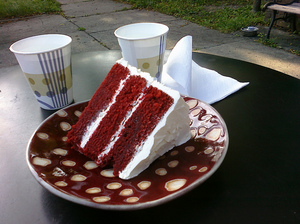
A beautiful, eye-catching slice of red velvet cake from Jefferson Market & Cakery.
Photo by Rex Roof
The true origin of red velvet cake is a bit of a mystery. There is some evidence that red velvet cake dates back to the 1920s, but a number of urban myths regarding its origins have materialized over the years. Like a number of other layer cakes, I thought red velvet cake was born in the South. Many of you may remember the red velvet groom's cake — also a Southern tradition — shaped like an armadillo from Shelby's wedding in Steel Magnolias.
It is also rumored that the cake was created in Canada at the Eaton’s department store bakery.
Perhaps the most interesting tale surrounding the origin of red velvet cake involves the famous Waldorf Astoria Hotel in New York City. (You may have heard similar mutations of this urban legend about cookie recipes from Neiman Marcus and Mrs. Fields.) It is said the hotel chef created red velvet cake, and it was a popular dessert at the hotel's restaurant. When a patron of the hotel wrote the chef requesting the recipe, he sent it to her along with a hefty bill for $350. She sought revenge by mailing the recipe out to hundreds of others in the form of a chain letter. That is why red velvet cake is also known as Waldorf-Astoria cake.
I read dozens of red velvet cake recipes and noticed the fat in the recipes varies widely from recipe to recipe. I've seen recipes that call for butter, oil, shortening or any combination thereof. Some red velvet recipes call for barely any cocoa powder at all, and others are much more chocolatey.
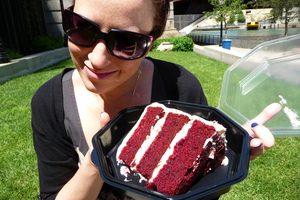
Tweet, a brunch-spot in Chicago, serves up colossal slices of red velvet cake. (Pardon my goofy mug.)
Photo by Rex Roof
The red velvet cake recipe in “All Cakes Considered” was different from others I’ve seen in that it does not contain any white vinegar or buttermilk. Melissa Gray substitutes sour cream for the buttermilk in her recipe.
My finished cake was very dense, like a pound cake. I practically needed a chainsaw to hack through it when I was cutting the cake layers! The tough texture of the cake paired with the fluffy, cream cheese frosting was an unwelcome contrast. It’s possible I over-mixed the cake. After I added the dry ingredients to the batter, I mixed in the food coloring, and it took me quite a few turns with the mixer to get rid of the cocoa-colored streaks and achieve a uniform red color in my batter.
The color of my cake was no where near as vibrant red as other cakes I’ve seen. A lot more than 1/2 bottle food coloring is required to make the batter a deep red. Next time, I'd like to try substituting a juice reduction of beets, strawberries or pomegranates as a natural alternative to food coloring.
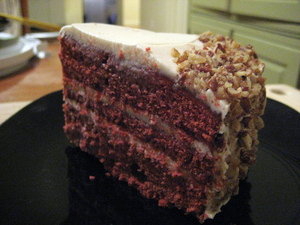
There's room for improvement in my red velvet cake.
Erin Mann | Contributor
The taste of the cake was unremarkable. Although the cake smelled like chocolate, my taste buds could hardly detect the flavor of the cocoa powder. The frosting was tasty and sweet, which was nicely balanced by the toasted pecans I used to decorate the sides of the cake.
Overall, my red velvet cake was a culinary disappointment. There are many other recipes out there; now it's time to experiment with others and find one I like. If you have a favorite red velvet cake recipe and you're willing to share (free of charge), please do so! I promise I won't mail out any chain letters.
Click here to view the recipe.
Erin Mann is ruining diets one cake at a time with her weekly baking adventures. Email her at
SheGotTheBeat@gmail.com or follow her on Twitter. Facebook users can also keep up to date with A CAKE A WEEK by joining
Comments
Superyalda
Thu, Oct 27, 2011 : 8:39 p.m.
I've been looking for the "original" Red Velvet Cake recipe -- without food coloring. I suspect that it was originally a reddish brown, as mentioned by BlueNever, resulting from the cocoa, but I could be wrong. Since I really don't like the idea of using food coloring, I'd love to know if that original recipe exists somewhere. And without the food coloring, you won't have to beat it too much :)
BlueNever!
Wed, Oct 19, 2011 : 3:45 p.m.
From research I've done, the Red velvet cake most probably originated in the North, Midwestern region. Two historical recipes closely resemble the product. One is the traditional Devil's Food chocolate cake (i.e. red devil, decadent) which used the old style cocoa which wasn't Dutch-processed alkali (or basic). The combination of the acidic vinegar and buttermilk formed the reddish color in the cocoa. The second reference is the traditional Red Beet cake. Farm families looked for ways to use excess beet crops by adding to chocolate cake. The cakes are very most, similar to carrot cakes. The beet juice produces a dark red chocolate cake. (See Maida Heater's American Desserts)
Monise
Wed, Feb 2, 2011 : 6:10 p.m.
Hey Erin! enjoyed reading your post. I glanced through the recipe because you said your cake came out heavy. I noticed that it called for all-purpose flour, as a lot of cakes do. I have NEVER used all-purpose flour to bake a cake, only cookies. Even if you sift it, it is still not as light as cake flour. I am now scouring the net for red velvet cakes to make comparisons....
Erin Mann
Thu, Feb 3, 2011 : 5:37 p.m.
You make a good point, Monise. The simple substitution of cake flour for AP flour could make a world of difference.
JenM
Wed, Nov 17, 2010 : 9:10 a.m.
Erin, Did your cake start to taste more chocolatey after a day or two?
bee
Tue, Nov 16, 2010 : 9:46 p.m.
I've made Red Velvet a few times and I always overmix it. I have yet to perfect that part of it, and haven't been terribly impressed with any of the recipes I've tried. One thing I recommend for coloring, though, is gel colors (which can be found at Meijer). They are more vibrant than the generic bottled stuff and have a "No Taste Red" which allows you to add as much color as you want without risking taste.
48104
Tue, Nov 16, 2010 : 5:49 p.m.
I can't find a reliable reference to red velvet cake (under that name) prior to the 1960s.
leaguebus
Tue, Nov 16, 2010 : 4:27 p.m.
There is a Waldorf Astoria cake recipe that uses mayonaise. Its very good...
A2K
Tue, Nov 16, 2010 : 2:53 p.m.
Oops, I forgot to add - substitute butter for the oil in the P.Deen recipe, and decrease it to 1 Cup *is important!!*
A2K
Tue, Nov 16, 2010 : 2:49 p.m.
Even though I can't stand her show *all that processed food...ugh!* Paula Deen's Red Velvet cupcake recipe is to DIE for *seriously GOOD* you can find it for free online/food network etc.