

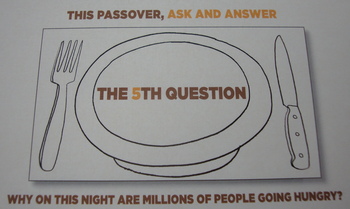
Why on this night are millions of people going hungry?

Mary Bilyeu, Contributor
A Seder is a very elaborate meal offering symbolic foods (i.e. matzah - unleavened bread), during which the story of the flight from Egypt is re-told. At the Seder, the youngest child who is able to recites four questions:
1. Why on this night do we eat only matzah?
Matzah is a reminder that the Jews fled Egypt quickly, and did not have time to let bread dough rise.
2. Why on this night do we eat bitter herbs?
Bitter herbs remind us of the cruel way the Pharaoh treated the Jews when they were enslaved in Egypt.
3. Why on this night do we dip our foods twice?
We dip bitter herbs into charoset [har-OH-set] to remind us of the mortar used in erecting the Pharaoh's buildings. And we dip parsley into salt water, with the salty water reminding us of the tears the Jews shed while the parsley reminds us of Spring and of renewal.
4. Why on this night do we lean on a pillow?
We lean on pillows for comfort, to remind us that the Jews were once slaves but are now free.
And this year, Mazon: A Jewish Response to Hunger (and one of my very favorite charities, devoted to feeding people) is hoping that we will all ask ourselves a fifth question: "Why on this night are millions of people going hungry?"
Today, on this first day of Passover, I could have offered you recipes for the Lamb-and-Leek patties or the Cherry-Blueberry Almond Macaroon Crisp that I served at my special dinner last night (and which I will post recipes for if I find time in the next few days). I could have written a long explanation of the Seder and its various steps and its significance. I could have explained each of the ritual items placed on a tray at the Seder. I could have offered an eight-day guide to Passover recipes, as I did with the eight Days of Chanukkah posts I provided in December. But all of that seemed trivial when I have the ability to not only feed my family each day but also to serve a celebratory meal at a holiday. There are far too many people in this country, and around the world, for whom the basic "three meals a day" is a luxury.
According to Food Gatherers, another one of my favorite charities, there are some very grim statistics regarding hunger among our own neighbors in Washtenaw County: "more than 43,900 people - including more than 14,000 children and 6,500 seniors - receive emergency food each year through ... emergency food pantries and meal sites. The findings represent a 138 percent increase since 2006." Nationwide, the numbers are staggering; Feeding America offers the following data:
* In 2008, 49.1 million Americans lived in food insecure households, 32.4 million adults and 16.7 million children.
* In 2008, 17.1 million households were food insecure, an increase from 13.0 million households in 2007.
* In 2008, 5.7 percent of households (6.7 million households) experienced very low food security, an increase from 4.1 percent in 2007.
* In 2008, households with children reported food insecurity at almost double the rate for those without children, 21.0 percent compared to 11.3 percent.
* In 2008, 8.1 percent of households with seniors (2.3 million households) were food insecure.
* In 2008, 4.1 percent of all U.S. households (4.8 million households) accessed emergency food from a food pantry one or more times.
Sometimes it seems as though the tragedy is so overwhelming that it's insurmountable. And admittedly, no one individual can solve the problems of poverty and hunger.
But one person can get up early and help to serve breakfast at St. Andrew's Episcopal Church. One person can donate money to help support Meals On Wheels. One person can volunteer to bring a dinner and spend an evening keeping a family company at Alpha House. There are countless ways that one person, one couple, one family, one class, one troop, one congregation can help to feed others.
So I asked myself, why on this night are millions of people going hungry? And what, on this night, can I - a notorious feeder of people - do to help? I hope to ask myself this question with great frequency and to follow through with action rather than just intent, never forgetting that there are those who don't have the security of knowing what - or whether - they'll eat tonight ....
Mary Bilyeu has won or placed in more than 60 cooking contests and writes about her adventures as she tries to win prizes, feeds hungry teenagers and other loved ones and generally just has fun in the kitchen. The phrase "You Should Only Be Happy" (written in Hebrew on the stone pictured next to the blog's title) comes from Deuteronomy 16:15 and is a wish for all her readers as they cook along with her ... may you always be happy here! You can contact Mary at yentamary@gmail.com or follow her on Twitter (twitter.com/foodfloozie). And look for her new food blog: foodfloozie.blogspot.com.
Comments
Black Francis
Tue, Mar 30, 2010 : 12:11 p.m.
If you have time or money, you can do something to help.