

Wildcrafting: My favorite recipe for greens
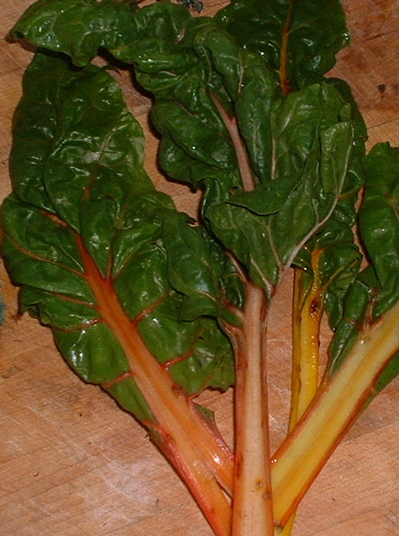
Chard can be used in this recipe, although I often use kale or collards to introduce people to those nutrient-rich plants. I've also suggested a number of "weeds"or wild foods that can be used mixed in, or on their own.
Linda Diane Feldt | Contributor
From 7:45 until 9 p.m. Sept. 11 you can find me demonstrating “Wild foods and Tame Greens” at the Ann Arbor HomeGrown Festival at Kerrytown. I’ll have more than an hour to create some tasty and unusual foods, teach a few new techniques, inspire the use of local healthy foods, and hopefully sell a few cookbooks in the process. It makes sense to put the recipes out beforehand, both to attract your interest as well as to be able to send people to the Web to get the instructions.
So until the 11th, I’ll post a couple of ideas and then choose which ones to make based on comments and also what greens are available. I’m starting with my very favorite, which has also convinced a lot of people that greens can be interesting and tasty while still be easy to cook.
This recipe is inspired by the many Indian style recipes for spinach I have enjoyed over the years. But it is not hot (spicy) unless you choose to make it so. The greens are infused with the spices until they turn buttery soft. It is fragrant, has a rich feel, and just tastes wonderful.
What greens should you use for this? You can go with traditional spinach. You can also try chard. I like it with kale and collards more than anything. Made with just dandelion greens it is stunning. I also mix and match. Kale with some dandelion, a bunch of yellow dock, the narrow leafed Rumex Crispus, leaves, late season lamb’s quarters, Chenopodium, does well (but doesn’t look great). Early in the spring it is a very nontraditional way to cook poke Phytolacca americana (but only early in the spring - poke is toxic after a few weeks). Turnip greens, beet greens, you can add chickweed, Stellaria media, purslane, Portulaca oleracea, whatever is available and that you’d like to try. You could even add a bit of garlic mustard Alliaria officinalis to the mix, although I would not use more than about 1/3 garlic mustard so that the subtle seasonings aren't overwhelmed.
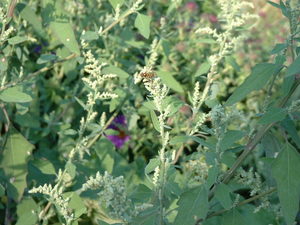
Lamb's quarters, Chenopodium album, is a great wild green to mix in. This late in the season it is a little tougher so cooking it is a good way to use it. It can turn brown in the process, and also cooks faster than kale or collards so add it halfway through.
Linda Diane Feldt | Contributor
I’ll probably do the demonstration with kale. Both kale and collards are abundant this time of year, and worth every bite. They both get sweeter once we’ve had our first frost, but it is great almost all year-round.
My feeling is that it is worth the trouble to buy whole spices, and grind your own. A mortar and pestle is fine, or dedicate a small coffee grinder as a spice grinder. It takes almost no extra time, and the result is fresher spices, better flavor, and often the whole spices are a little less expensive as well. The turmeric and asafetida ‑‑ is purchased already ground.
This recipe can be found in my cookbook “Spinach and Beyond: Loving Life and Dark Green Leafy Vegetables” available locally at Morgan and York, Crazy Wisdom Bookstore and Tearoom, Nicola’s Books, and Indigo Forest. Or come to the HomeGrown Festival and I’ll autograph a copy for you.
Aromatic GreensServes: 4-6
Time: 5 minutes to prepare, 20-30 to cook
Type of dish: Side
Equipment needed: Skillet, spice grinder optional
Leftovers: Use within three days, can be frozen
Ingredients: Asafetida, cumin, coriander, cardamon seeds, cloves, cinnamon, turmeric, 2 bunches greens or two packages frozen, or combination of greens.In a large skillet, use about 1 cup of water. Add 1/8 teaspoon asafetida, 2 teaspoon ground cumin, 1 teaspoon ground coriander, 1 teaspoon ground cardamom seeds, 1/2 teaspoon ground cloves, 1/2 teaspoon ground cinnamon, 1 teaspoon turmeric.
While simmering wash and sort through two bunches greens. Spinach, kale or collards are best. Tear or chop into bite-sized pieces. Or use 2 packages frozen greens. No need to dry the greens. Add to skillet, and cover. The cover may not fit right away, stir occasionally until they are reduced in size and the cover settles. Let cook covered, on low heat for at least 20 minutes or until very tender. Stir a few times, add more water if needed.
Remove from heat and blend in about 3/4 cup yogurt. Serve warm.Variations: In place of the water, use 2 tablespoons olive oil. Heat the spices until they pop, and are very fragrant, about 2 minutes. Add the greens, pour additional water over them (about 3/4 cup), and proceed as above.
Linda Diane Feldt is a local Holistic Health Practitioner, herbalist, writer and teacher. You can follow her daily wildcrafting ideas and observations on twitter, visit her web site, or contact her at ldfeldt (at) holisticwisdom.org
Upcoming classes include a free class on what you need to know for foraging, wild foods and herbal medicine, Sept. 23 sponsored by The People’s Food Co-op. There will also be a weed walk, for a small fee, Sept. 26 from 1-3. Contact Linda Diane for more details. And of course the HomeGrown Festival Sept. 11.
Comments
Lisa D
Thu, Oct 7, 2010 : 8:47 p.m.
This can also be found at By the Pound at South Main Market. It is such a strong smell that although I like it, I decided it was better not to have it in my kitchen or to cook with it.
Vivienne Armentrout
Sun, Sep 12, 2010 : 5:43 a.m.
I'm pretty sure that I saw it at the newly expanded Bombay Grocers in East Ann Arbor (on Packard, near Platt). I've seen this in recipes before and now that you have published this tempting recipe I'll have to go get some.
Linda Diane Feldt
Thu, Sep 2, 2010 : 5:02 a.m.
@Jean, excellent question. First, Asafetida can be left out of the recipe with no harm. It is a strange spice common in India, also known as Hing. I've been told by friends that have visited that the raw smell of it is the smell of India. According to wikipedia, http://en.wikipedia.org/wiki/Asafoetida that is partly because it is added to cooking fuel so that gas leaks can be detected easily. It is a very strange strong and somewhat unpleasant but intriguing odor when raw, cooked it mellows and has a sort of onion family exotic flavor. But very unique, impossible to describe well. I've had a couple dinner guests object to it - and a little goes a long way. I especially love it in the Indian dish Chana Masala. Combined with the tomatoes it is an interesting and appealing accent. I expect other people will chip in and and let us know where to find it locally, but the People's Food Co-op is where I last bought it, not as a bulk herb but in its own jar. The smell is too strong to sell it in bulk. The numerous Indian groceries around town would also carry it, perhaps by another name, or as Hing, and there are also numerous variations on the spelling. It is a gum resin, and is usually sold combined with rice flour and gum arabic. My favorite Indian cookbook "Lord Krishna's Cuisine" mentions two forms of Asafetida, and the need to use far less if you have the more pure form which she refers to as Hing. Which I have not found around here, but may be available. It is as I said OK to leave out of this recipe, and I was puzzled by this spice for a long time myself. But I've come to really enjoy its unique note when combined with the other spices. Thanks for asking.
Jean
Thu, Sep 2, 2010 : 3:57 a.m.
I have been in the kitchen and garden for decades. But I don't know what asafetida is. How could I have missed it? Please clue me in.